The average investor stares at their bank balance and sees safety. I look at that same number and see a melting ice cube in a furnace. The greatest misconception in modern finance is that “cash” is a static store of value. It isn’t. It is a depreciating claim on a vanishing pool of resources.
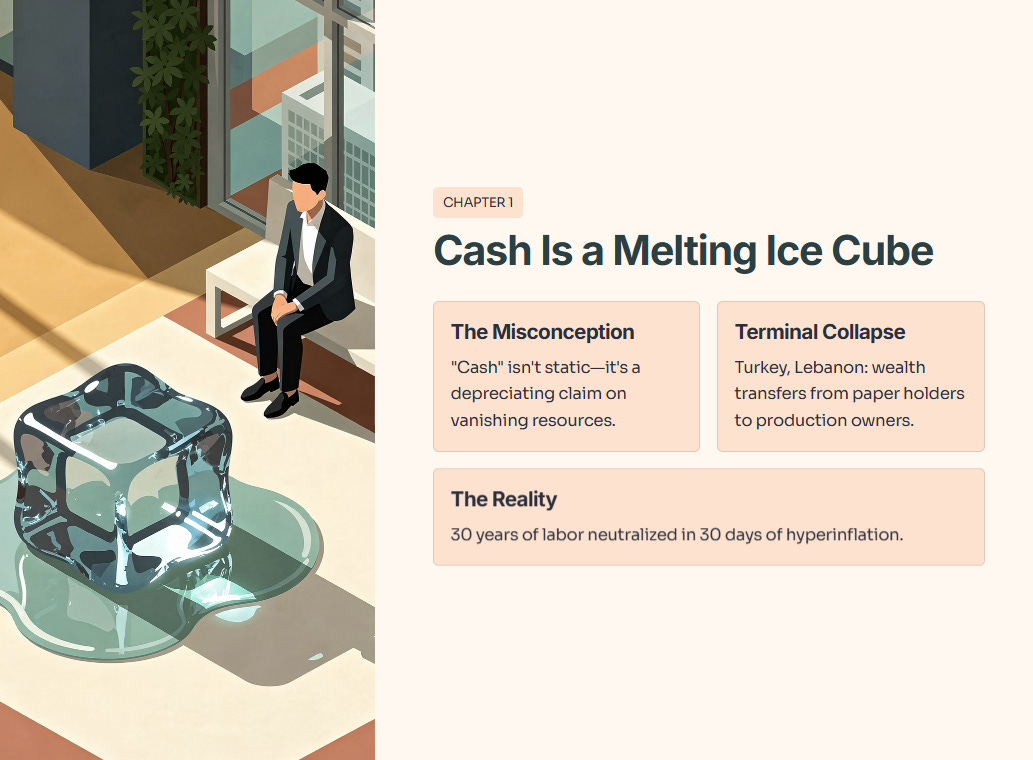
When a currency enters a terminal collapse—as we are seeing in real-time across Turkey, Lebanon, and parts of the frontier markets—wealth isn’t “deleted” by the universe; it is forcibly transferred from those holding paper to those holding the means of production. If you are standing on the wrong side of the ledger when the music stops, your thirty years of labor can be neutralized in thirty days of hyperinflation.
In This Article:
The Concept Deep Dive: The Anatomy of a Currency Autopsy
The Iggy Audit: The Narrative Analysis
The Data Fortress: The Evidence
The Scenario Matrix: The Forecast
InvestingPro Reality Check
The Verdict: The Action Plan
🦎 About Iggy the Investing Iguana
Welcome to the Iguana Pit! If you’re new here, I’m Iggy: your guide through the dense jungle of the Singapore markets. My mission is simple: to spot the predators before they spot your portfolio.
We are now 5,800+ subscribers strong across YouTube and Substack, focusing purely on the data-driven alpha that mainstream media misses.
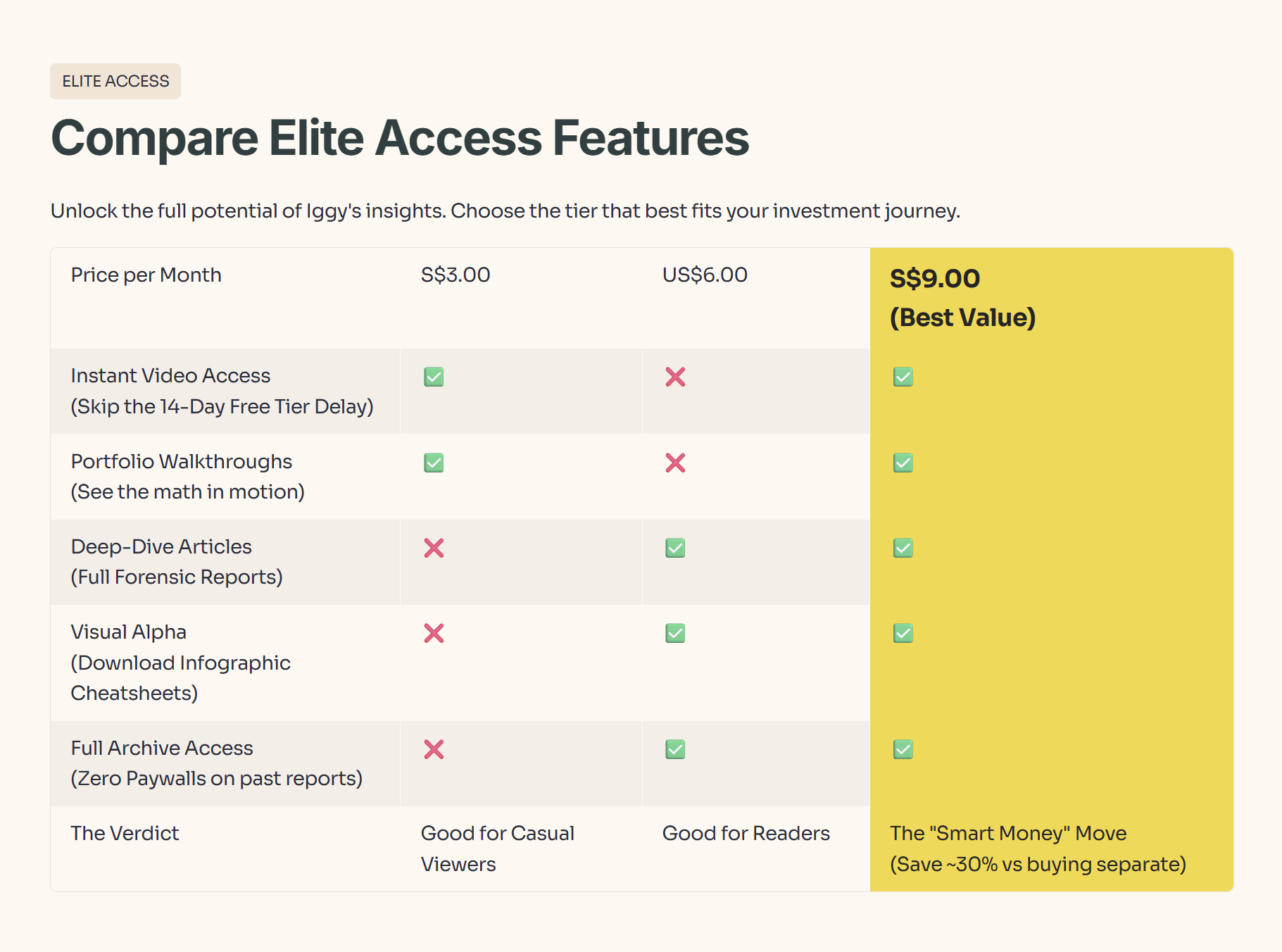
🚀 Join the “Elite 150” Inner Circle
Real alpha is found behind the velvet rope. Stop following the herd and start following the data with our 150+ paid members.
📺 The YouTube Edge (S$3/mo): Beat the Delay.
Instant Access: Watch new videos the moment they drop.
The Free Tier Trap: Free subscribers wait up to 14 days to see the same video. (By then, the news is old and the trade is gone).
📝 The Substack Deep-Dive (US$6/mo): Unlock the Vault.
Zero Paywalls: Read the full “Deep Dive” articles and “Substack Exclusive” articles found only on Substack.
Visual Alpha: Download exclusive Infographic Cheatsheets not available to free readers.
💎 The Ultimate Value Pass (S$9/mo): (BEST VALUE)
Get It All: Paid via YouTube, this bundle grants you Instant Video Access AND Full Substack Access.
The Math: You save ~30% compared to buying them separately. It’s the “Smart Money” move.
Why wait 2 weeks for old news? Get the data while it’s fresh. 👉 Join Here: https://www.youtube.com/@InvestingIguana/membership
The Concept Deep Dive: The Anatomy of a Currency Autopsy
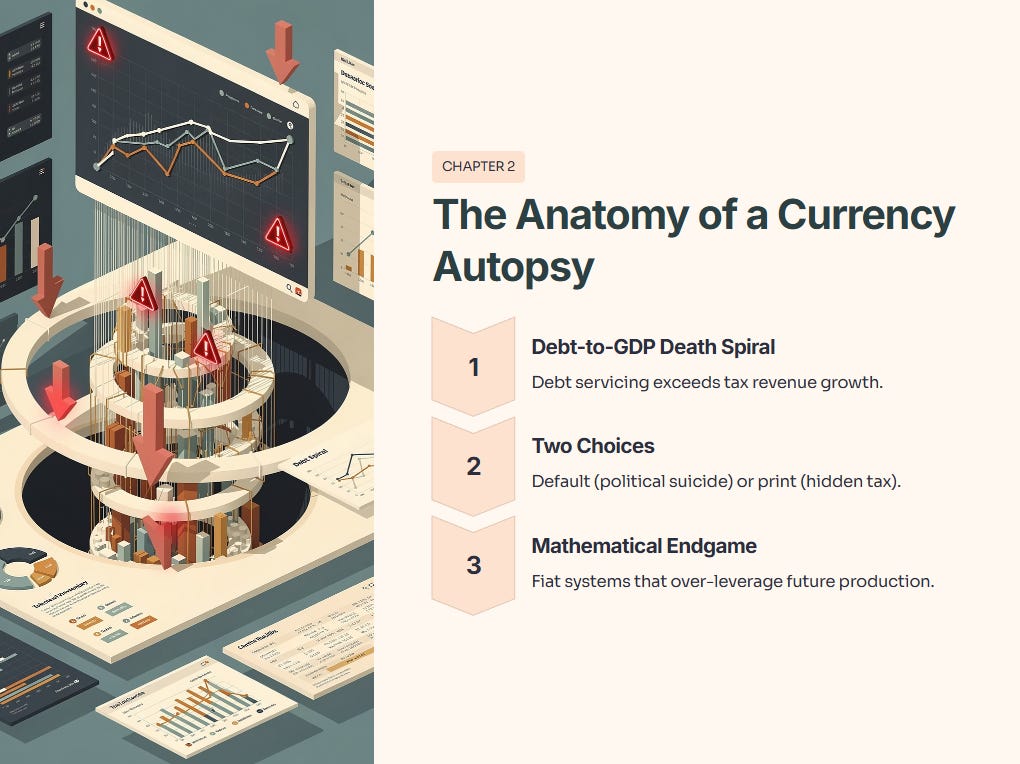
Currency collapse is rarely a “black swan” event; it is a calculated, mathematical endgame for fiat systems that over-leverage their future production. To understand why money dies, we must understand the Debt-to-GDP Death Spiral. When a nation’s debt servicing costs exceed its tax revenue growth, the central bank has only two choices: default (which is political suicide) or print (which is a hidden tax).
This leads to the Cantillon Effect, where the first recipients of the newly created money—banks and institutional players—spend it before prices rise. By the time that money reaches the “retail” saver in the form of a 2% interest rate, the price of milk, eggs, and energy has already surged. This is the “Stage 3” collapse we are witnessing globally in 2026. In Turkey, the 35% inflation (used to be 65%!!!) projected for this year isn’t just a “high number”; it is a systemic liquidation of the middle class’s purchasing power.
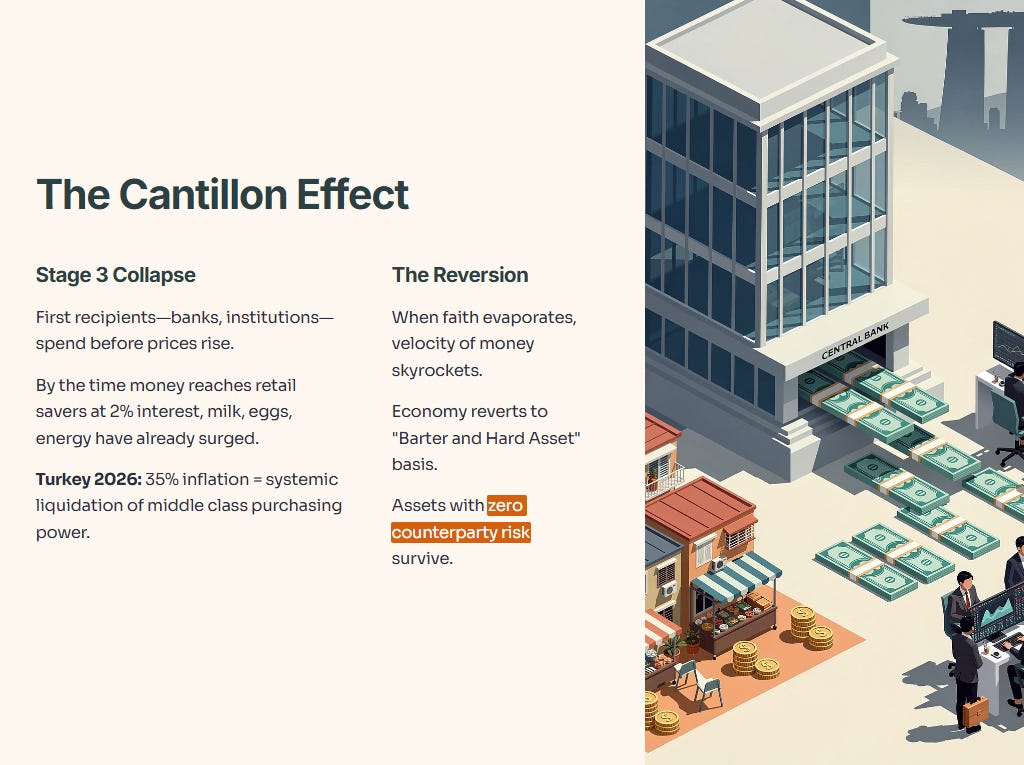
When faith in the “Full Faith and Credit” of a government evaporates, the velocity of money skyrockets. History shows that in these moments, the economy reverts to a “Barter and Hard Asset” basis. Assets with zero counterparty risk and inelastic demand become the only surviving stores of value.
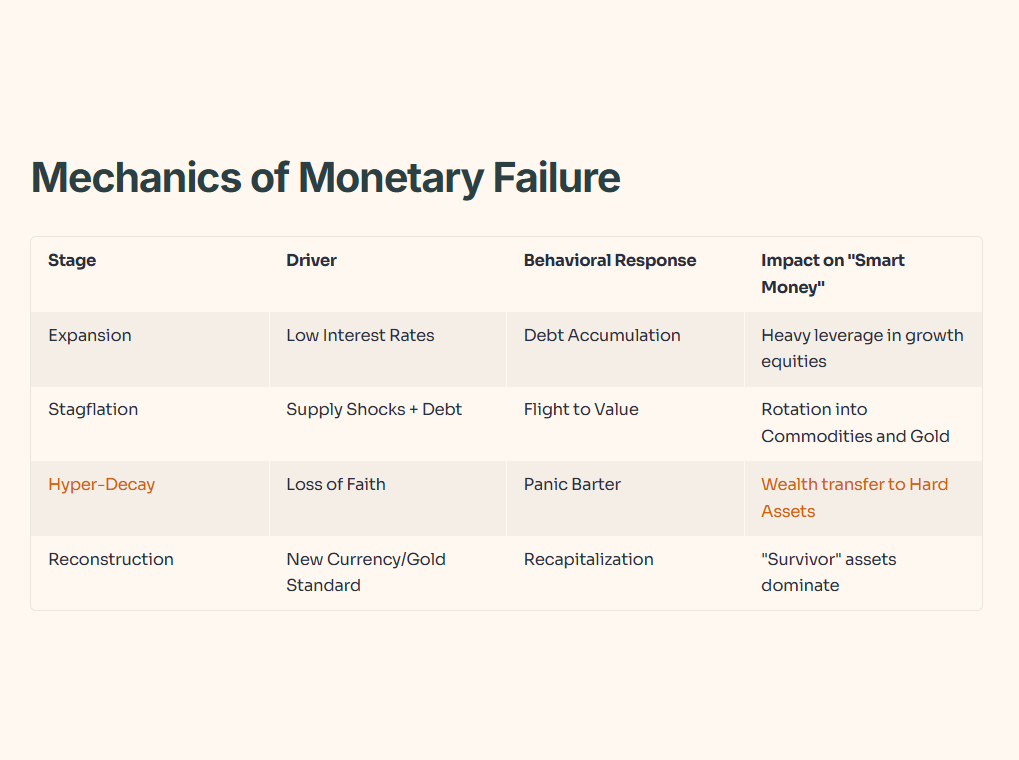
Mechanics of Monetary Failure
Analysis of the “Why”
The table above outlines a trajectory that most investors believe is reserved for “third-world” nations. They are wrong. The outlier in current data is the speed at which Stage 3 (Hyper-Decay) is approaching developed markets. When we look at the history of the Weimar Republic or modern-day Venezuela, the trend is identical: a gradual erosion followed by a vertical spike in prices. The “Why” is simple: governments cannot outprint the laws of physics.
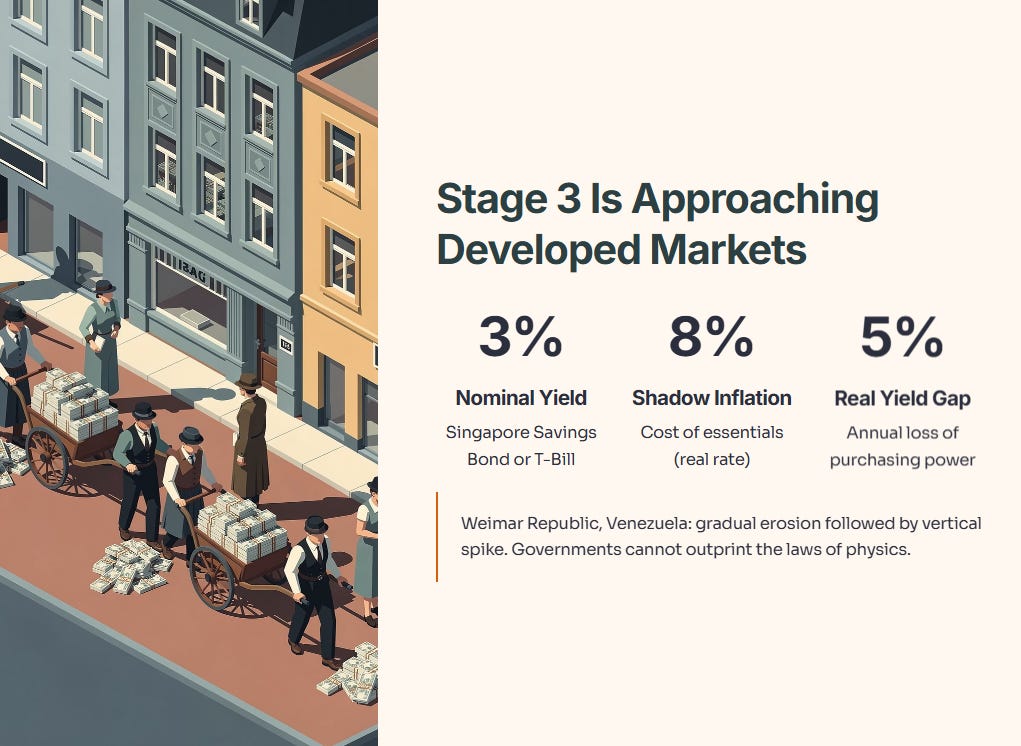
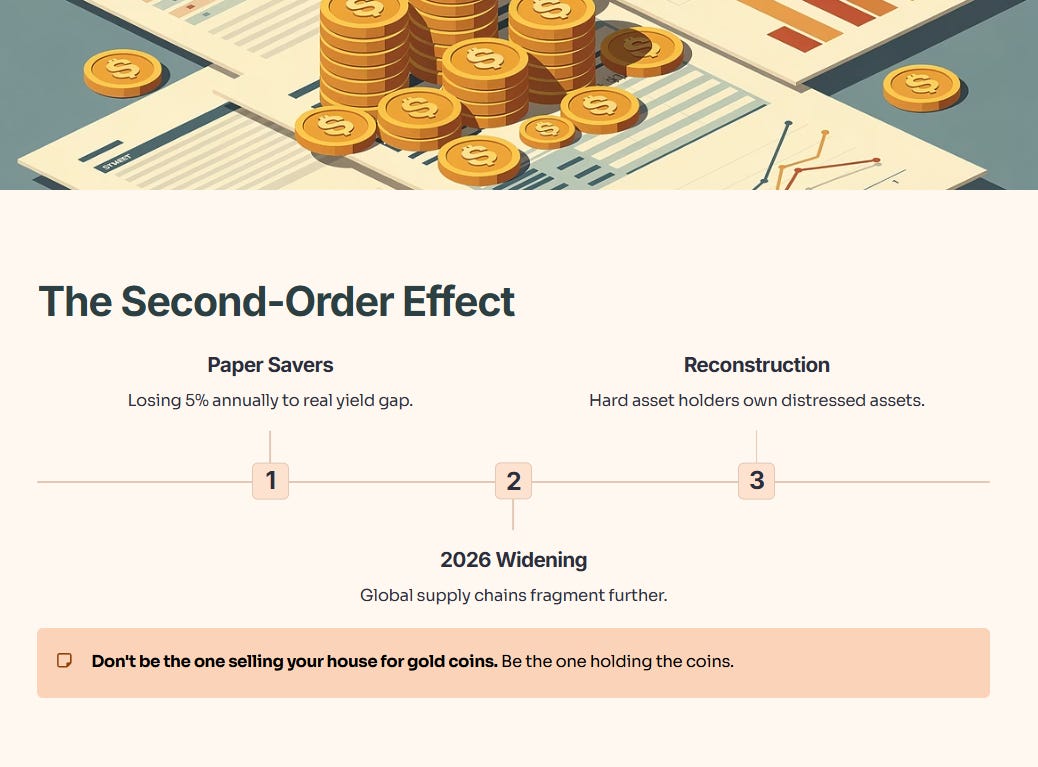
In a collapse, the Second-Order Effect on your portfolio is the “Real Yield Gap.” If the nominal yield on your “safe” Singapore Savings Bond or T-Bill is 3%, but the shadow inflation (measured by the cost of essentials) is 8%, you are losing 5% of your life’s work every year. By 2026, we expect this gap to widen as global supply chains fragment further. The survivors in the table above—those who moved to “Hard Assets” early—are the ones who end up owning the distressed assets of the “Paper Savers” in the Reconstruction phase. You don’t want to be the one selling your house for a bag of gold coins; you want to be the one holding the coins.
The Iggy Audit: The Narrative Analysis
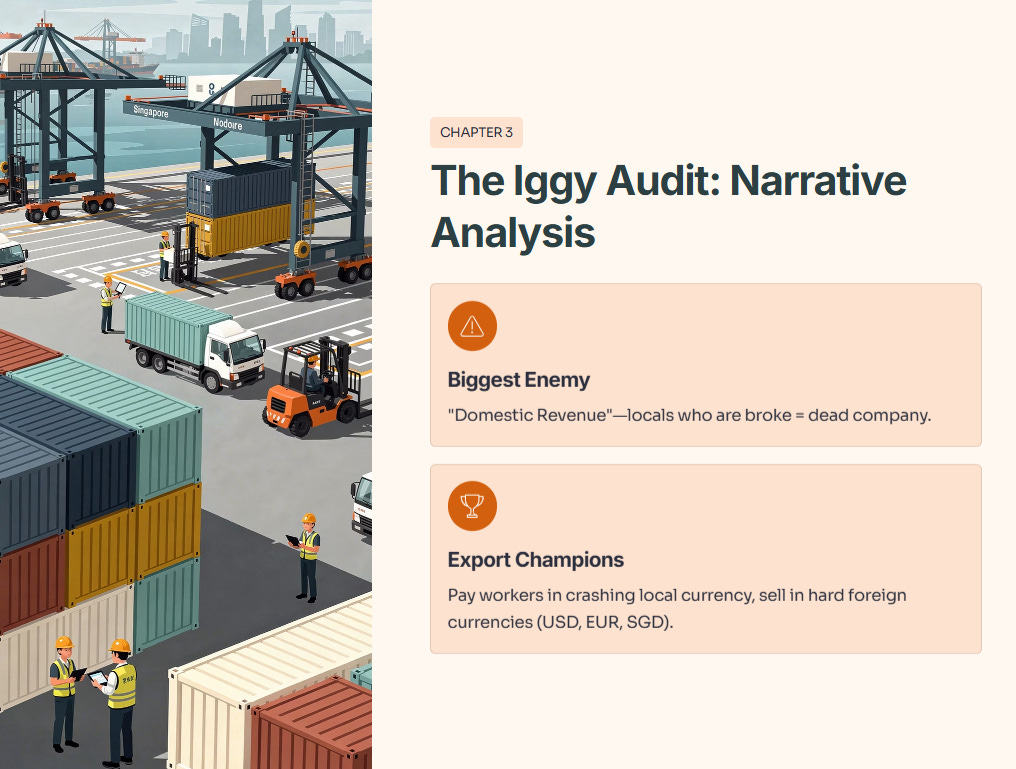
In a local currency crisis, your biggest enemy is “Domestic Revenue.” If a company earns its money from locals who are broke, that company is dead. We look for Export Champions—companies that pay their workers in the crashing local currency but sell their products in hard foreign currencies (USD, EUR, SGD).
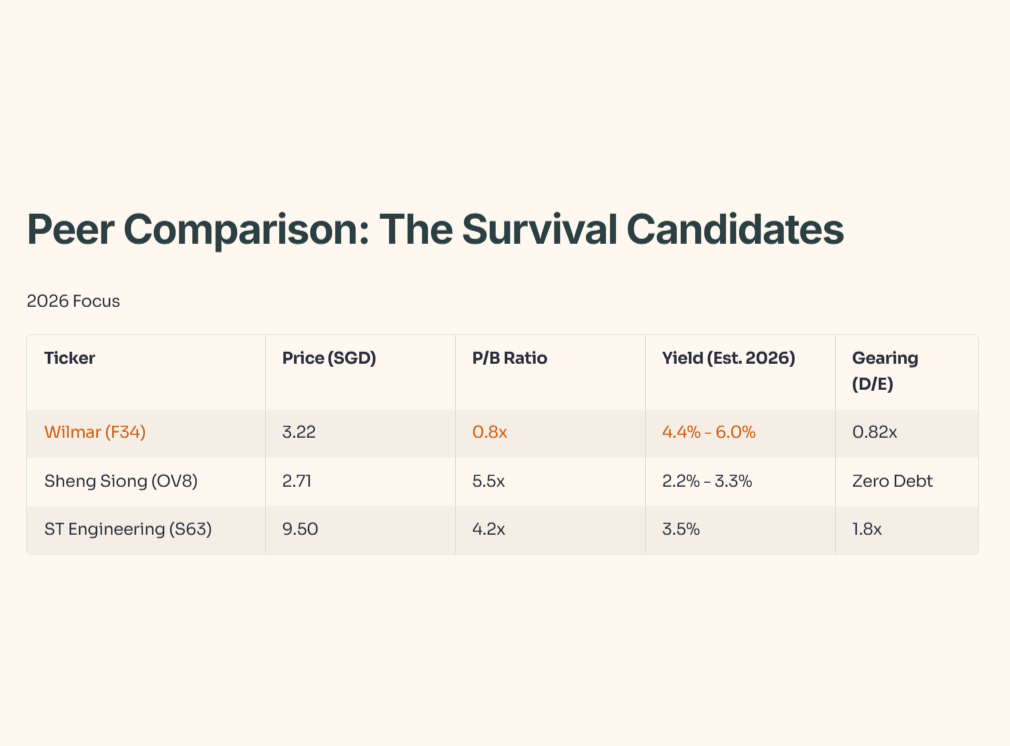
Peer Comparison: The Survival Candidates (2026 Focus)
Analysis: The Winner and the Loser
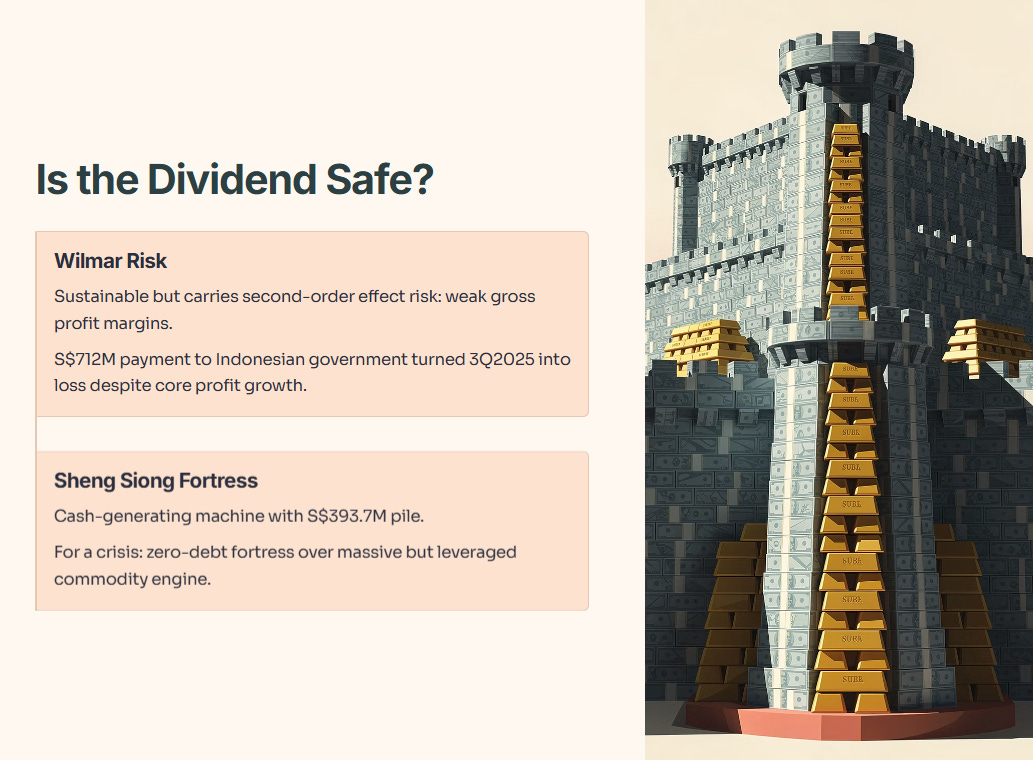
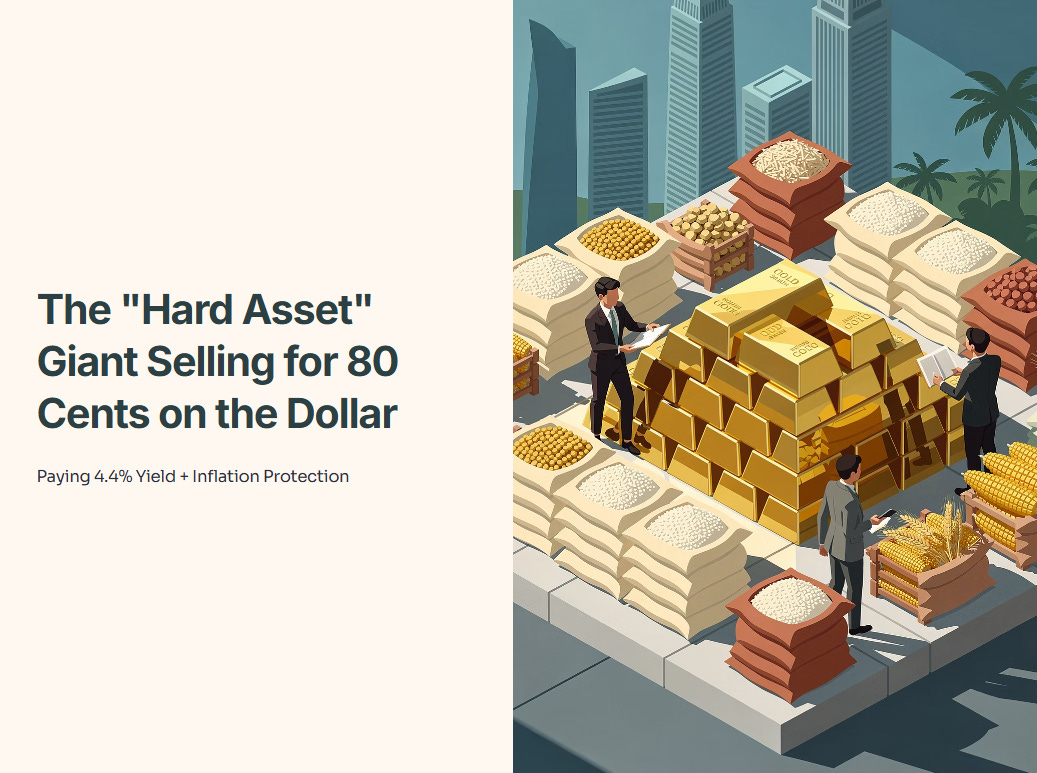
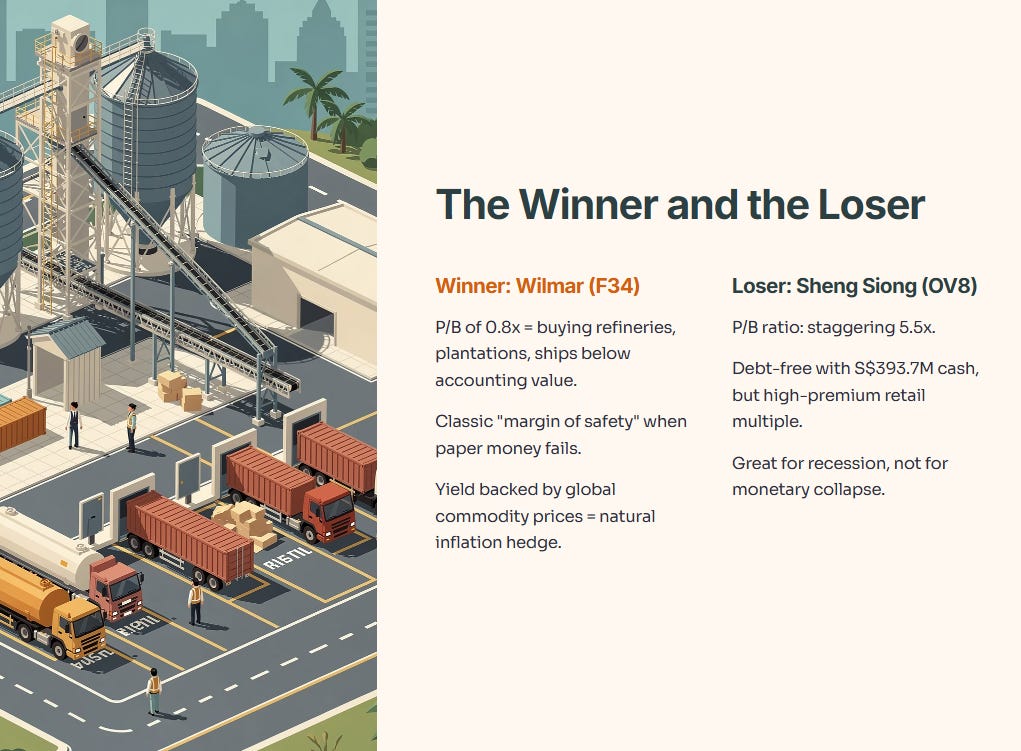
The clear winner for a “Total Collapse” scenario is Wilmar International (F34). Trading at a P/B of 0.8x means you are buying their physical refineries, plantations, and ships for less than their accounting value—a classic “margin of safety” when paper money fails. Their yield (projected at 4.4%–6.0%) is backed by global commodity prices, providing a natural inflation hedge.
The “Loser” in a pure collapse context—though a great company otherwise—is Sheng Siong (OV8). While it is debt-free and holds S$393.7 million in cash, its P/B ratio is a staggering 5.5x. In an economic wipeout, you want deep physical value, not high-premium retail multiples. Sheng Siong is the ultimate “Defensive Growth” play for a regular recession, but in a monetary collapse, Wilmar’s hard-asset floor makes it the “smart money” pick.
The Data Fortress: The Evidence
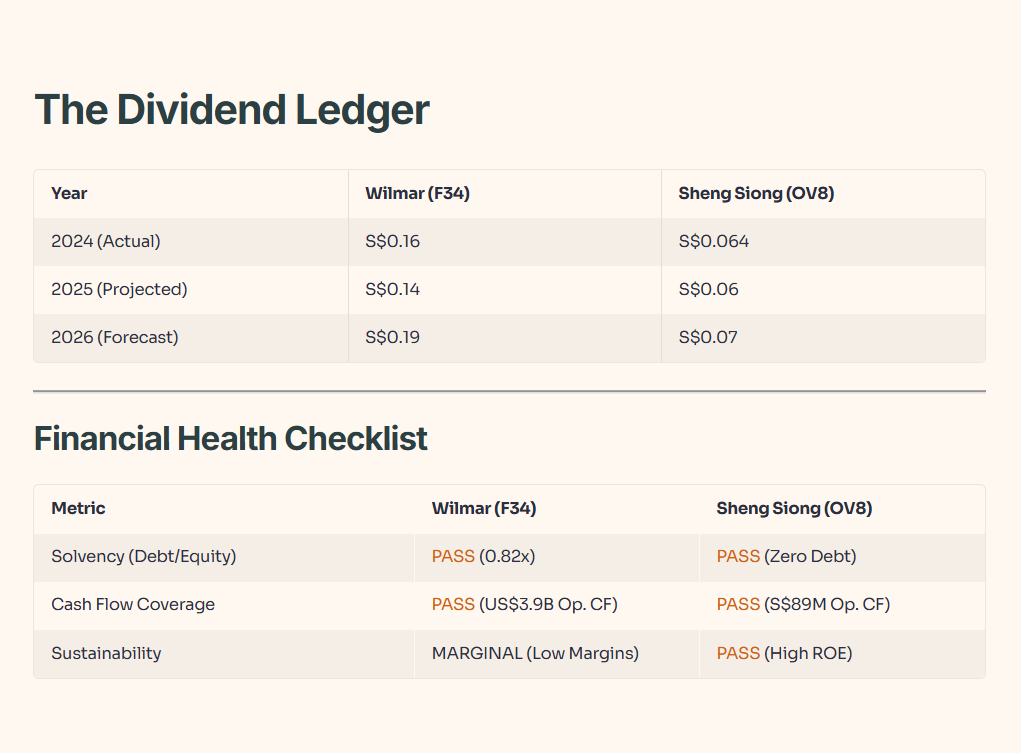
The Dividend Ledger (3-Year Trajectory)
Financial Health Checklist
Commentary: Is the Dividend Safe?
Wilmar’s dividend is sustainable but carries a “Second-Order Effect” risk: weak gross profit margins. A payment of ~S$712 million to the Indonesian government recently turned their 3Q2025 net profit into a loss, despite core profit growth. Conversely, Sheng Siong is a cash-generating machine with a S$393.7M pile. For a crisis, I’ll take the zero-debt fortress of Sheng Siong over Wilmar’s massive but leveraged commodity engine every day of the week.