



A surge of Singaporean interest in Johor Bahru says more about policy and price at home than it does about bargains abroad. When domestic housing grows dear and policy turns stern, capital looks for nearby relief. Johor is close, familiar, and now—thanks to a long‑awaited train—far more connected. Yet cheapness is not the same as value. The proper question is whether a JB property, once stripped of illusions, raises portfolio quality for a Singapore investor. That means measuring net income after friction, liquidity under stress, and how currency bleeds returns over time.
This analysis keeps the frame of the earlier cut but makes the argument explicit. It starts with the current drivers, descends to the messy bits on the ground, subjects the “cheap” thesis to cash‑flow math, and ends with a playbook. The tone is plain: if the goal is better long‑run compounding, the decision must survive both spreadsheets and sleep.
The JB Lure: Understanding the Current Investment Wave

Why Now? The Drivers Are Clear
Three forces explain the 2025 wave.
First, the RTS Link is due to begin carrying passengers by December 2026. Five minutes between Woodlands North and Bukit Chagar, frequent headways, and high peak capacity do not just shorten journeys; they change labour markets, tenancy patterns, and willingness to live across the strait. Rent follows commute time, not maps.
Second, the JS‑SEZ brings scale and policy intent. Firms that seek Singapore’s proximity but not its costs can base operations next door. That broadens demand beyond speculative weekend buyers into durable employment‑linked tenants. The pattern—transport plus special zones—has transformed many borders before. Johor’s turn is plausible.
Third, the currency. In late August 2025, SGD buys roughly the high‑3.2s in MYR. This flatters entry costs and emboldens buyers. It also sets a trap: an exit several years later can give back those FX gains, leaving investors with the work but not the reward. FX is a tailwind on day one and an audit at the end.
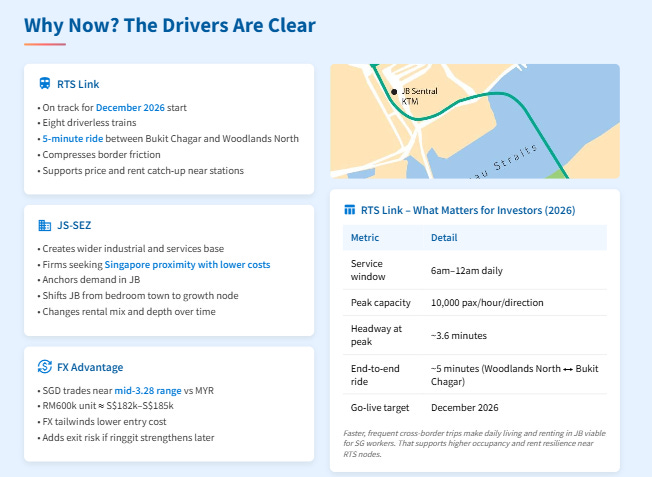
Caption: The RTS compresses friction across the border. Shorter, reliable commutes raise the “effective radius” of viable renting and living in JB for SG‑linked workers. That underpins occupancy, rent depth, and price resilience near stations.
