The November Savings Bond Pays 1.67% in Year One and 2.45% Over Ten. Three Questions to Ask Before the 27 October Deadline
The headline rate depends on how long the money stays. Here is what the bond pays at each exit point, what waiting for December could change, and what a T-bill or fixed deposit would have to pay to match it.
The November Singapore Savings Bond pays 1.67% in its first year and 2.45% a year on average if it is kept for all ten. The 1-year T-bill cut-off yield was 1.92% at the 15 October auction and the best 12-month fixed deposit rate on Beansprout’s 18 October list was 2.10% (which depends on the bank and the minimum deposit), and both pay more than that first-year rate. Applications close at 9.00 pm on Tuesday 27 October, and the December rate cannot be known by then.
Savings bonds have a reputation as the sensible, quiet choice, and that reputation is mostly earned. What gets checked less often is the number itself. The rate on this bond is not one rate. It is ten, one for each year, and which one matters depends on a question the bond cannot answer for you.
Two kinds of reader will open this. One keeps cash in a fixed deposit and wonders whether the bond is worth a look. The other already owns an earlier issue and wonders whether to move. I read the Beansprout report of 20 October in full and checked the issue dates against MAS’s application notice, and I take no view on whether anyone should apply. What I can do is set out what the numbers say and where they stop.
What This Piece Does
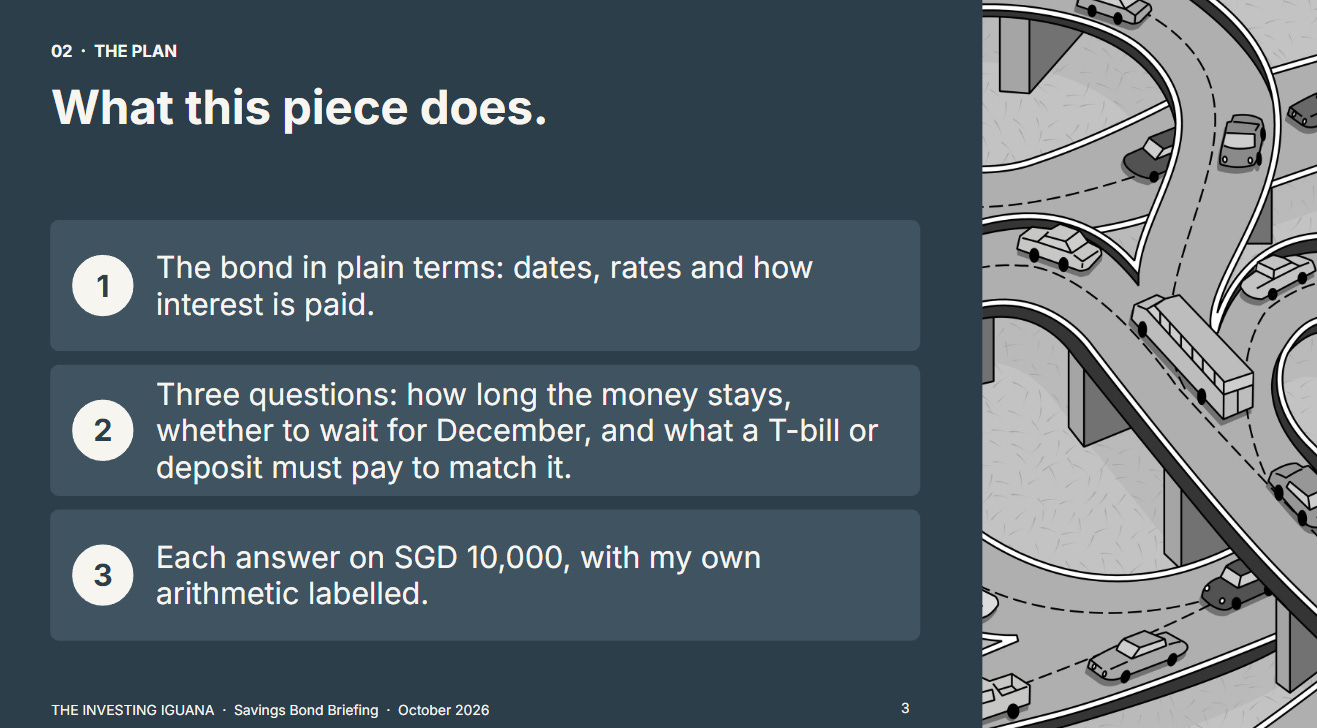
It sets out the bond in plain terms: the dates, the rates, and how interest is paid.
It works through three questions: how long the money will really stay, whether waiting for December changes anything, and what a T-bill or fixed deposit would have to pay to match the bond over the same years.
It puts each answer in terms of SGD 10,000, with my own arithmetic labelled as mine.
The first two questions are free to read. The third, the comparison with a T-bill and a fixed deposit, is in the members’ half. This piece takes no view on whether to apply. Nothing here is a recommendation.

What This Piece Does
The Bond in Plain Terms
The dates and the rates
Question 1: How Long Will This Money Really Stay?
What each exit point pays
🟠 Angela’s Observation
Question 2: Should You Wait for December?
Why the December rate does not exist yet
🟠 Angela’s Observation
Question 3: What Does a T-Bill or Fixed Deposit Have to Pay to Match It?
The year-one gap
Where the bond catches up
What you give up for the difference
🟠 Angela’s Observation
What I Am Watching Next, Without Predicting
Iggy’s Forensic Read
The Bond in Plain Terms
The dates and the rates
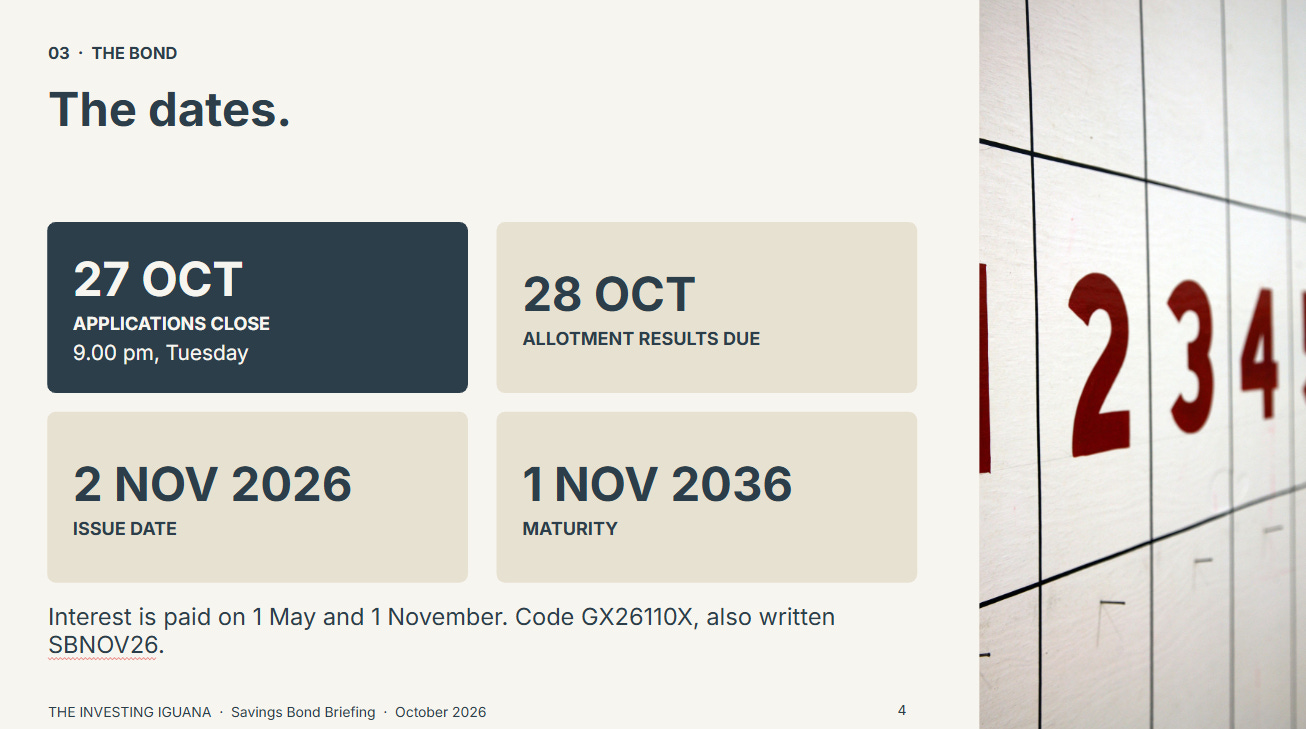
The November issue has the code GX26110X, also written SBNOV26. According to MAS’s application notice, individuals can apply until 9.00 pm on Tuesday 27 October, the bond is issued on 2 November 2026, and it matures on 1 November 2036. Interest is paid on 1 May and 1 November. Little Big Red Dot reports that allotment results are due on 28 October.
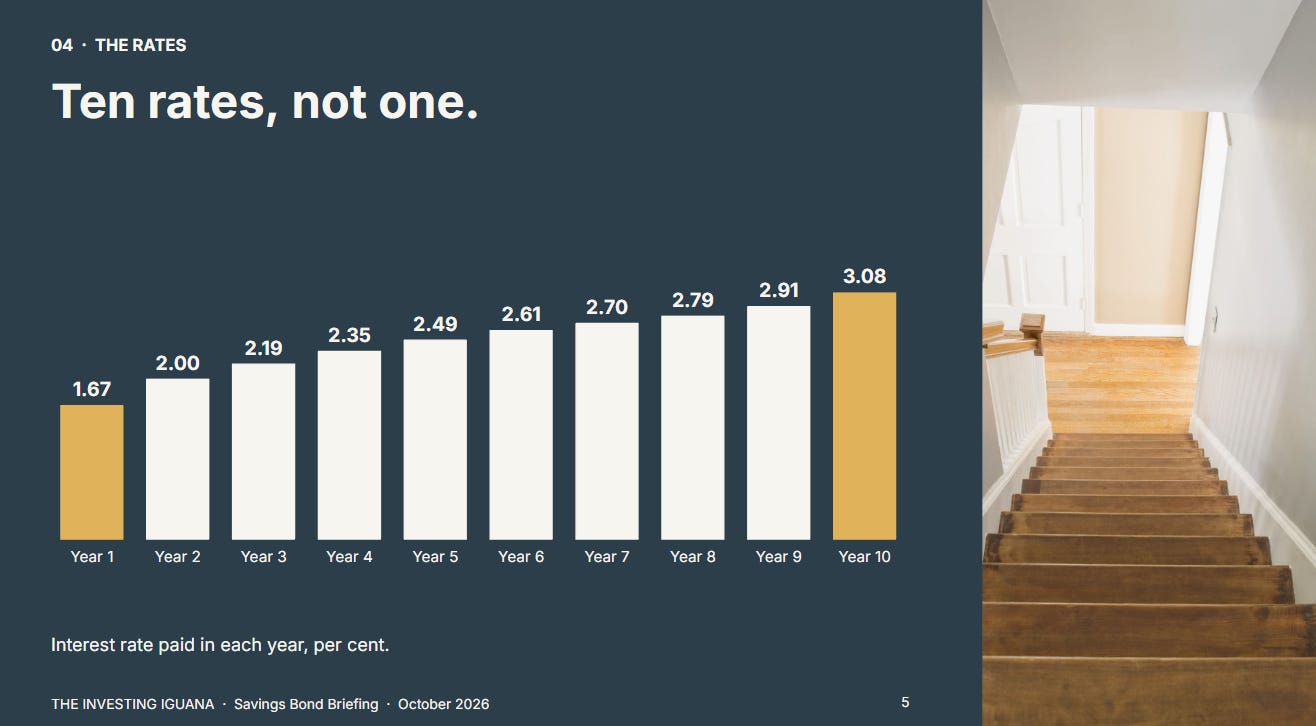
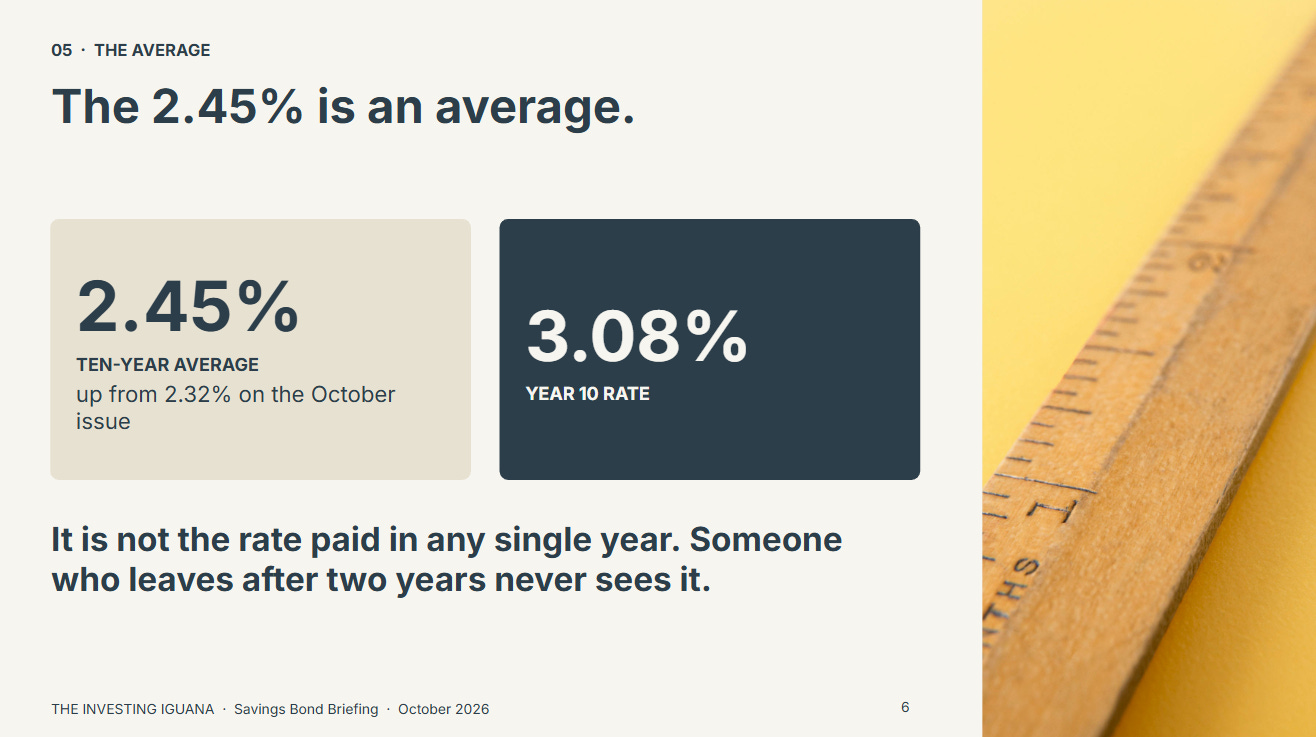
The rate steps up each year. Beansprout reports a first-year rate of 1.67%, a year 10 rate of 3.08%, and a 10-year average of 2.45%, up from 2.32% on the October issue. The 2.45% is the average over ten years, not the rate paid in any single year. Someone who leaves after two years never sees it.
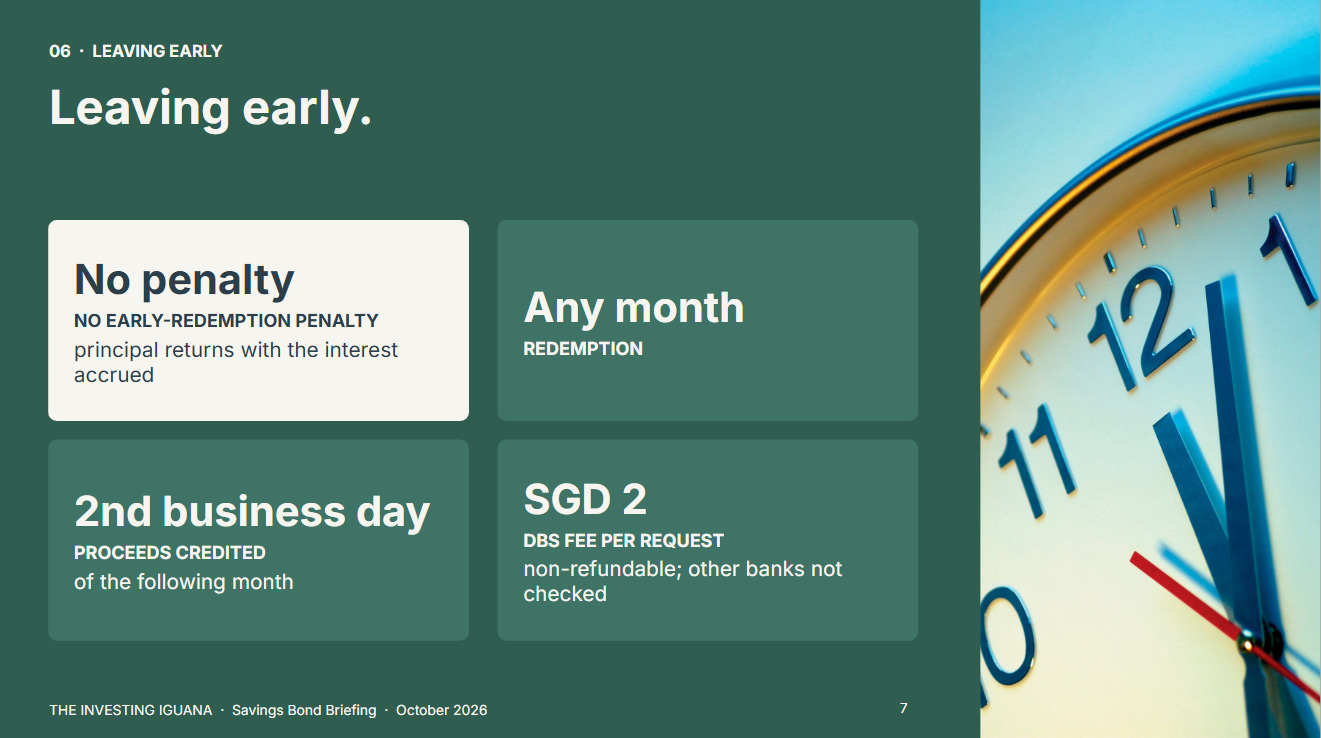
The bond is a government security sold to individuals, and it can be redeemed in any month. According to Beansprout and Little Big Red Dot there is no early-redemption penalty, and the principal comes back with the interest accrued to that point. The condition is on timing.
Beansprout says redemption proceeds are credited by the second business day of the following month, and that a transaction fee applies. DBS’s redemption page puts that fee at SGD 2 per redemption request, non-refundable, and says proceeds are paid by the second business day of the following month. I did not check the fee at other banks.
Question 1: How Long Will This Money Really Stay?
What each exit point pays
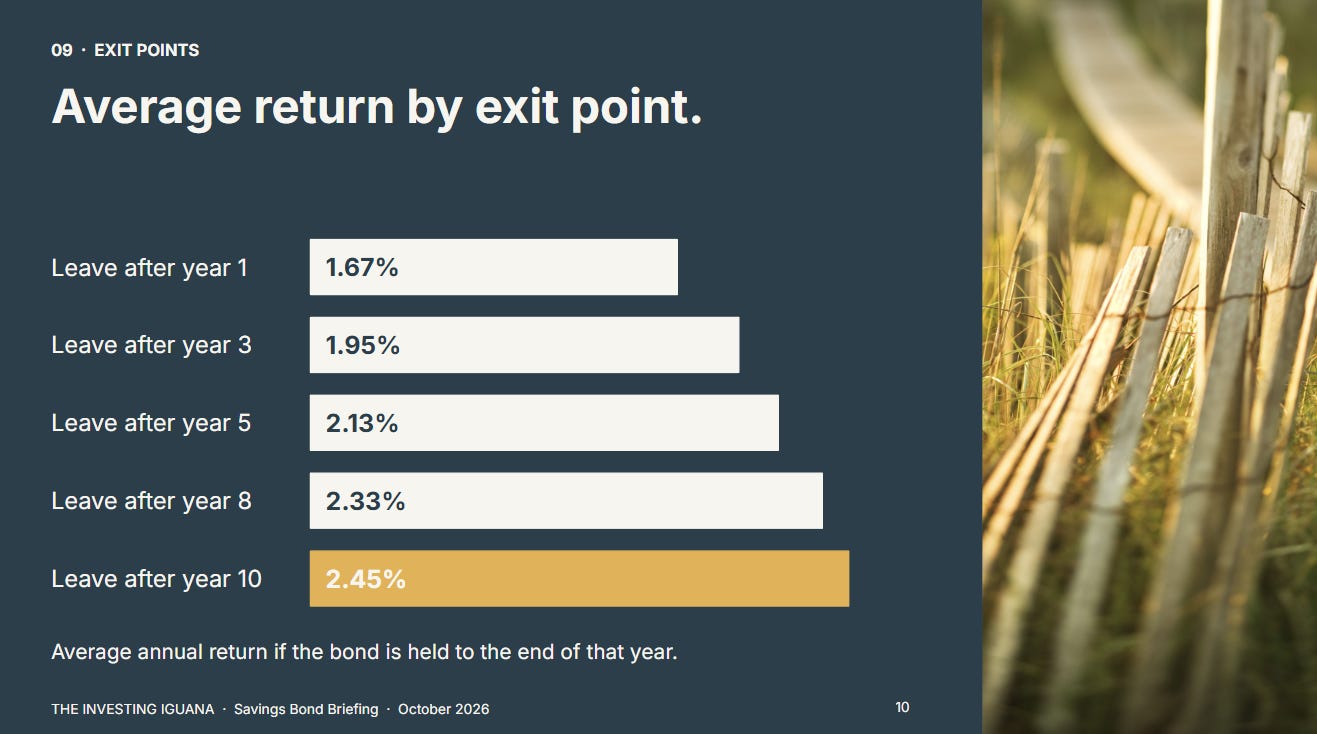
The table below uses the coupons that Little Big Red Dot and ilovessb report for the November bond, applied to SGD 10,000. The cumulative interest is my own arithmetic, a plain sum of the coupons on SGD 10,000, with no reinvestment of interest. The last column is the average annual return if the bond is held to the end of that year, and ilovessb publishes the same figures. At year 10 it is the 2.45% that is published for ten years, slightly below the simple average of the ten coupons because the interest is paid out and not reinvested.
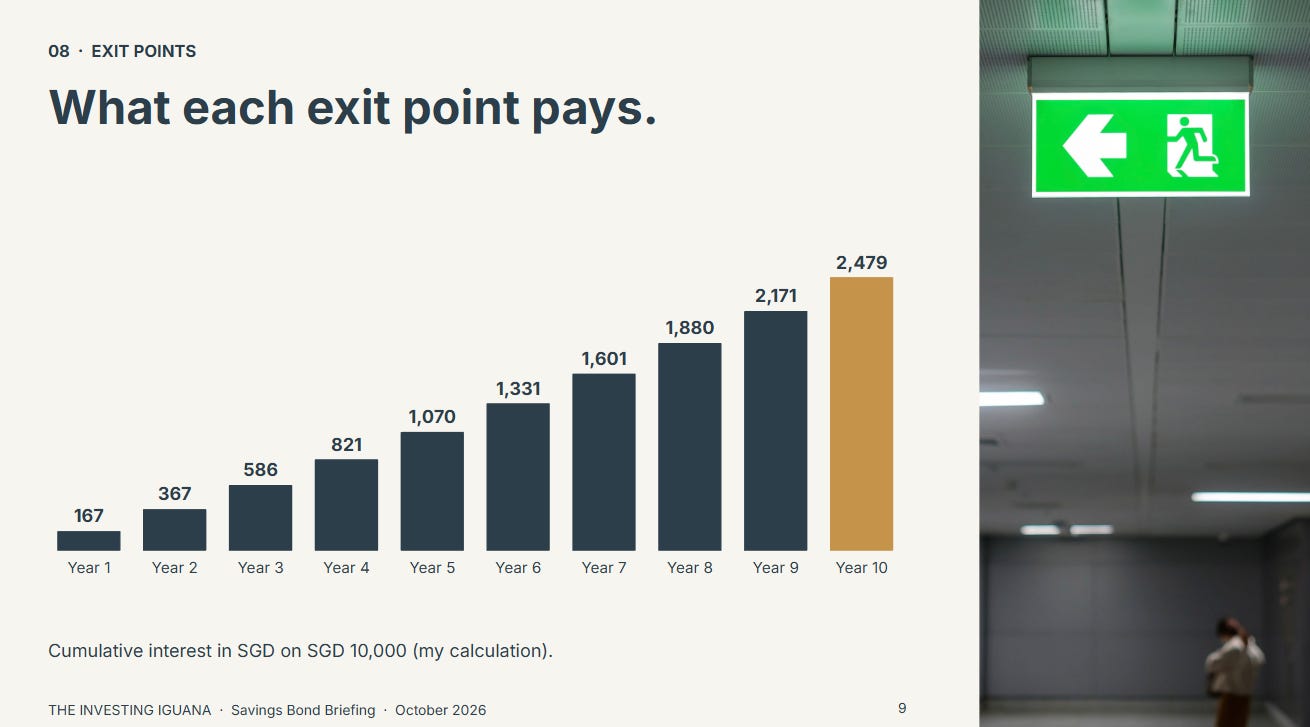
The year 9 coupon of 2.91% is not in the Little Big Red Dot list I read. I took it from ilovessb, which lists all ten coupons and agrees with Little Big Red Dot on years 1 to 8. As a check, the ten coupons sum to 24.79%, which is the SGD 2,479 ten-year total on SGD 10,000.
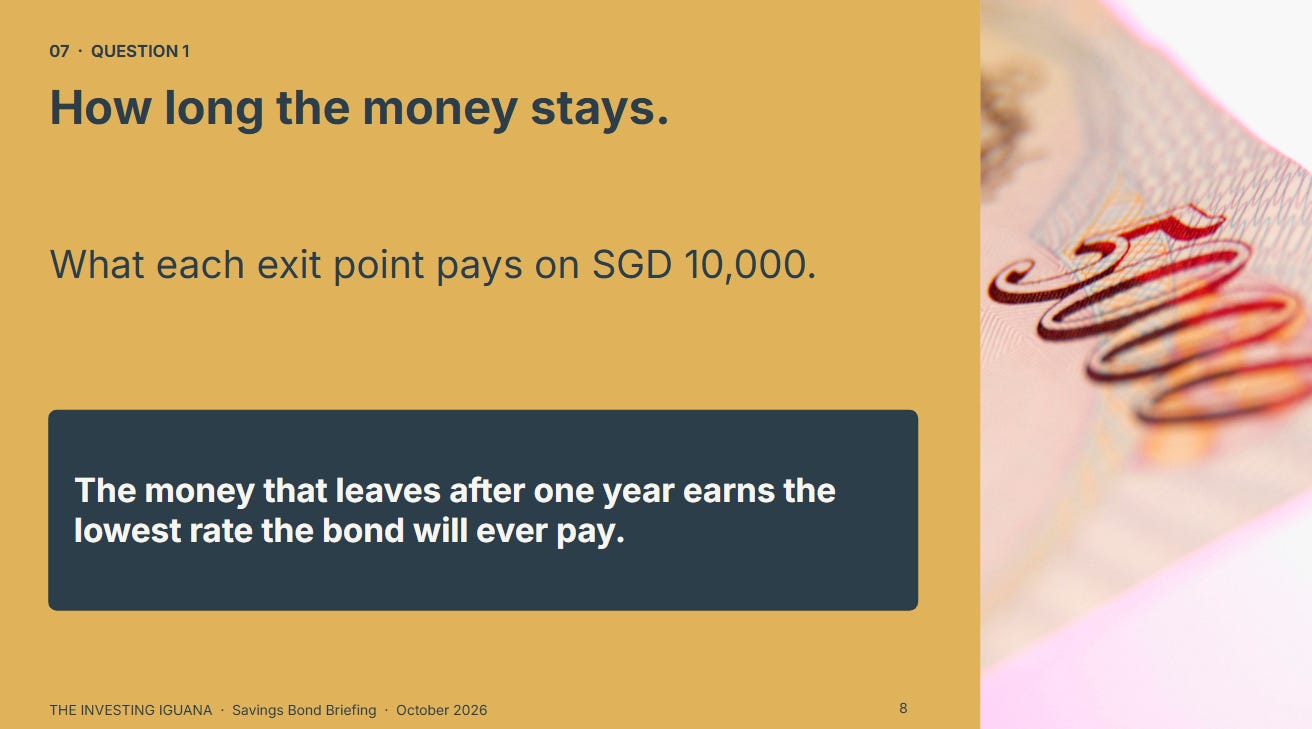
Read down the last column and the pattern is plain. The money that leaves after one year has earned the lowest rate the bond will ever pay. The money that stays eight years has averaged 2.33%. The headline 2.45% belongs only to the person who is still there at the end.
The pushback I expect is a fair one: if leaving is free, why not stay only as long as the rate suits? You can, and that flexibility is the real selling point. But the table shows what it costs in rate terms. The early years are the weak ones, so a short stay is a stay at the weakest rates.
🟠 Angela’s Observation
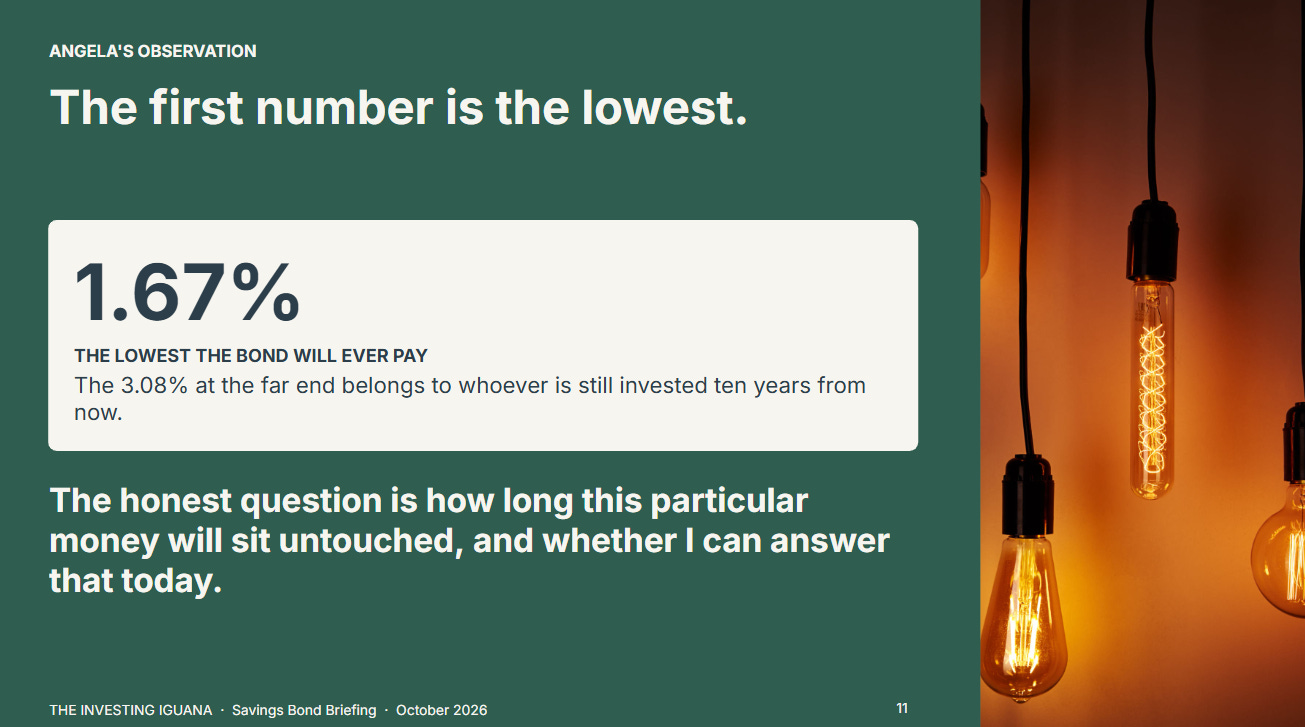
I used to look at the first number on a savings product and stop there. On this bond the first number, 1.67%, is the lowest it will ever pay, and the 3.08% at the far end belongs to whoever is still invested ten years from now. It reminded me of a timetable where the fast service only runs in the last hour of the day. So the honest question is not which year’s rate looks best. It is how long this particular money will sit untouched, and whether I can answer that today. Can I?
Question 2: Should You Wait for December?
Why the December rate does not exist yet
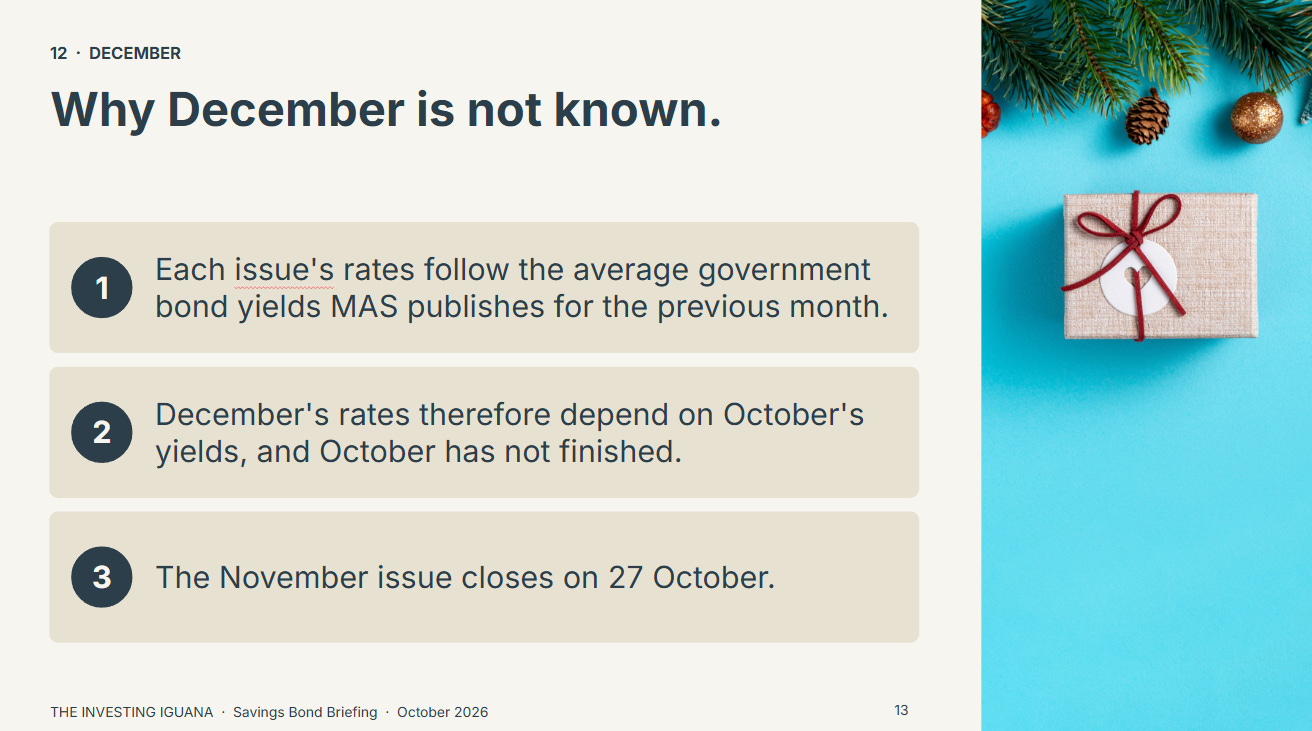
Beansprout explains that each issue’s rates are linked to the average Singapore Government Securities yields MAS publishes for the previous month. That means the December rates depend on October’s yields, and October has not finished. The November issue closes on 27 October, so a reader has to decide before the December number can exist.
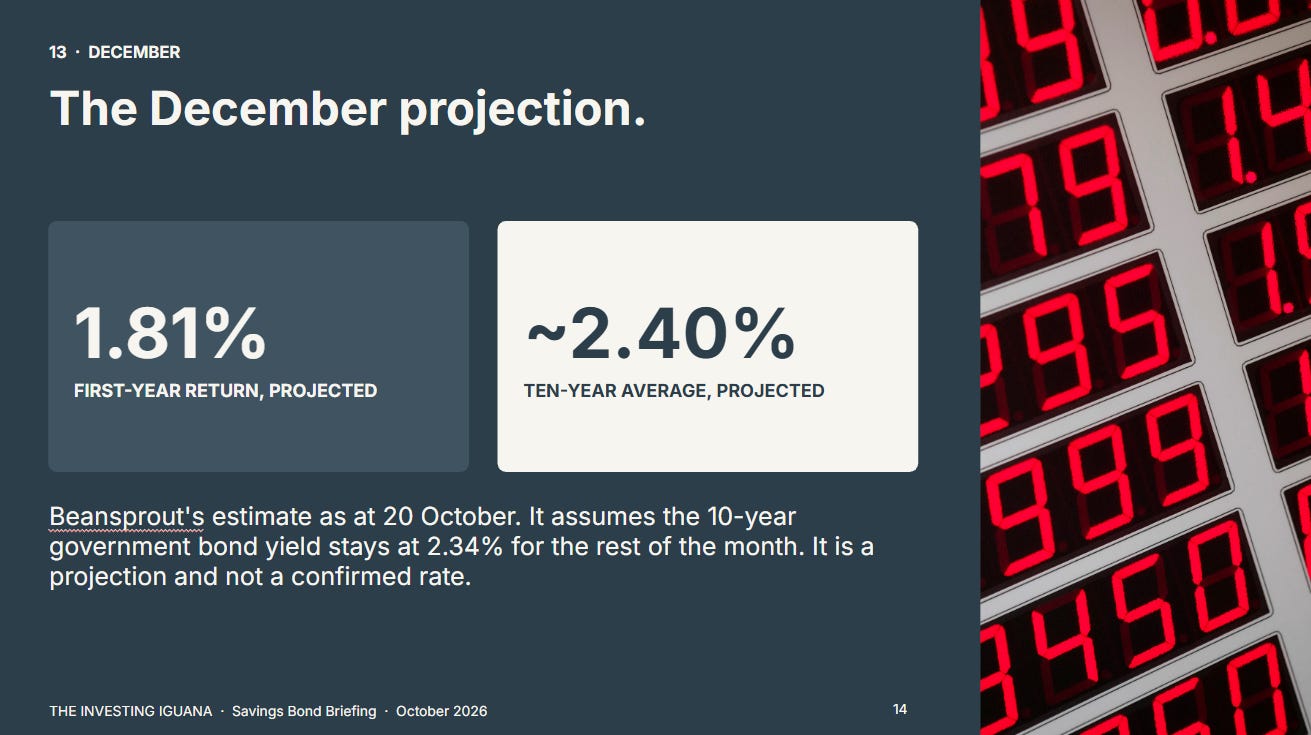
What does exist is a projection. As at 20 October, Beansprout’s estimate for the December issue is a first-year return of 1.81% and a 10-year average of about 2.40%. It assumes the 10-year government bond yield stays at 2.34%, its 16 October close, for the rest of the month. Beansprout is clear that these are projections and not confirmed rates.
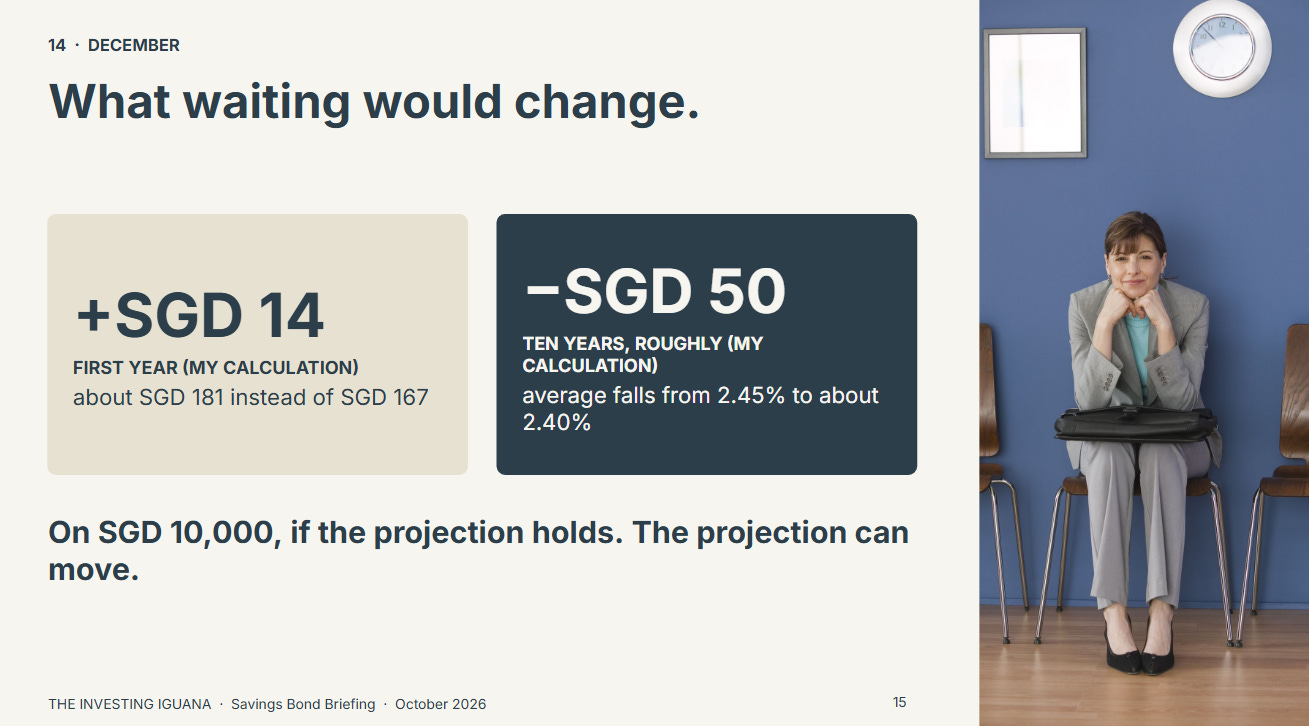
If the projection holds, the trade on SGD 10,000 is small. The first year pays about SGD 181 instead of SGD 167, which is SGD 14 more. The ten-year average falls from 2.45% to about 2.40%, which is roughly SGD 50 less over ten years. Both figures are my own arithmetic from the projection, and the projection can move.
Is there a queue?
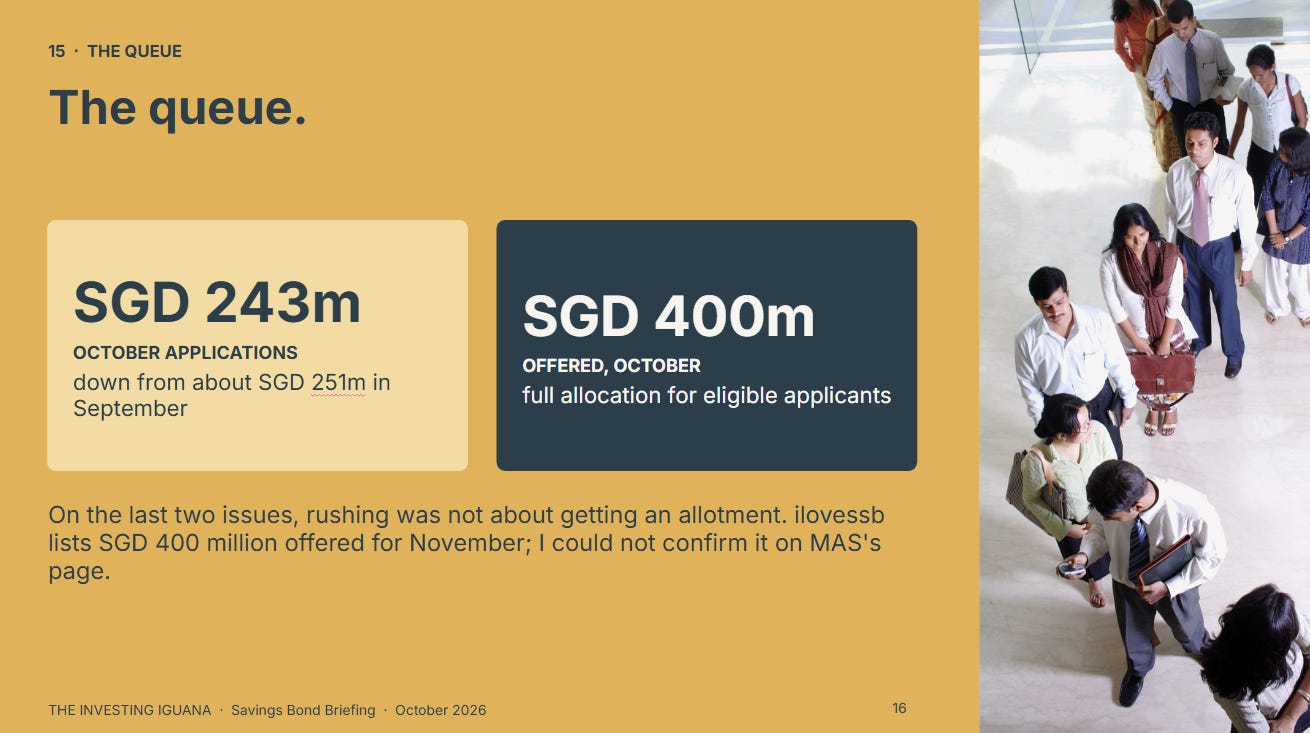
Beansprout reports that applications for the October issue came to about SGD 243 million, down from about SGD 251 million for September, against SGD 400 million offered. Eligible applicants received their full allocation. ilovessb lists the amount offered for the November issue as SGD 400 million as well, which I could not confirm on MAS’s own page. Whether applications stay under that is not known until allotment on 28 October. On the last two issues, rushing was not about getting an allotment.
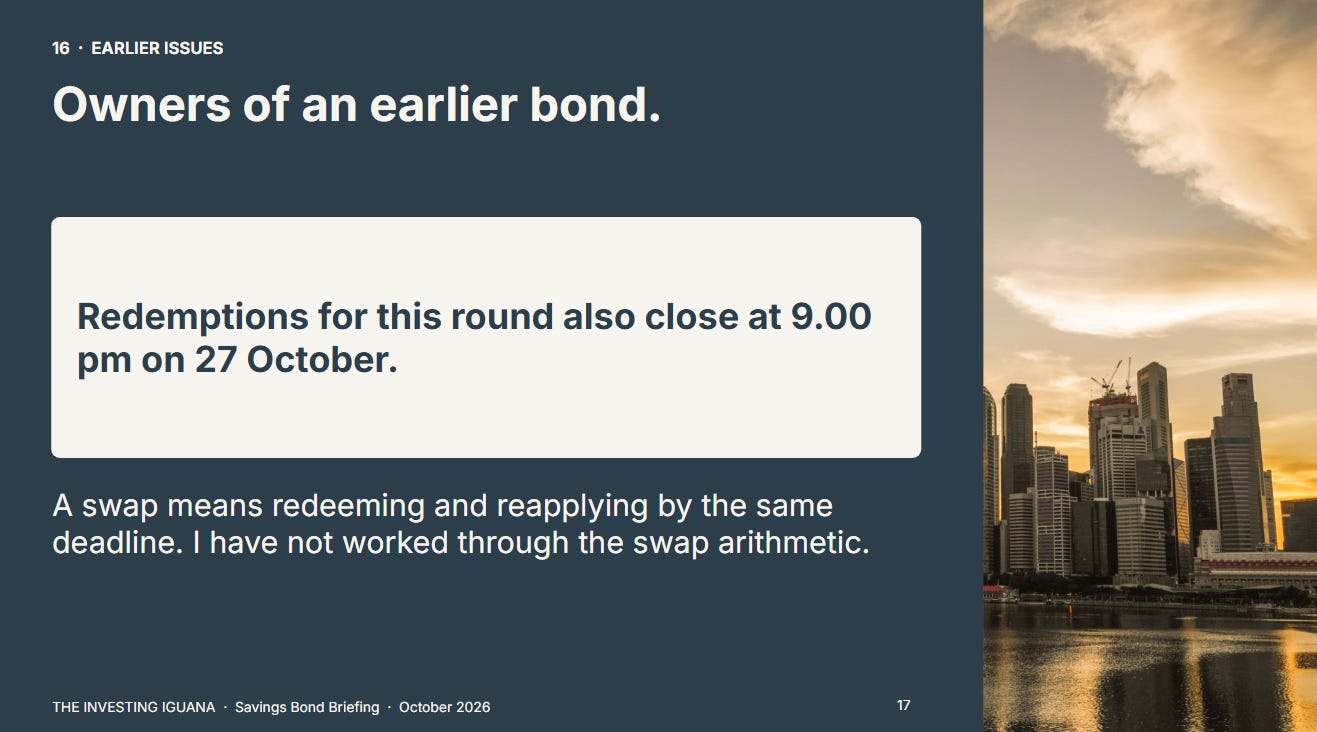
For readers who already own an earlier bond, Beansprout says redemptions for this round also close at 9.00 pm on 27 October, so a swap means redeeming and reapplying by the same deadline. I have not worked through the swap arithmetic here.
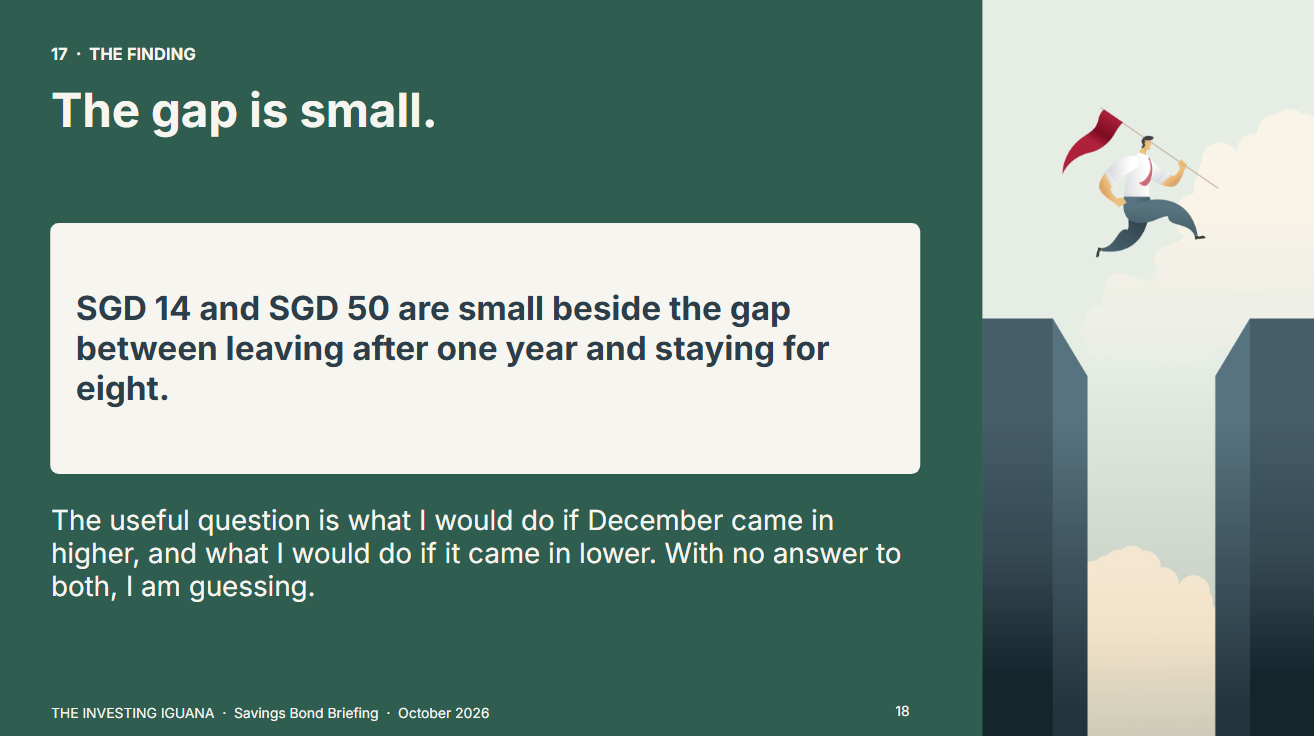
The pushback is that if the difference is only SGD 14 and SGD 50, the choice hardly matters. I agree, and I think that is the useful finding. The gap between November and December is small beside the gap between leaving after one year and staying for eight. So the question I would ask is not which month, but what I would do if December came in higher, and what I would do if it came in lower. If I have no answer to both, I am guessing.
What the Paid Half Adds
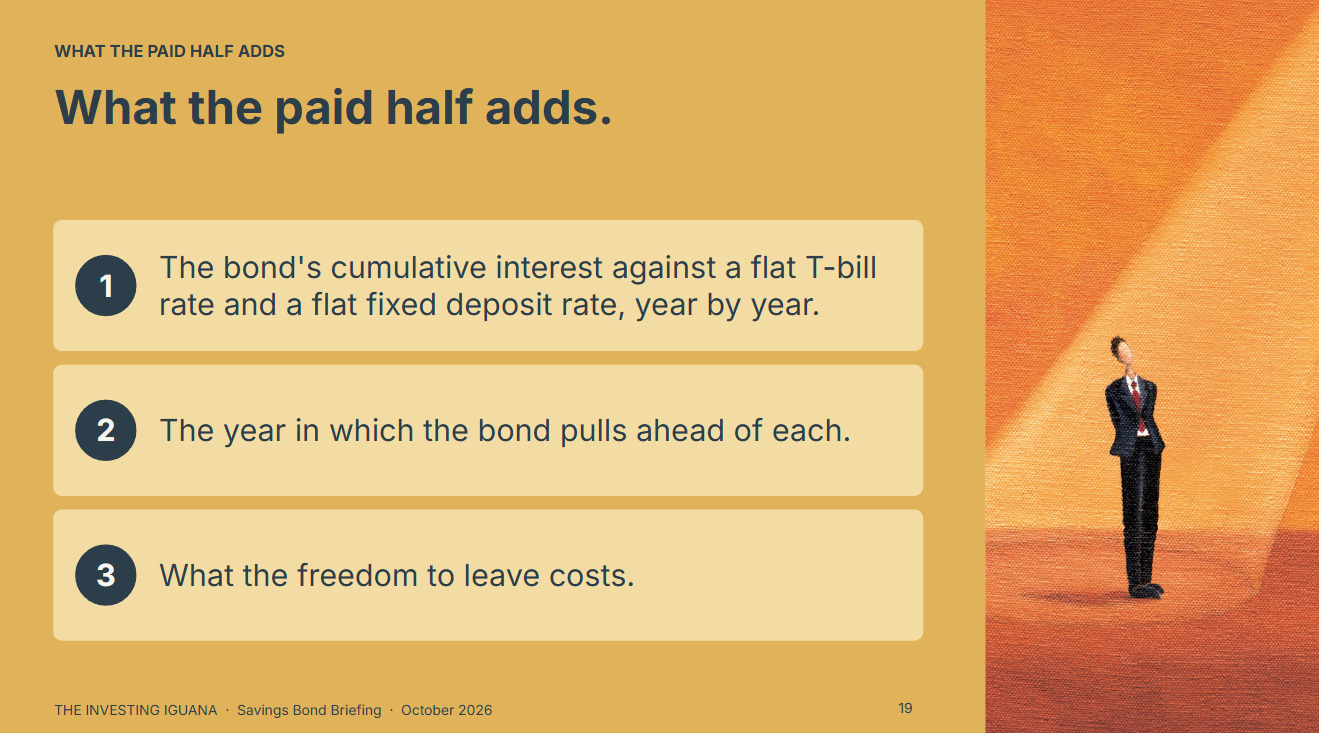
The free half sets out the bond, what each exit point pays and what waiting for December could change. The paid half adds the comparison that takes the most work to build: the bond’s cumulative interest set against a flat T-bill rate and a flat fixed deposit rate, year by year, the year in which the bond pulls ahead of each, and what the freedom to leave costs. The extra is depth, nothing else. There are three ways in.
The Substack Only Plan, US$8/month, gives the full written analysis, portfolio walkthroughs and analyst cheatsheets.
The YouTube Only Plan, S$5/month, gives the full-length Members Edition video.
The YouTube/Substack Combo, S$12/month, gives all of it.
🔒 What’s Next
The next section sets the bond’s cumulative interest against a flat T-bill rate and a flat fixed deposit rate, year by year, and shows in which year the bond pulls ahead of each.