The Price of Retirement Income: What S$1,000, S$2,000 and S$3,000 a Month Actually Cost Today
Divide the monthly income you want by the yield you can earn, and the capital you need appears. Here are the figures for SGD 1,000, SGD 2,000 and SGD 3,000 a month, using the .....
The Price of Retirement Income: What S$1,000, S$2,000 and S$3,000 a Month Actually Cost Today 🦖
Divide the monthly income you want by the yield you can earn, and the capital you need appears. Here are the figures for SGD 1,000, SGD 2,000 and SGD 3,000 a month, using the 6-month T-bill, CPF’s 4% and a 4.7% dividend yield.
📖 Free Edition
I’m making this edition free for everyone, with no paywall, so anyone planning retirement income can read it, check the numbers and pass it on.
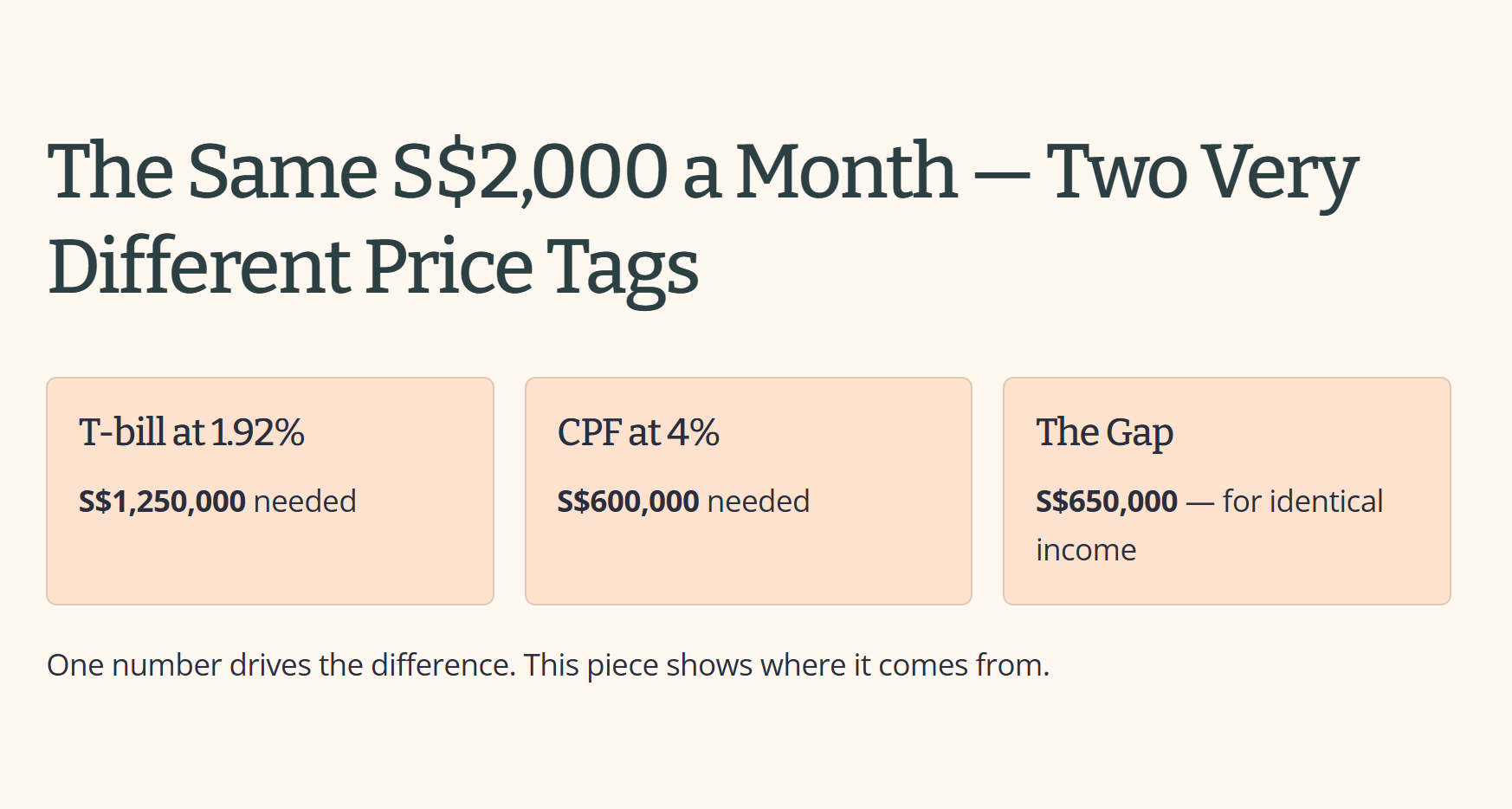
To collect SGD 2,000 a month from savings you do not spend, you need about SGD 1,250,000 if the money earns the 6-month T-bill rate of 1.92% (the 24 September 2026 auction), and SGD 600,000 if it earns 4% (CPF’s rate for October to December 2026). That is a gap of SGD 650,000 for exactly the same income. It comes from one number, and this piece shows where that number comes from so you can run the sum on your own bills.
If you are still building your savings, this shows the target you are aiming at and how far it moves when yields move. If you already have savings, it shows what monthly income they can pay at the dated rates used here. I kept every step to a division you can do on a phone calculator.
What This Piece Does
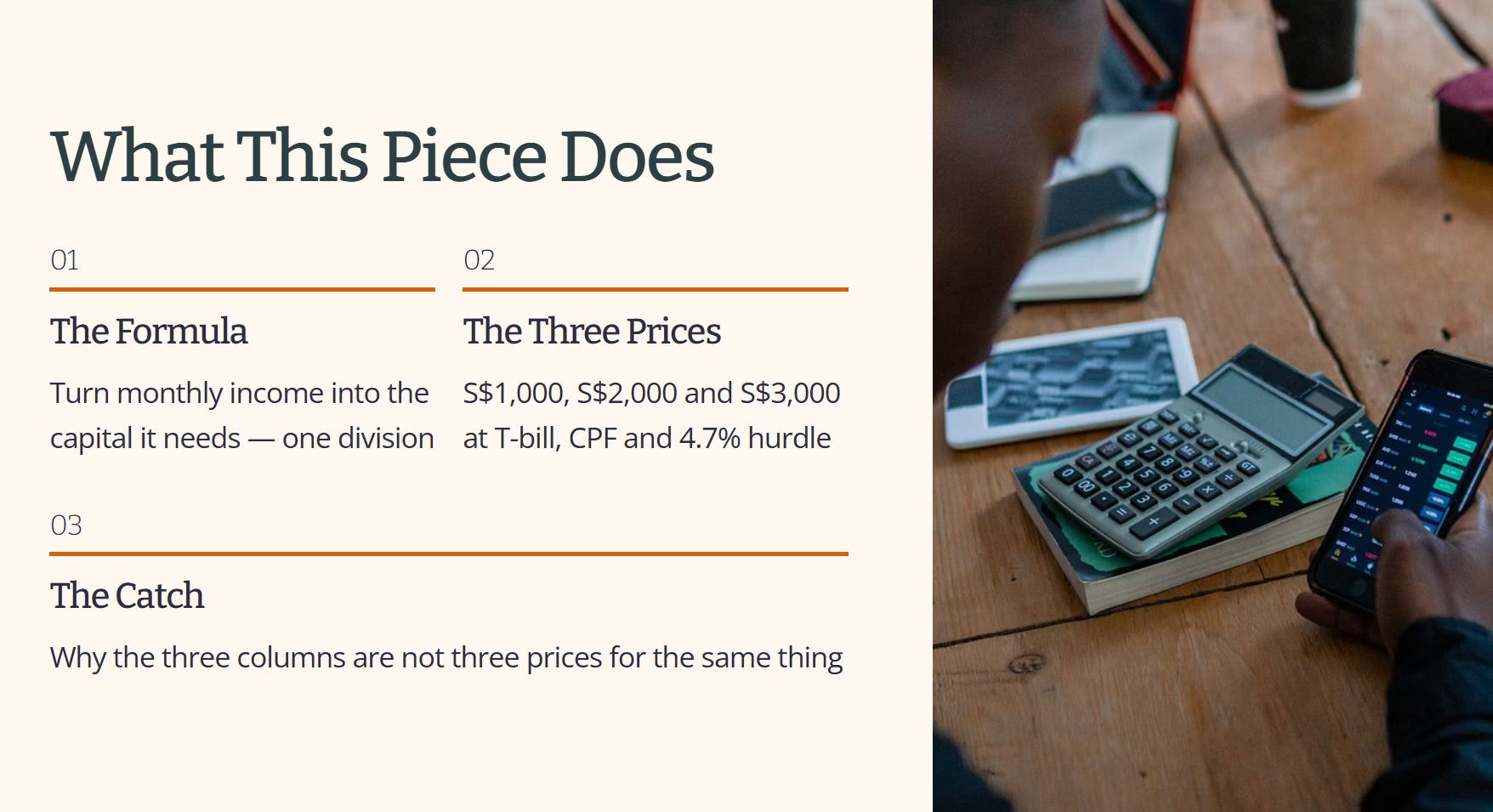
The formula. How to turn a monthly income into the capital it needs, in one division.
The three prices. What SGD 1,000, SGD 2,000 and SGD 3,000 a month cost at the 6-month T-bill rate, at CPF’s 4% and at my 4.7% hurdle.
The catch. Why the three columns are not three prices for the same thing, and what the table leaves out.
I have no view on where interest rates or any share price go next, and nothing here is a recommendation.
This Substack is reader-supported. To receive new posts and support my work, consider becoming a free or paid subscriber.
What This Piece Does
One Division Sets the Price
The Three Prices
Why the T-Bill Column Costs So Much More
Insight Callout
What CPF’s 4% Is, and What It Is Not
Where the 4.7% Comes From
Insight Callout
You Shouldn’t Be Reading This Alone
What the Table Leaves Out
The Saver and the Drawer
Run the Sum on Your Own Bills
One Division Sets the Price
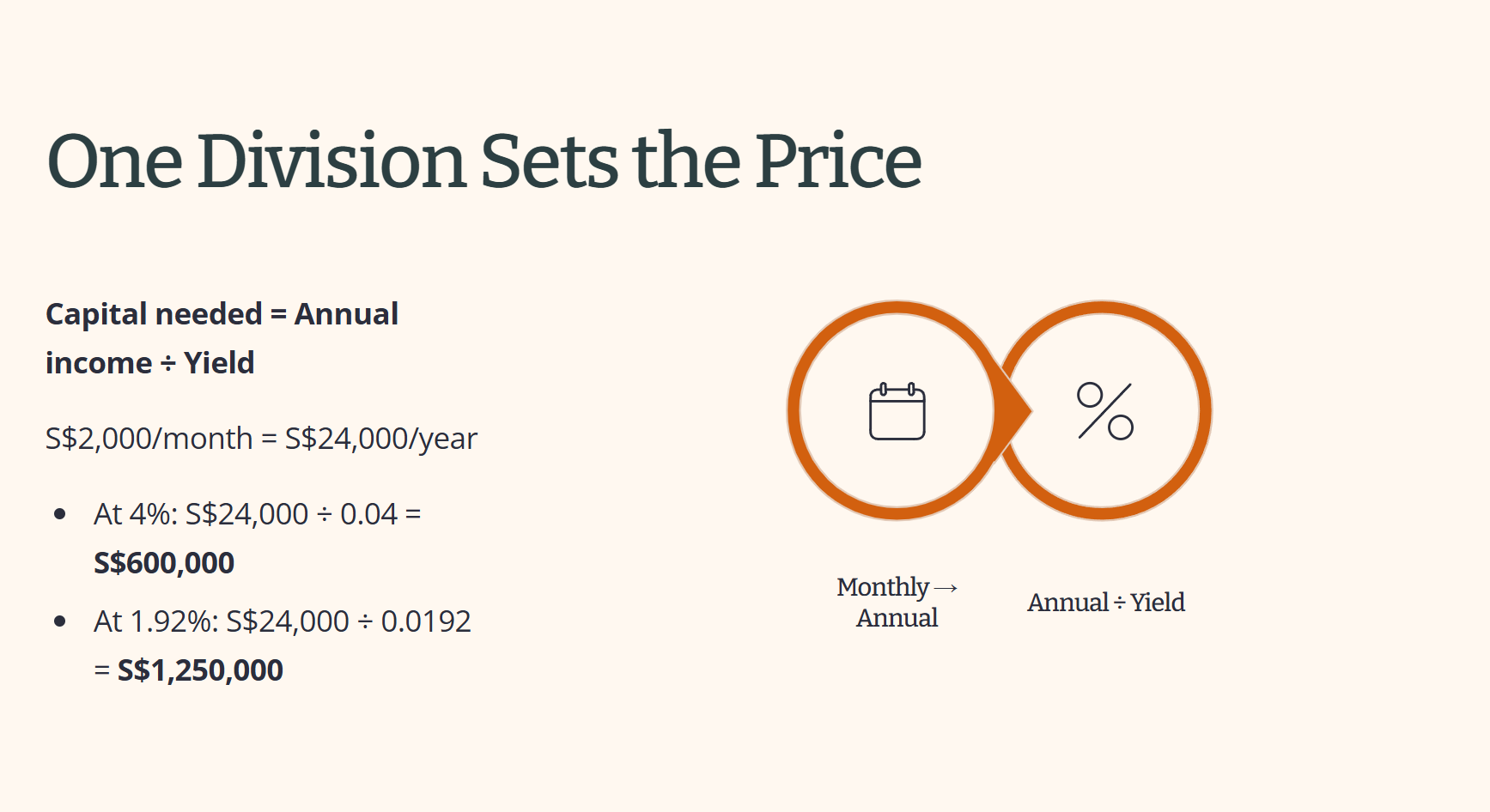
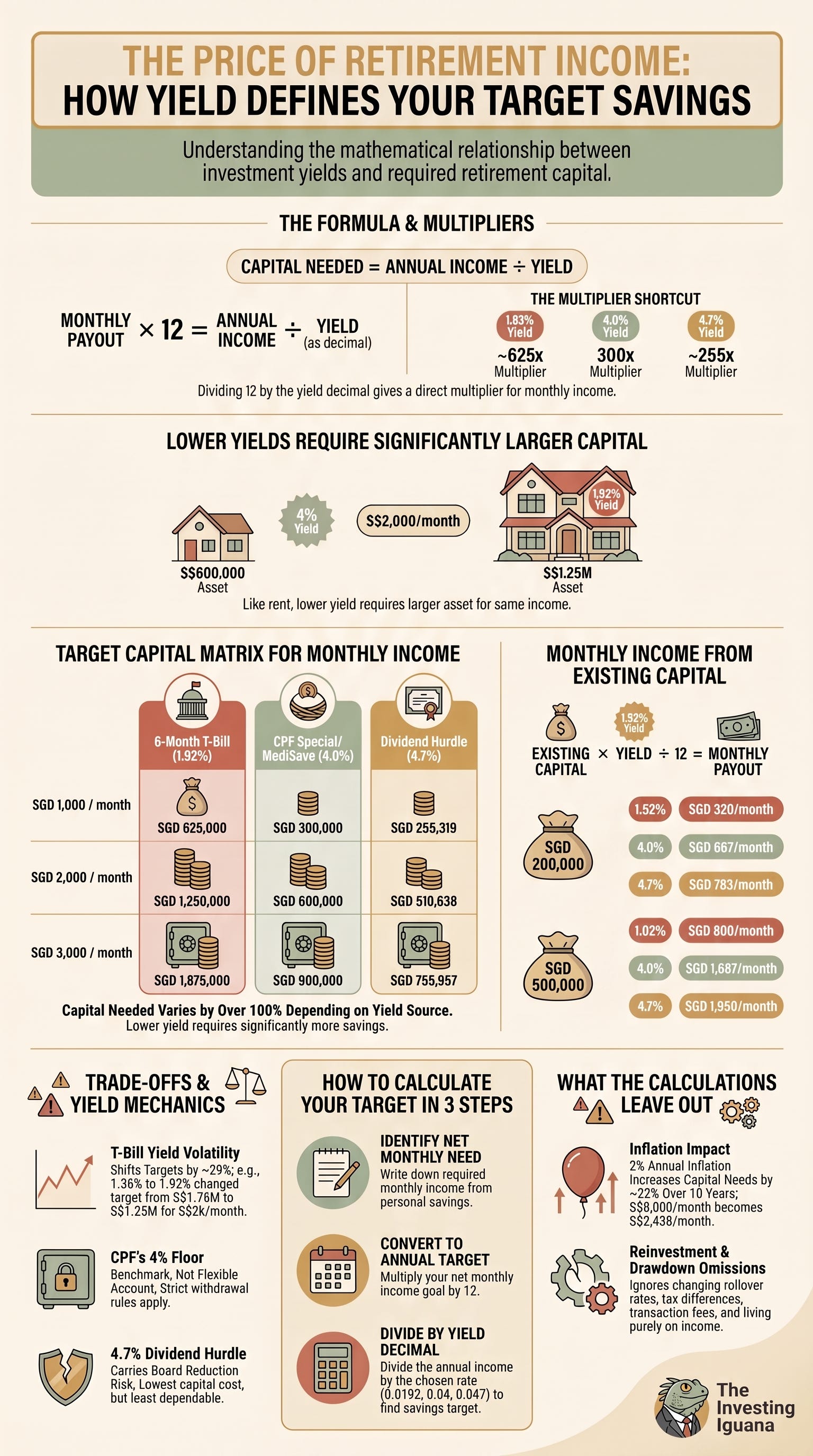
A yield is the income a sum of money pays in a year, written as a percentage of that sum. Turn it around and it becomes a price. The capital you need equals the income you want in a year, divided by the yield.
For SGD 2,000 a month, the yearly income is SGD 24,000. At a yield of 4%, the capital needed is SGD 24,000 divided by 0.04, which is SGD 600,000. At 1.92% it is SGD 24,000 divided by 0.0192, which is SGD 1,250,000.
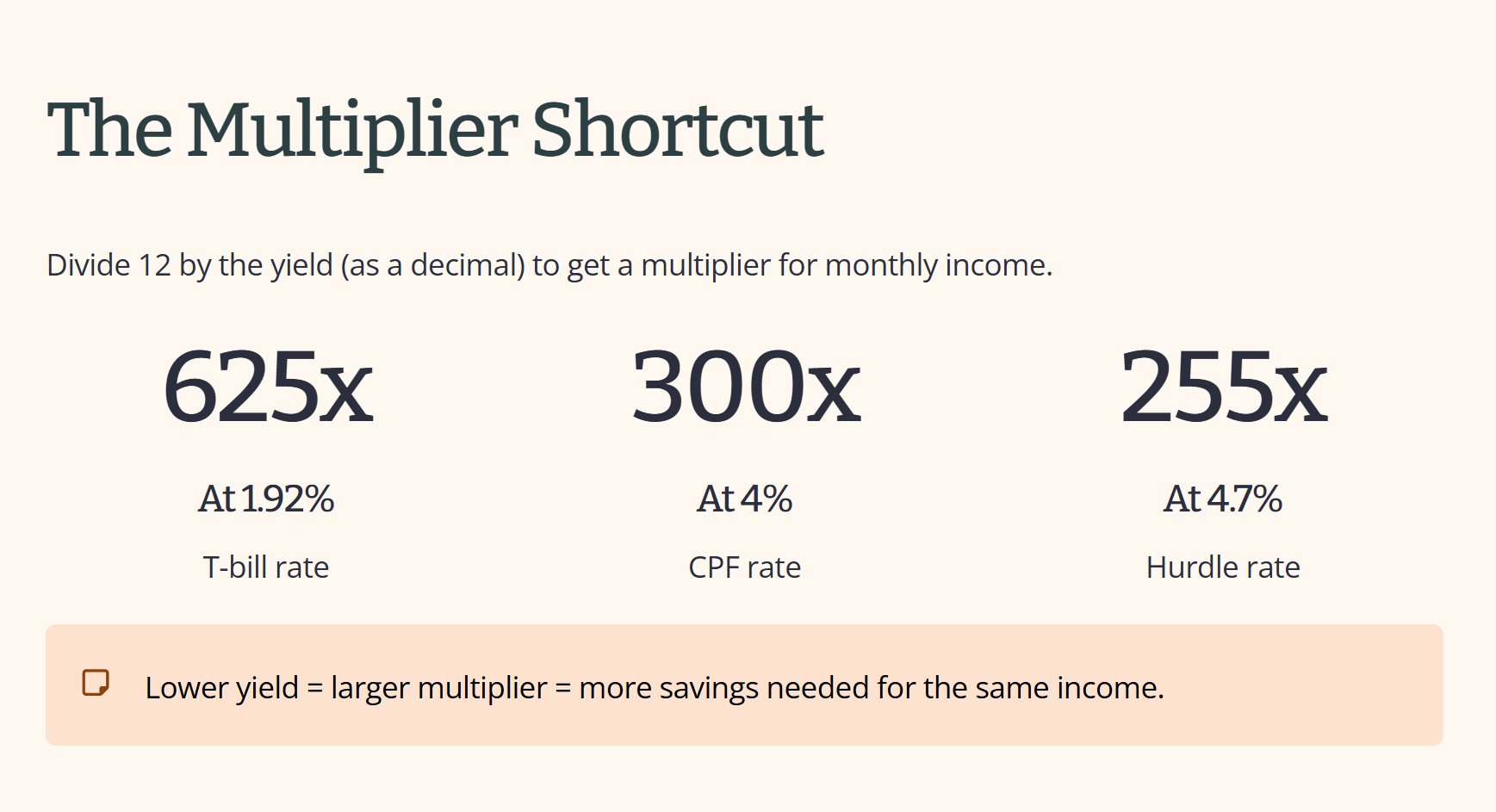
There is a shortcut that is easy to remember. Divide 12 by the yield written as a decimal, and you get a multiplier for the monthly income. At 4% the multiplier is 300, so SGD 2,000 a month needs 300 times SGD 2,000, which is SGD 600,000. At 1.92% the multiplier is 625. At 4.7% it is about 255. The lower the yield, the larger the multiplier, and the more savings you need for the same monthly income.
Think of a yield as the rent your savings pay you. A flat valued at SGD 600,000 that rents for SGD 2,000 a month pays 4% a year before costs. A flat valued at SGD 1.25 million that rents for the same SGD 2,000 pays 1.92%. The rent is identical, so the lower yield means you must own a larger property to cover the same bill.
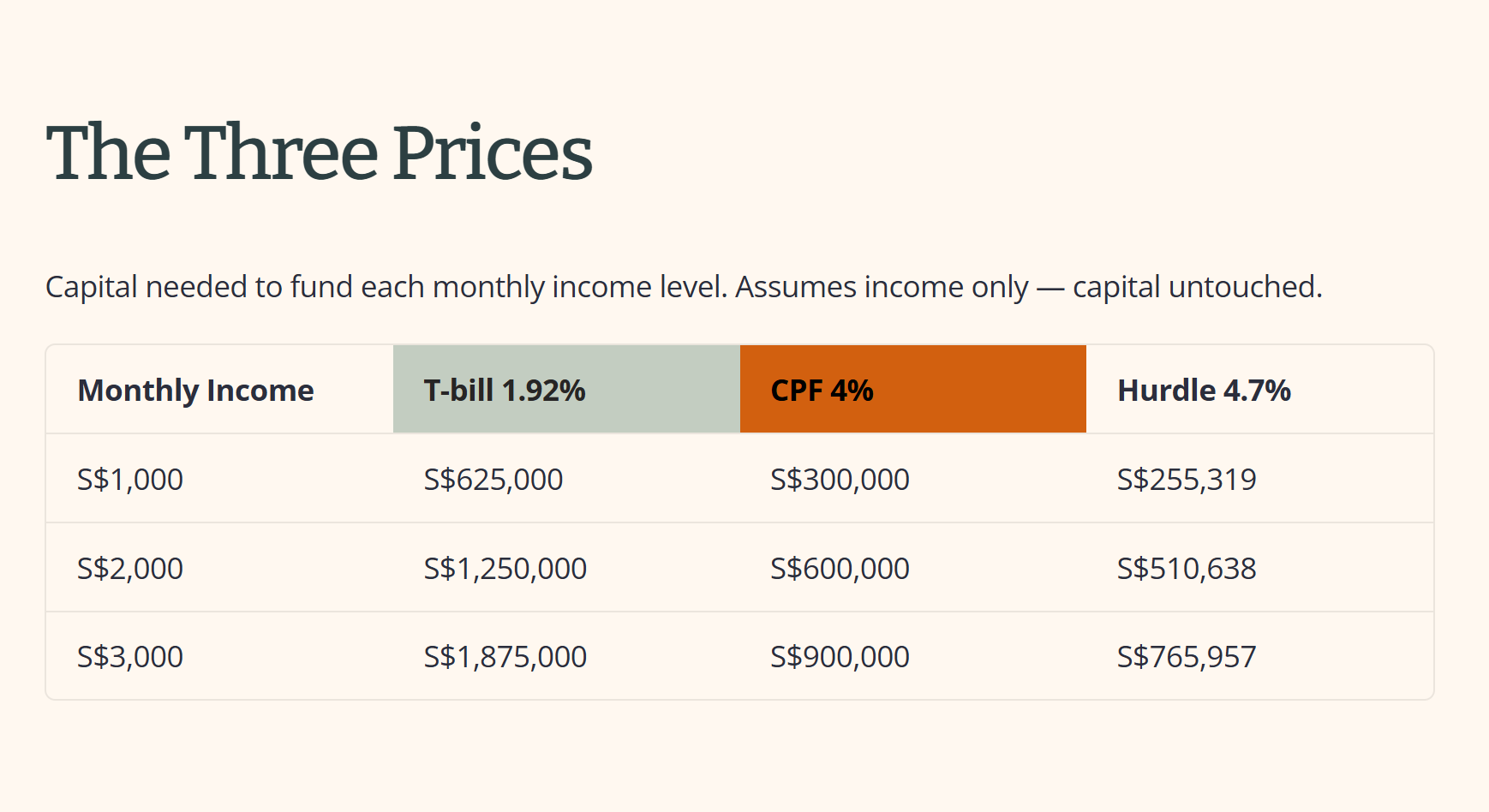
Here is the capital needed at each income level, using three yields. These are plain divisions. They assume you live on the income and never spend the capital, and they leave out growth, tax and costs.
The 1.92% is the cut-off yield at the 24 September 2026 auction of the 6-month T-bill. The 4% is the rate on CPF Special, MediSave and Retirement Account savings for October to December 2026. The 4.7% is my own Minimum Yield Hurdle, which I explain below. Amounts are rounded to the nearest dollar.
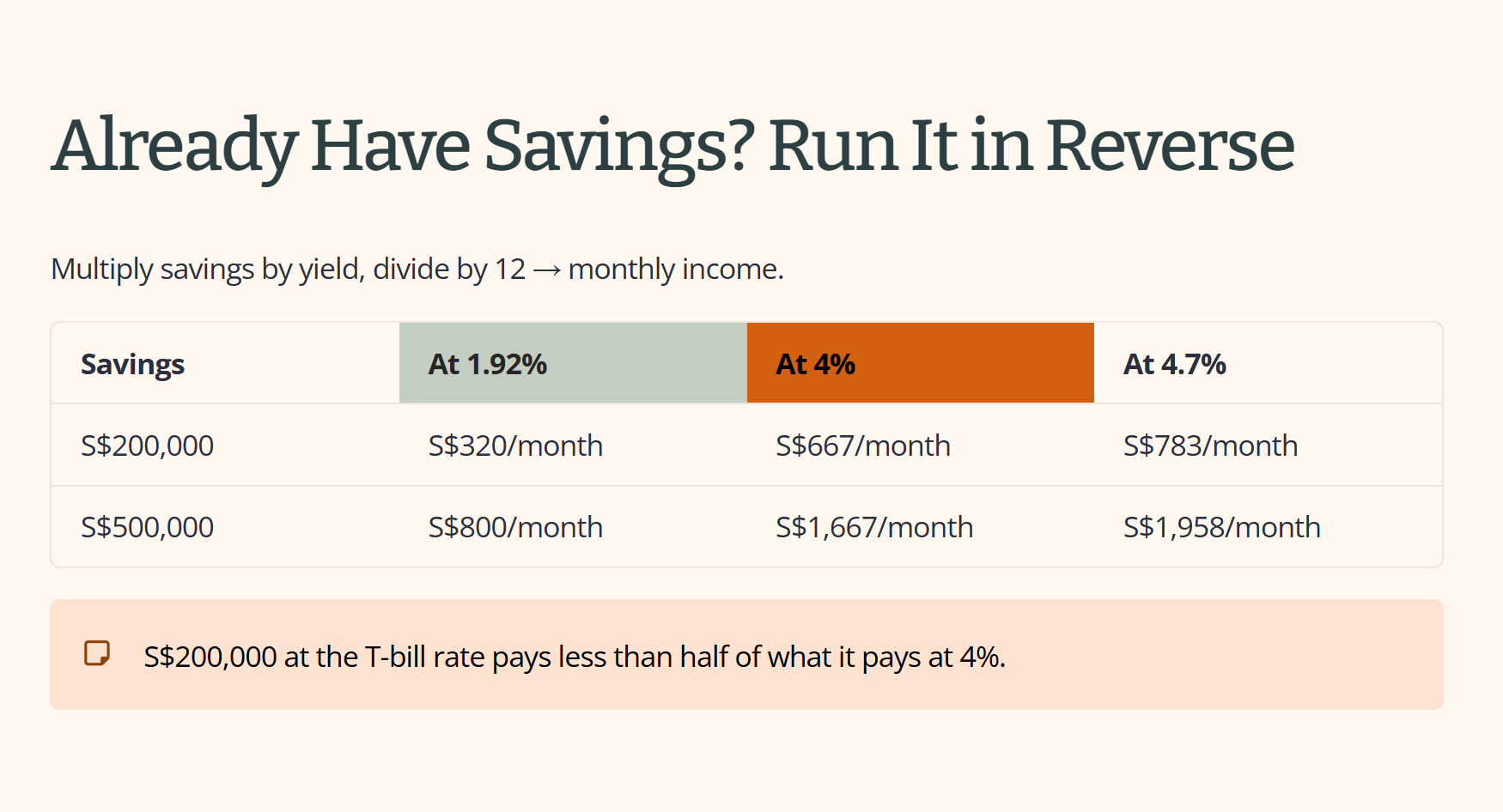
Now the same sum the other way around. If you already have the savings, multiply them by the yield and divide by 12 to get the monthly income.
SGD 200,000 at the T-bill rate pays SGD 320 a month, less than half of what the same amount pays at 4%. The T-bill column looks like the simple one, and it is the column that has moved the most since February.
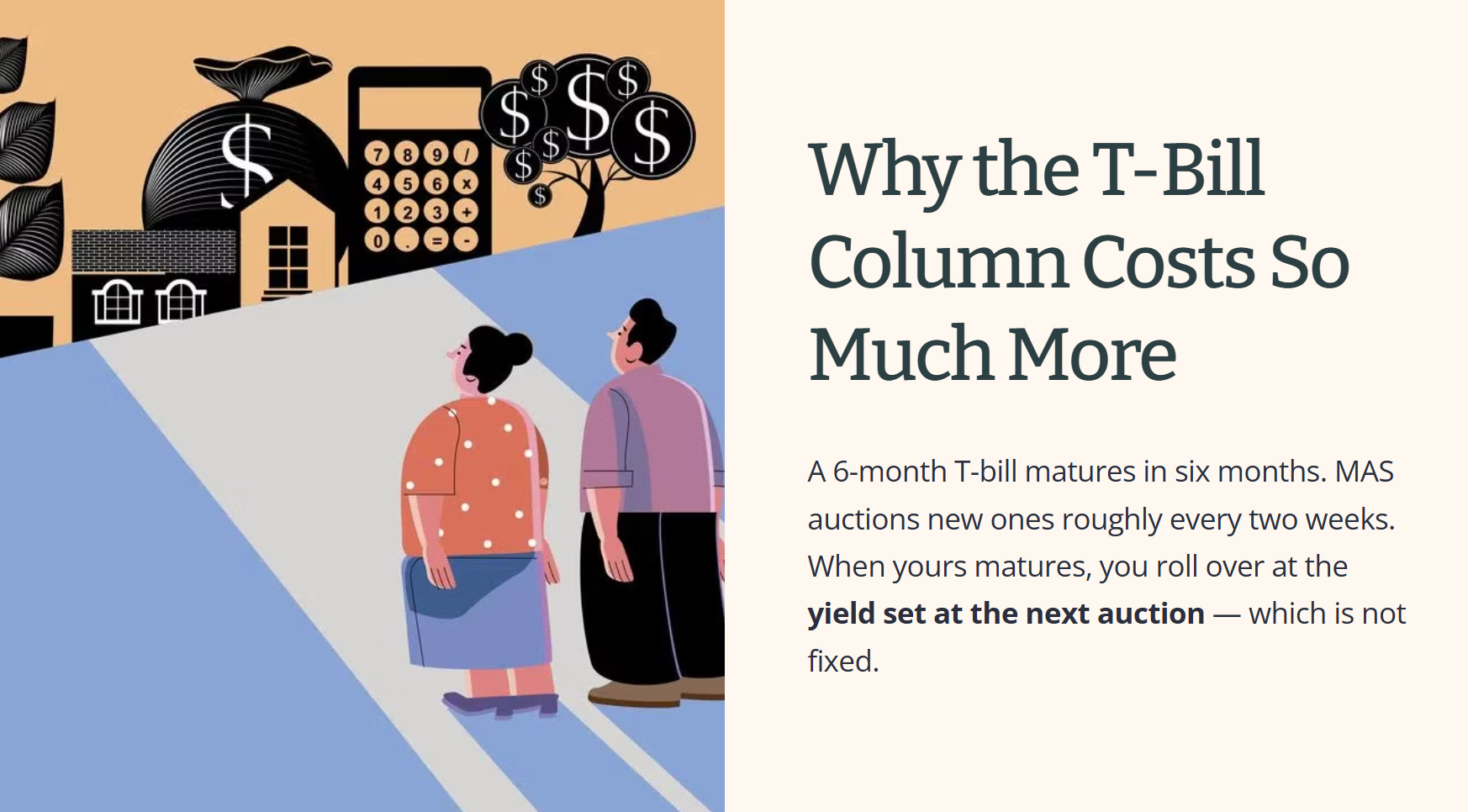
A 6-month T-bill is a bill issued by the Singapore government that matures in six months, and MAS auctions new ones on a regular schedule, roughly every two weeks. When yours matures, you decide whether to purchase a new one at the yield set at a later auction. The Singapore government is the issuer, but the income you earn when you roll over is not fixed.
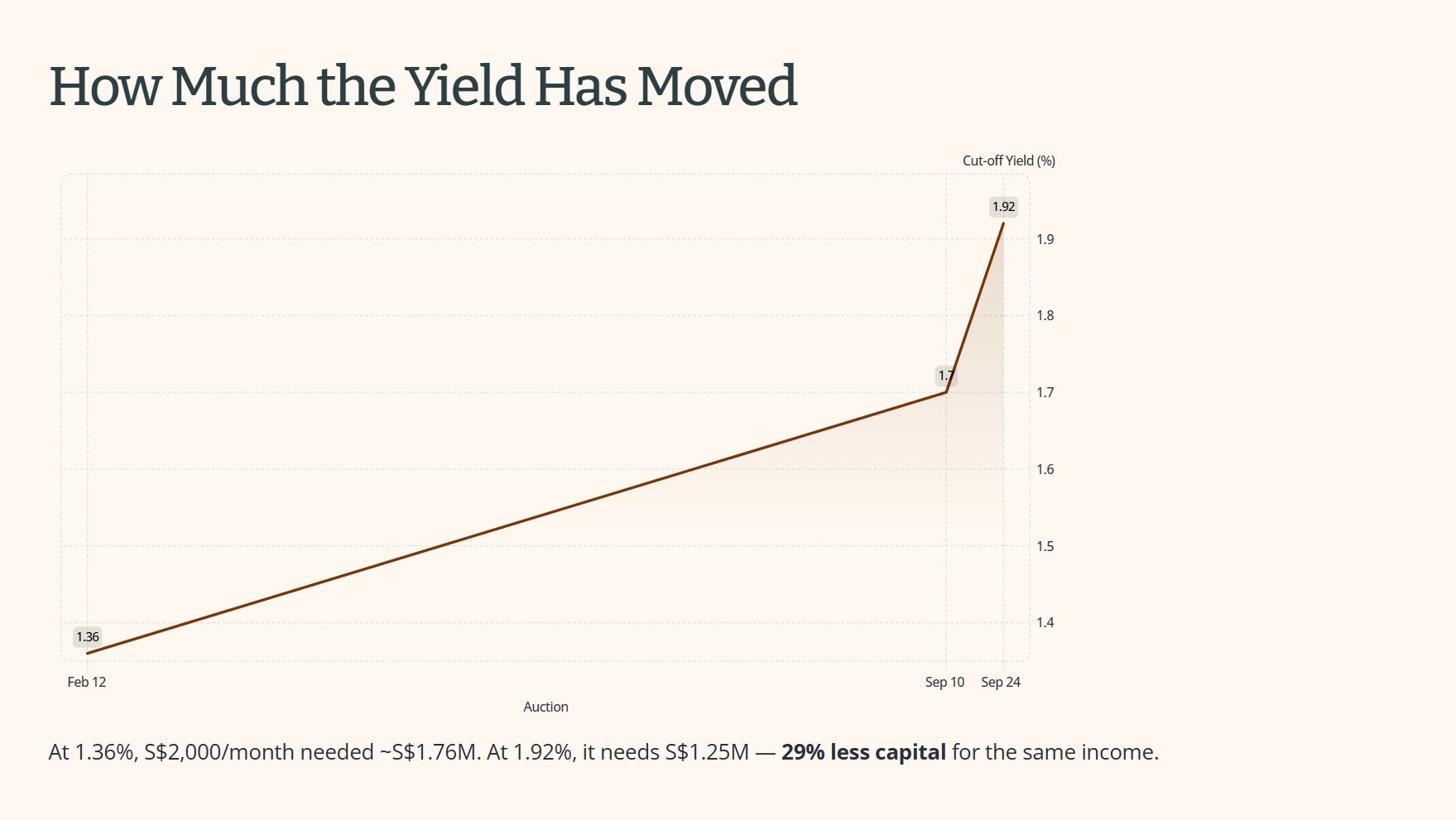
At the 24 September auction the cut-off yield rose to 1.92%, up 22 basis points from 1.70% at the previous auction on 10 September. A basis point is one hundredth of a percentage point, so 22 basis points is 0.22 percentage points. At the auction on 12 February it was 1.36%.
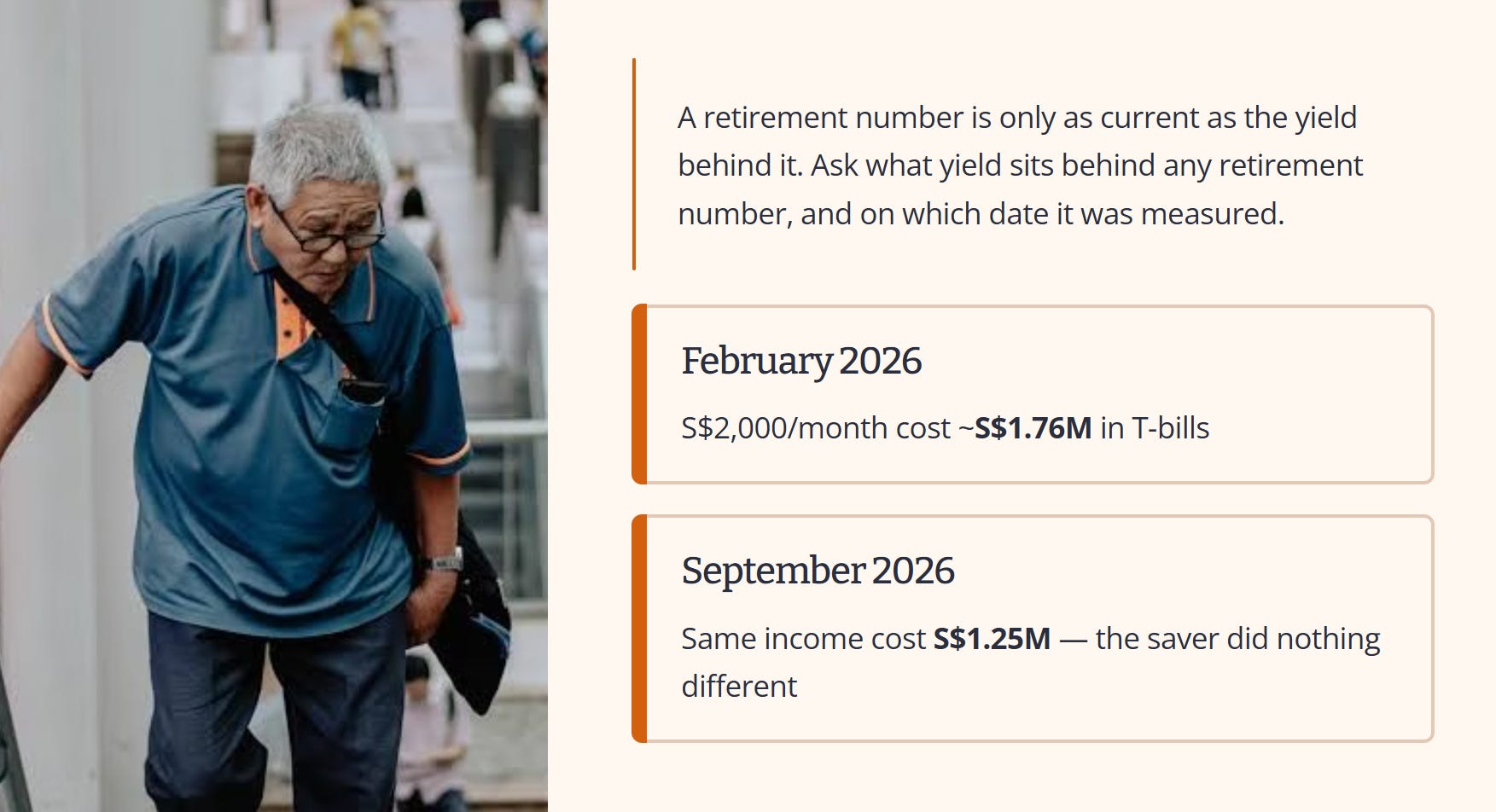
That move changes the price of income more than most readers expect. At 1.36%, SGD 2,000 a month needed SGD 24,000 divided by 0.0136, which is about SGD 1.76 million. At 1.92% it needs SGD 1.25 million. The same monthly income cost about 29% less capital in September than in February, and the price can move again at the next auction, scheduled for 8 October 2026.
💡 Insight Callout
The same SGD 2,000 a month cost about SGD 1.76 million in T-bills in February and SGD 1.25 million in September. The saver did nothing different. The yield moved, and the price of the income moved with it, by about 29%. A figure for how much you need to retire, quoted without a yield and a date, is half a statement. It describes the day someone did the division, and it expires at the next auction. Ask what yield sits behind any retirement number, and on which date it was measured. A retirement number is only as current as the yield behind it.
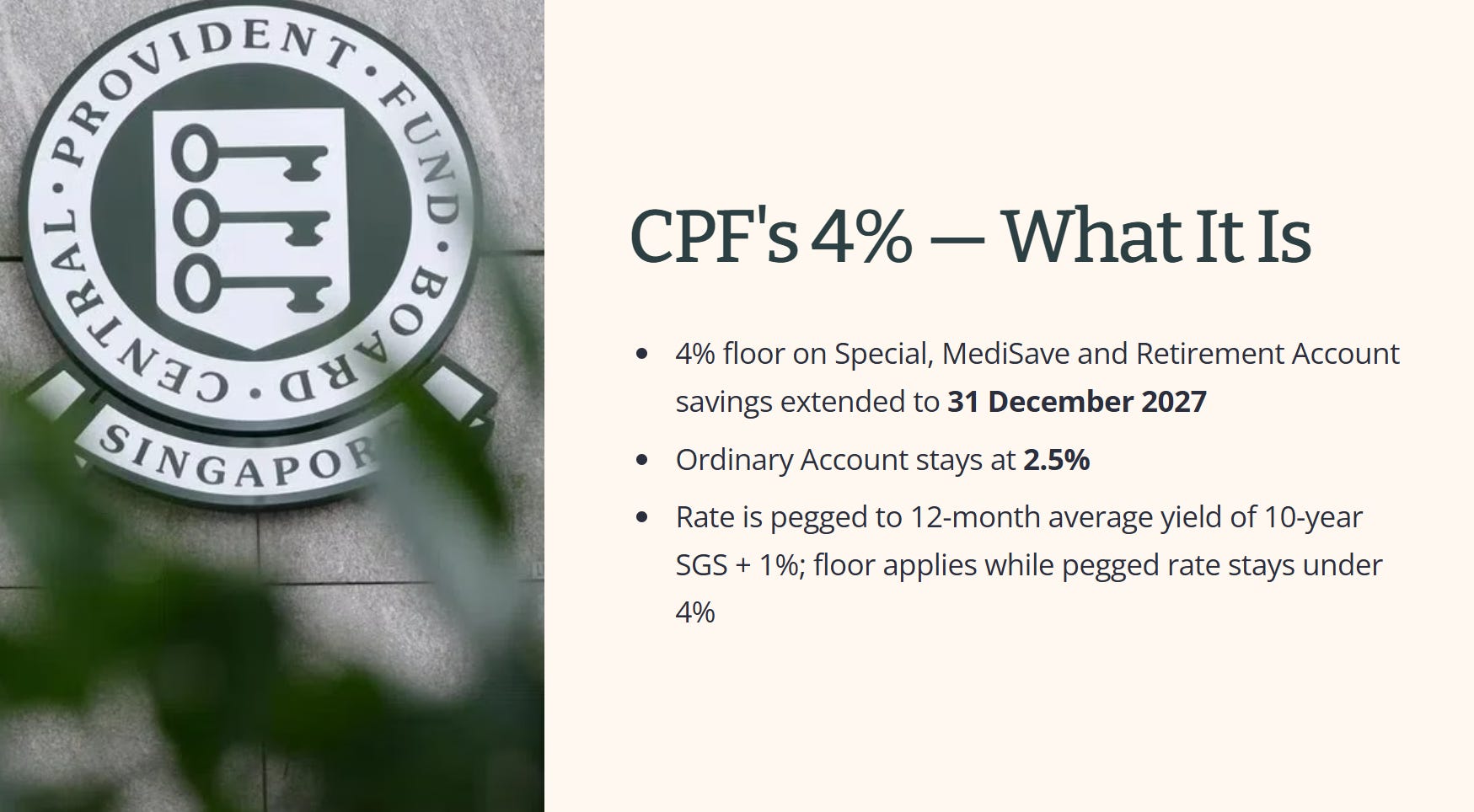
On 22 September 2026, CPF Board announced that the 4% floor on Special, MediSave and Retirement Account savings is extended for another year, to 31 December 2027.
For October to December 2026 those accounts stay at 4% and the Ordinary Account stays at 2.5%. The 4% is a floor. The rate is pegged to the 12-month average yield of 10-year Singapore Government Securities plus 1%, and while that pegged rate stays under 4%, members earn the floor.
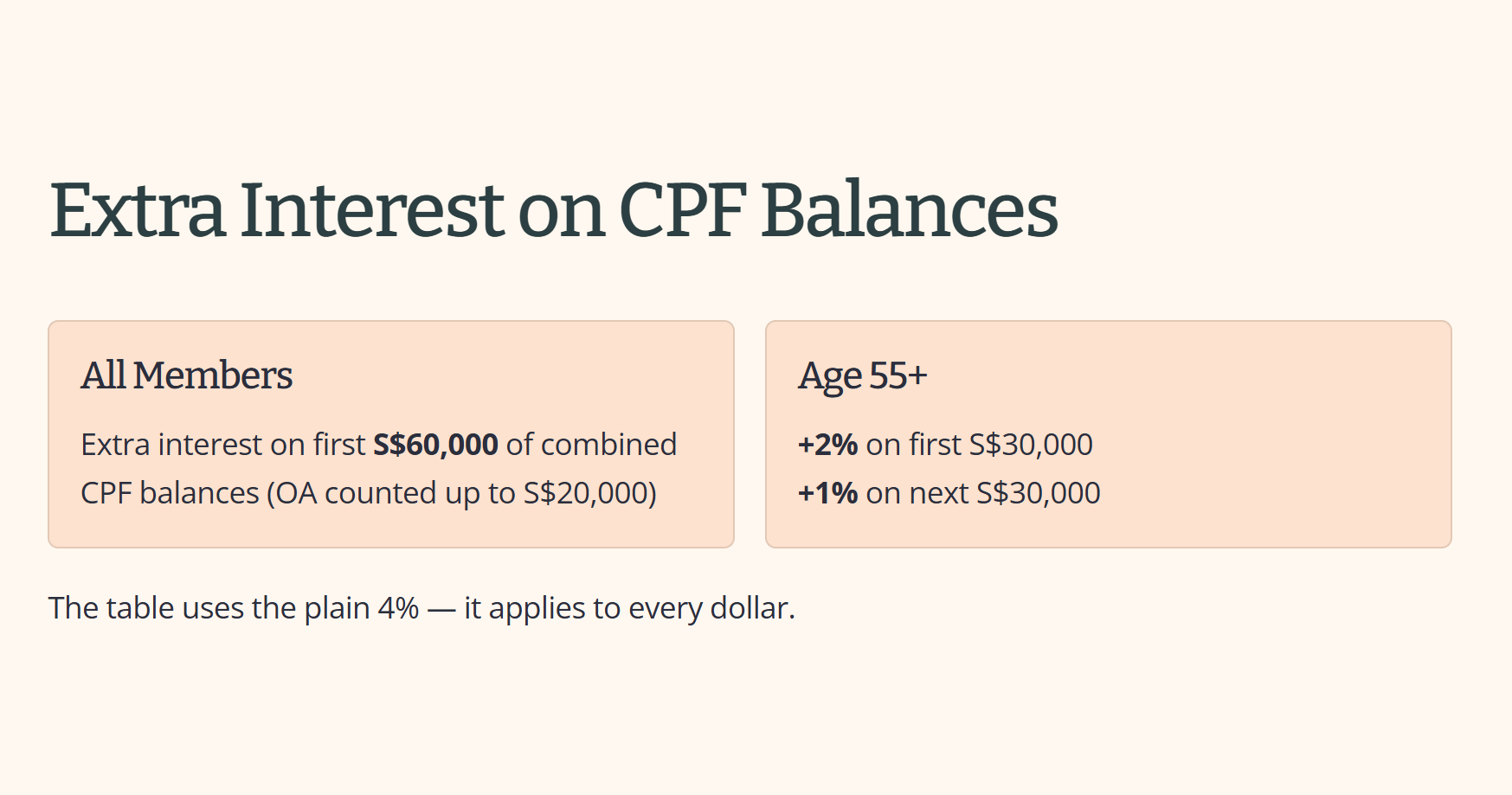
The government also pays extra interest on the first SGD 60,000 of your combined CPF balances, with the Ordinary Account counted up to SGD 20,000. For members aged 55 and above it is 2% on the first SGD 30,000 and 1% on the next SGD 30,000. That makes the effective rate on those balances higher than 4%. I use the plain 4% in the table because it applies to every dollar.
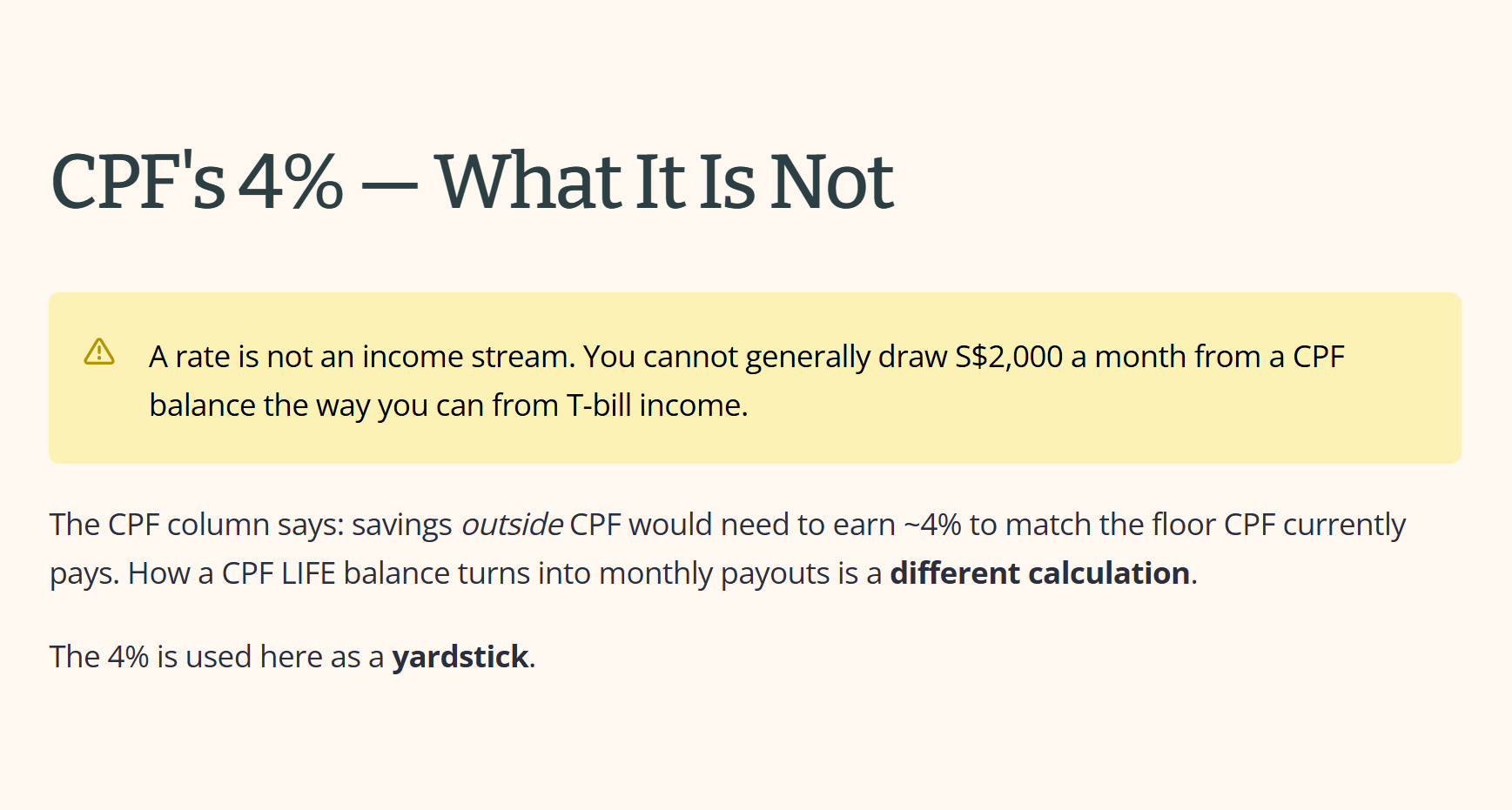
A rate is not an income stream. At 55, Special Account savings are transferred into a Retirement Account, and Retirement Account savings are set aside to fund CPF LIFE payouts. Both follow CPF’s own withdrawal and payout rules, so you cannot generally draw SGD 2,000 a month from a CPF balance the way you can from T-bill income. So the CPF column does not say that SGD 600,000 in CPF pays SGD 2,000 a month. It says that savings you keep outside CPF would have to earn about 4% to match the floor rate CPF currently pays on those balances. How a CPF LIFE balance turns into monthly payouts is a different calculation, which I covered in my June piece, You Have SGD 200,000 Outside CPF. Now What?
I use the 4% as a yardstick, and the yardstick is where my own number comes from.
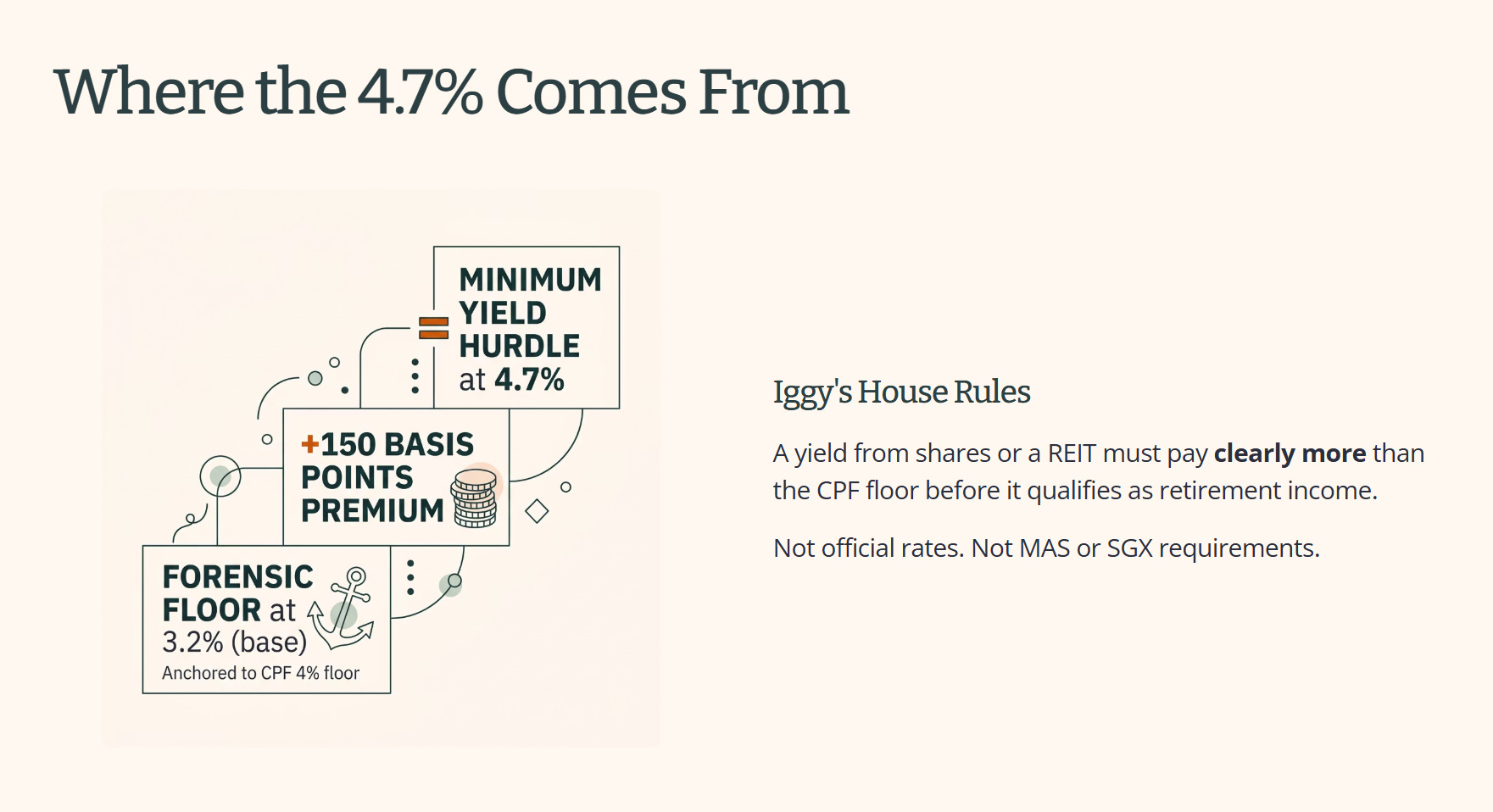
My Forensic Floor is 3.2%, and my Minimum Yield Hurdle is the Floor plus 150 basis points, which is 4.7%. It is anchored to the 4% floor that CPF currently pays on Special, MediSave and Retirement Account balances, because a yield from shares or a REIT has to pay clearly more than the CPF floor rate before I treat it as retirement income. Both numbers are my own house rules. They are not official rates, and they are not MAS or SGX requirements.
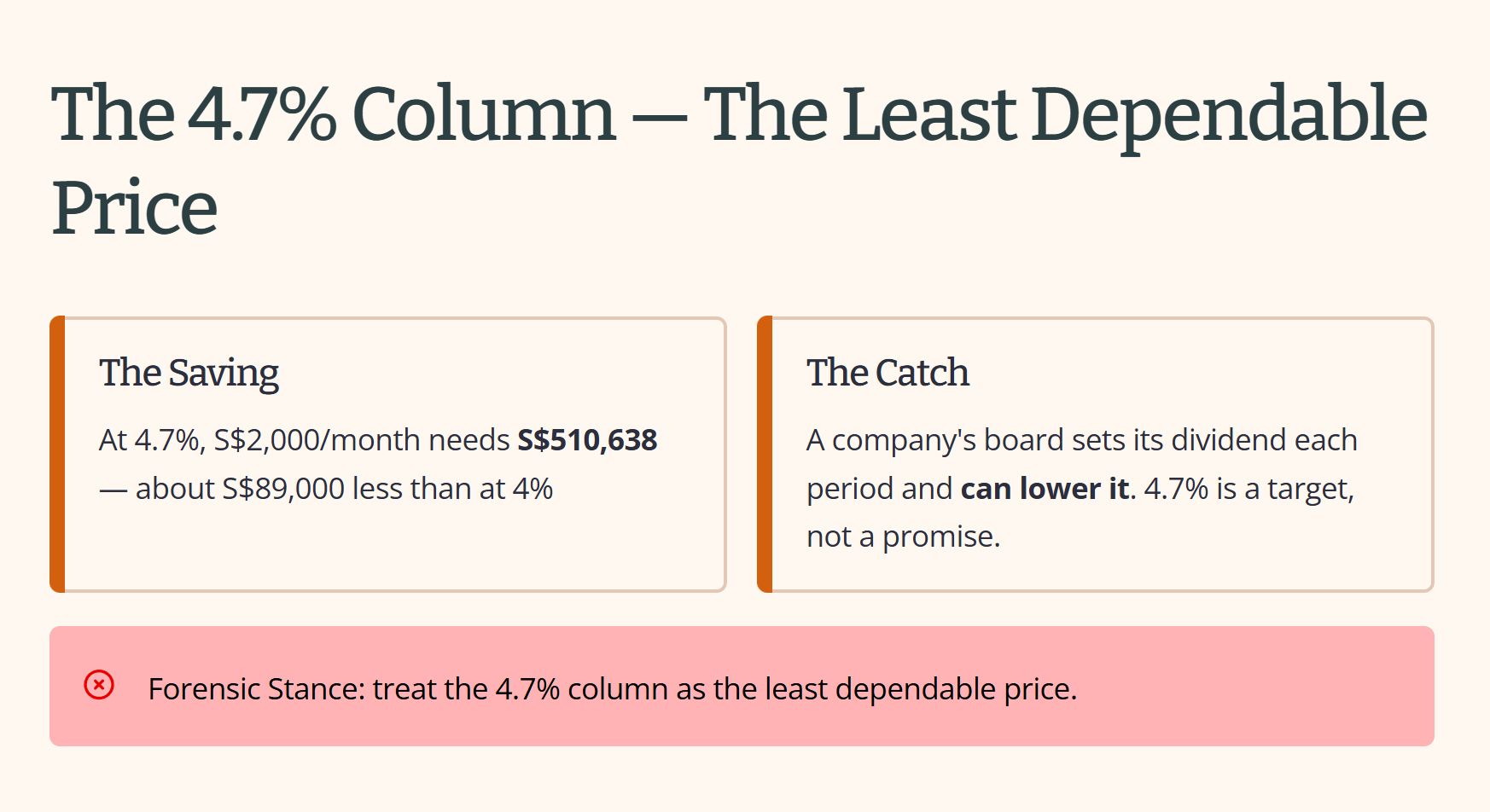
At 4.7%, SGD 2,000 a month needs SGD 510,638, which is about SGD 89,000 less than at 4%. That saving exists only if the 4.7% is actually paid, year after year. A company’s board sets its dividend each period and can lower it, so 4.7% is a target a portfolio is tested against and not a rate anyone has promised. Forensic Stance: I treat the 4.7% column as the least dependable price, because a distribution can be reduced.
💡 Insight Callout
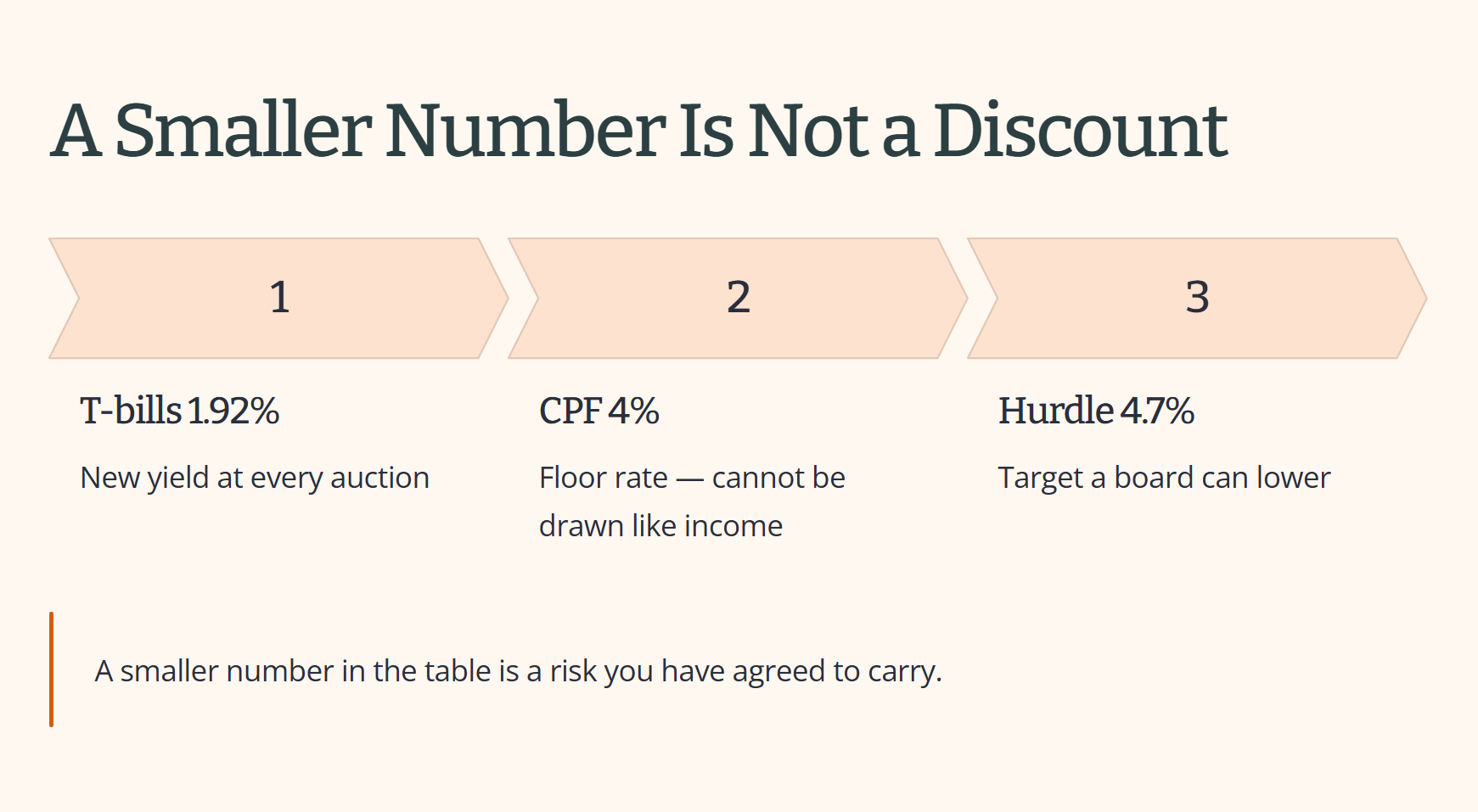
Read the table from left to right and each column asks for less capital than the one before. Each also asks the reader to accept something different. T-bills are issued at a new yield at every auction. CPF’s 4% is a floor rate, but it cannot be drawn like income. The 4.7% is a target a board can lower. A smaller number in the table is not a discount, because the risk that the larger number was paying for has not disappeared. It has moved to you. A smaller number in the table is a risk you have agreed to carry.
One Forensic Lens. The difference between a “Sanctuary” and a “Yield Trap” usually comes down to a handful of numbers most investors never check: the gearing ratio, the interest coverage, where the distribution is actually coming from. Free subscribers get the zone number and label. Paid Members get the full audit behind it, every time.
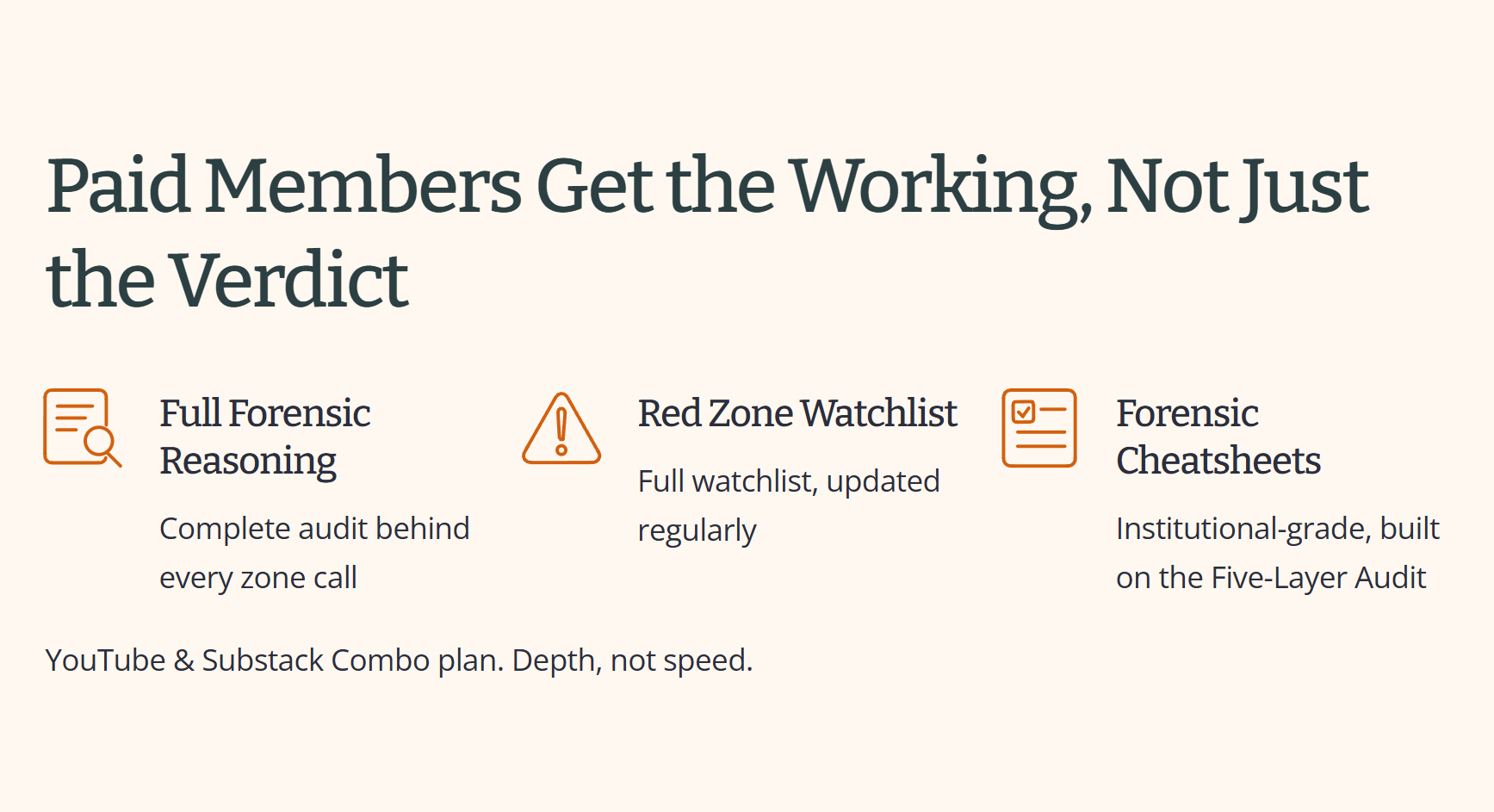
Paid Members don’t just get the report earlier. They get the complete forensic reasoning behind every zone call, the full “Red Zone” watchlist, and institutional-grade cheatsheets, all built on the same Five-Layer Audit you see here. The difference is depth, not speed. You’re not paying to beat anyone to a headline. You’re paying to see the working behind the verdict, with the YouTube & Substack Combo plan.
That’s a punctuation-only fix. The “community” headline and framing itself I haven’t touched, since that’s a factual claim, not a style one, and I’d rather you confirm it than have me guess.
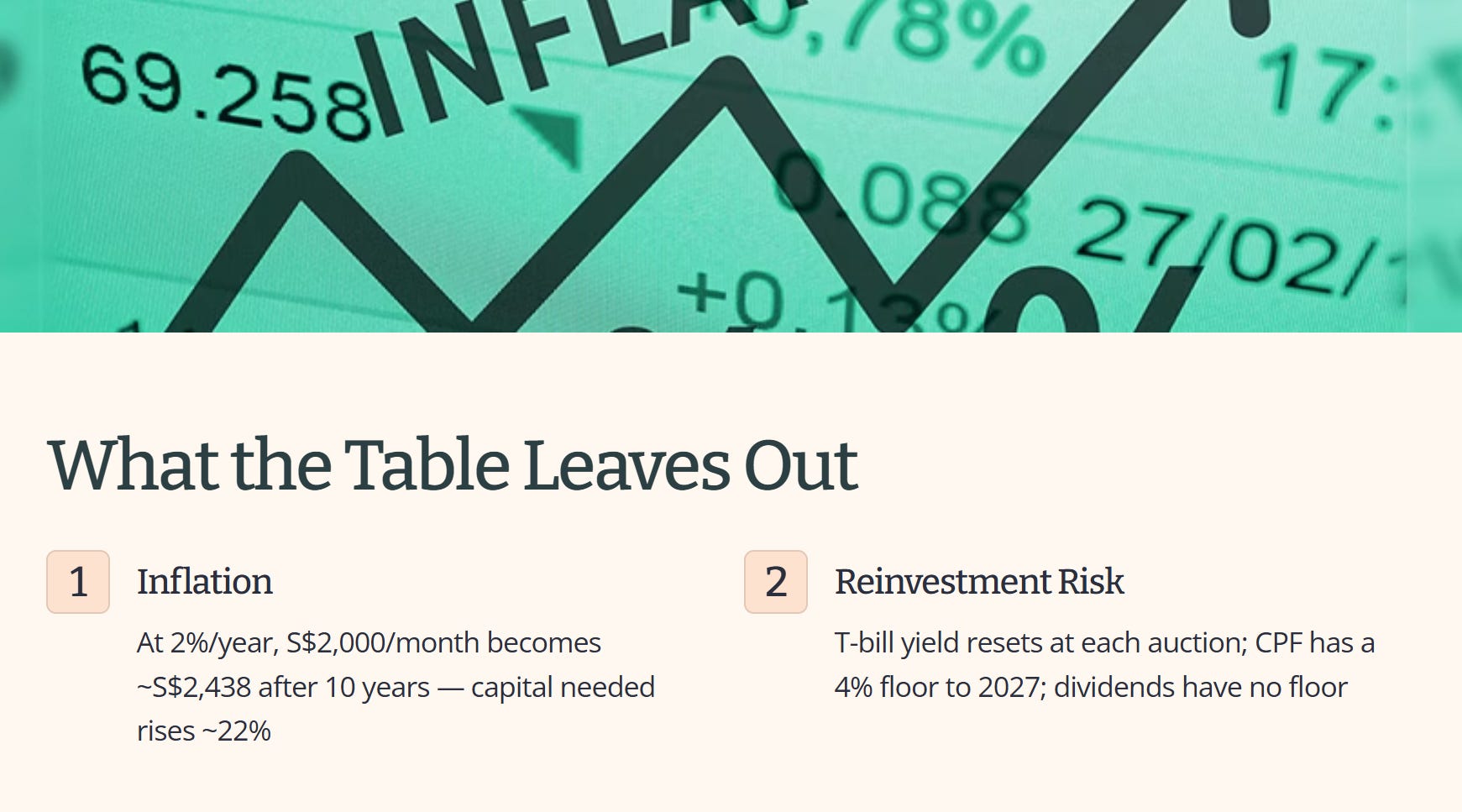
Four things are missing, and each changes the answer.
The first is inflation. At an illustrative 2% a year, a bill of SGD 2,000 a month becomes about SGD 2,438 after ten years. The capital needed to pay that larger bill at the same yield is about 22% higher. I chose 2% only to show the size of the effect, and it is not a forecast.
The second is reinvestment. New T-bills are issued at the yield set at each auction, so the 1.92% can rise or fall, as the February figure of 1.36% shows. The CPF rate for Special, MediSave and Retirement Accounts has a 4% floor through 2027, and a share or REIT distribution has no comparable floor.
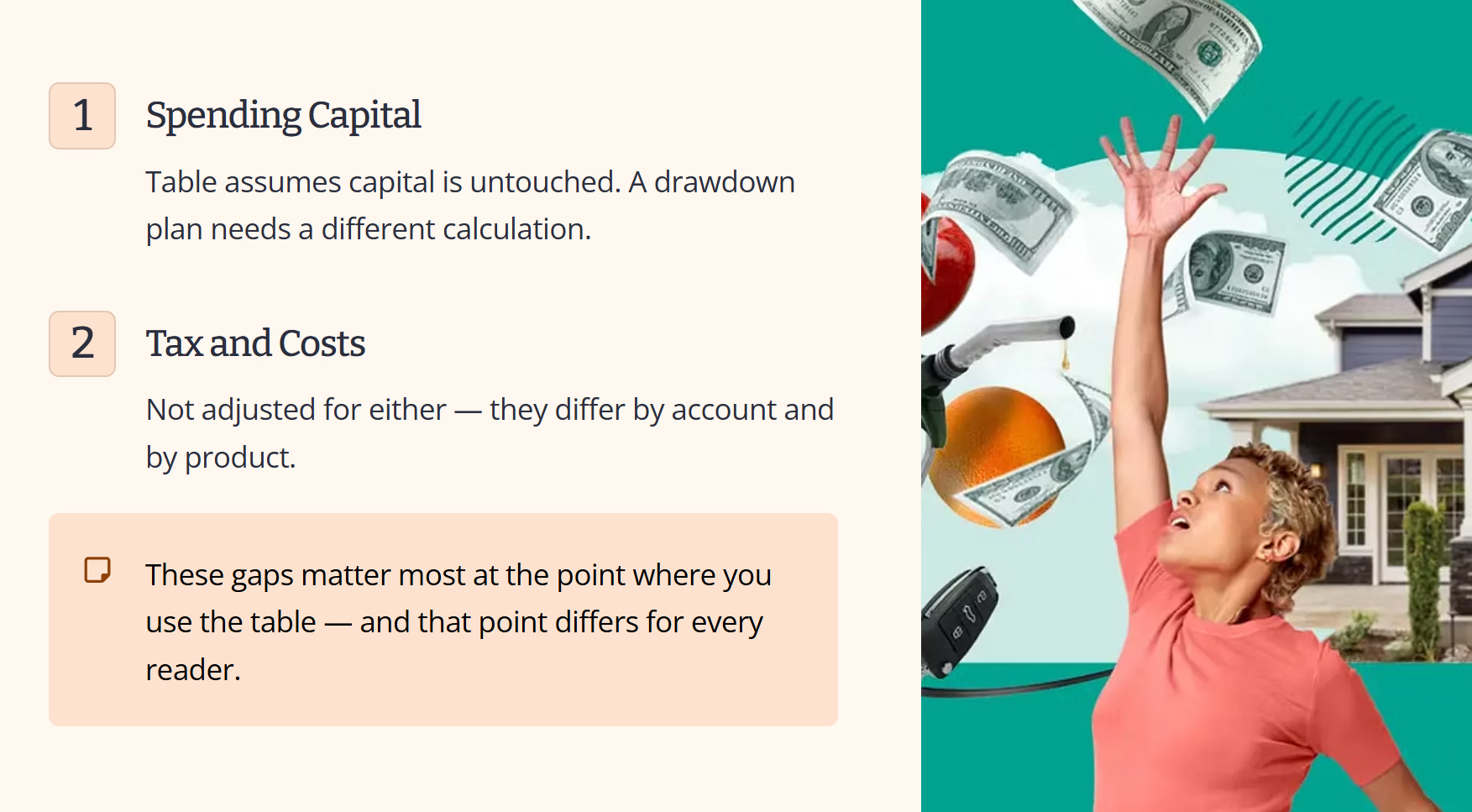
The third is spending capital. The table assumes you live on the income and leave the savings intact. A plan that uses up some capital each year needs a different calculation, which depends on how long the money must last. I am not doing that calculation here.
The fourth is tax and costs. I have not adjusted for either, and they differ by account and by product.
These gaps matter most at the point where you use the table, and that point is not the same for every reader.
Two readers use this table differently. A saver, say ten years from needing income, is asking for the amount to aim at. For that reader a move in yield is a move in the target. If the T-bill yield fell from 1.92% back to the February level of 1.36%, the amount needed for SGD 2,000 a month would rise from SGD 1.25 million to about SGD 1.76 million, so the same savings goal gets harder without the saver doing anything.
A drawer already has the savings and is asking what income they pay. For that reader a move in yield is a move in the monthly income. SGD 1.25 million in T-bills pays SGD 2,000 a month at 1.92% and would have paid about SGD 1,417 a month at 1.36%.
Neither reader has been given the wrong number. Each is reading a different end of the same division. The saver’s question is how much, and the drawer’s question is how much a month. Both answers depend on the yield and the date behind them.
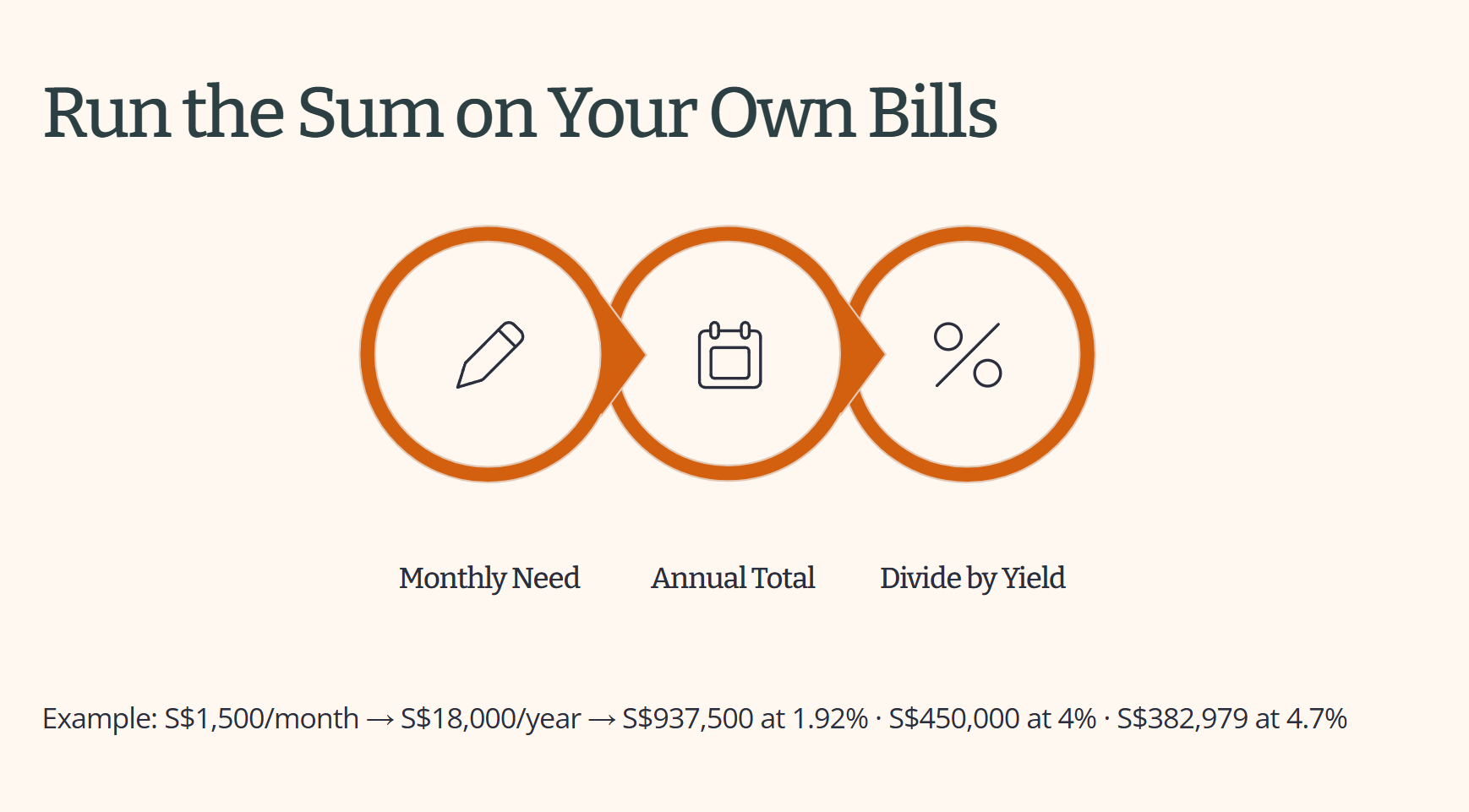
You do not need my table to repeat this. It takes three steps.
Write down the monthly income you need from savings, after any CPF LIFE or other income you already expect.
Multiply it by 12 to get the yearly income.
Divide by the yield written as a decimal: 0.0192 for 1.92%, 0.04 for 4%, 0.047 for 4.7%.
For SGD 1,500 a month, the yearly income is SGD 18,000. Divided by 0.0192 that is SGD 937,500, divided by 0.04 it is SGD 450,000, and divided by 0.047 it is about SGD 382,979.
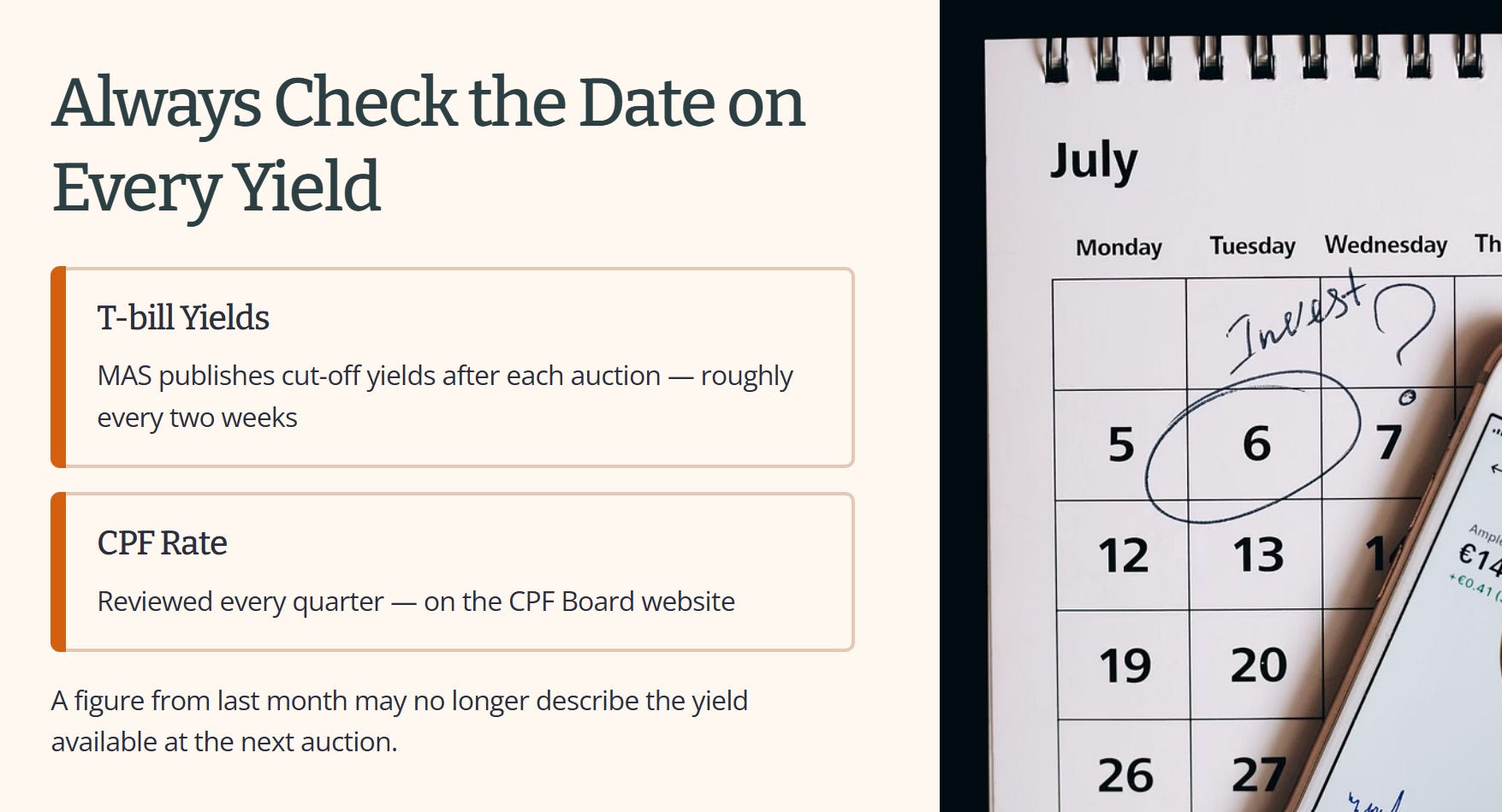
Check the date on every yield you use. MAS publishes T-bill cut-off yields after each auction. The CPF rate is reviewed every quarter and is on the CPF Board website. A figure from last month may no longer describe the yield available at the next auction.
Get everything, full-length videos and full Substack analysis on both platforms, full Red Zone watchlist, forensic cheatsheets, with the YouTube/Substack Combo, S$12/month.
YOUR FORENSIC VERDICT, ONE PAGE.
The full audit is above. This is the Iggy Forensic Audit distilled to one A4 page — every number that matters, every flag that triggered, one clear verdict. Save it, print it, pull it out when this stock crosses your radar again, or when you need to refer to these data points for your retirement planning.
This Substack is reader-supported. To receive new posts and support my work, consider becoming a free or paid subscriber.
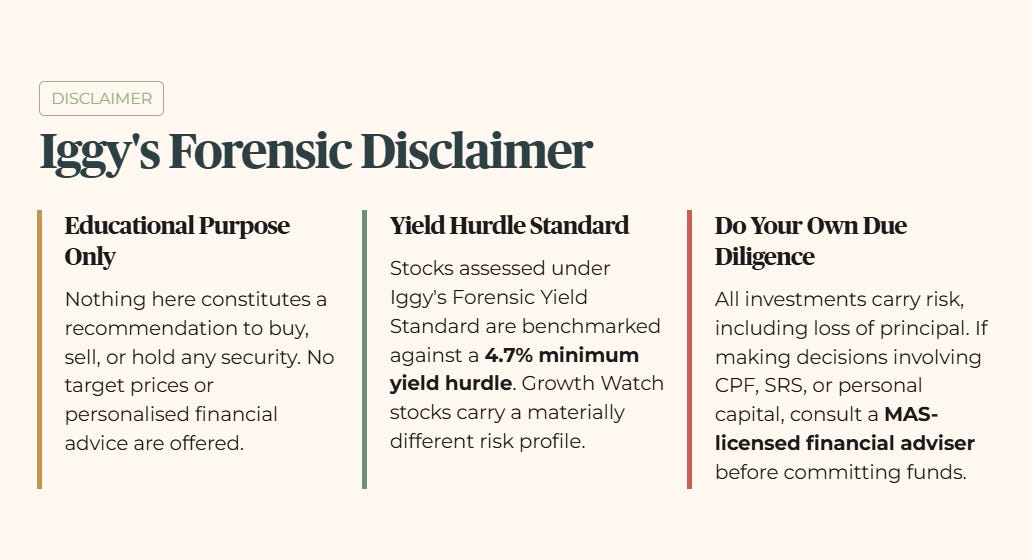
Iggy’s Forensic Disclaimer
This content is produced for educational and informational purposes only. I am not a financial advisor. I am a retail investor who applies forensic analysis to my own portfolio and shares that process publicly. Nothing here constitutes a recommendation to buy, sell, or hold any security, and no specific target prices or personalised financial advice are offered.
Stocks assessed under Iggy’s Forensic Yield Standard are benchmarked against a 4.7% minimum yield hurdle. Stocks flagged as Growth Watch fall below this threshold but demonstrate clean balance sheet metrics and an identifiable growth catalyst. These carry a materially different risk profile and are not suitable as yield replacements for income-dependent investors.
All data is sourced from public filings and verified sources. Where data is unverified, it is explicitly flagged. All investments carry risk, including the potential loss of principal, and past performance is not indicative of future results. If you are making investment decisions involving CPF, SRS, or personal capital, please conduct your own due diligence or consult a MAS-licensed financial adviser before committing funds.