




The Real Price of a Debt-Free $4,500 a Month in Retirement Is $711,000, Not $1.8 Million.
Skip CPF entirely and the number more than doubles. The gap comes down to one thing: CPF pays a better rate on your next dollar than your dividend portfolio does.
Most retirement calculators will tell you a comfortable $4,500 a month needs close to two million dollars sitting in a low risk portfolio. The real number, done properly, is $711,000. The other $1.1 million disappears the moment CPF actually gets counted.

If you’re already sitting on the Enhanced Retirement Sum, this changes how you think about every dollar you put into a portfolio after that. If you’re still years from touching your CPF, this changes how much of your own saving discipline should go toward that ceiling versus the open market.
I ran this one for my own planning before I ran it for anyone else, mostly because the answer surprised me too.

What “$4,500 a Month, Debt-Free” Actually Means
The Number Without CPF In The Picture
What CPF Actually Replaces
The Three Numbers That Matter: BRS, FRS, and ERS
The Trade-Off CPF Doesn’t Advertise
Closing the Gap With a Portfolio That Clears My Standard
The Second Lever: SRS
If You’re Not 55 Yet
The Obvious Objection
Iggy’s Elite Read
What “$4,500 a Month, Debt-Free” Actually Means
Let’s be precise about what’s being measured before any of the arithmetic starts. This is $4,500 a month, per person, assuming the mortgage is cleared and there’s no other debt sitting on the balance sheet. No rent, no loan repayments, just the ordinary cost of living plus enough left over for a comfortable, not austere, retirement.
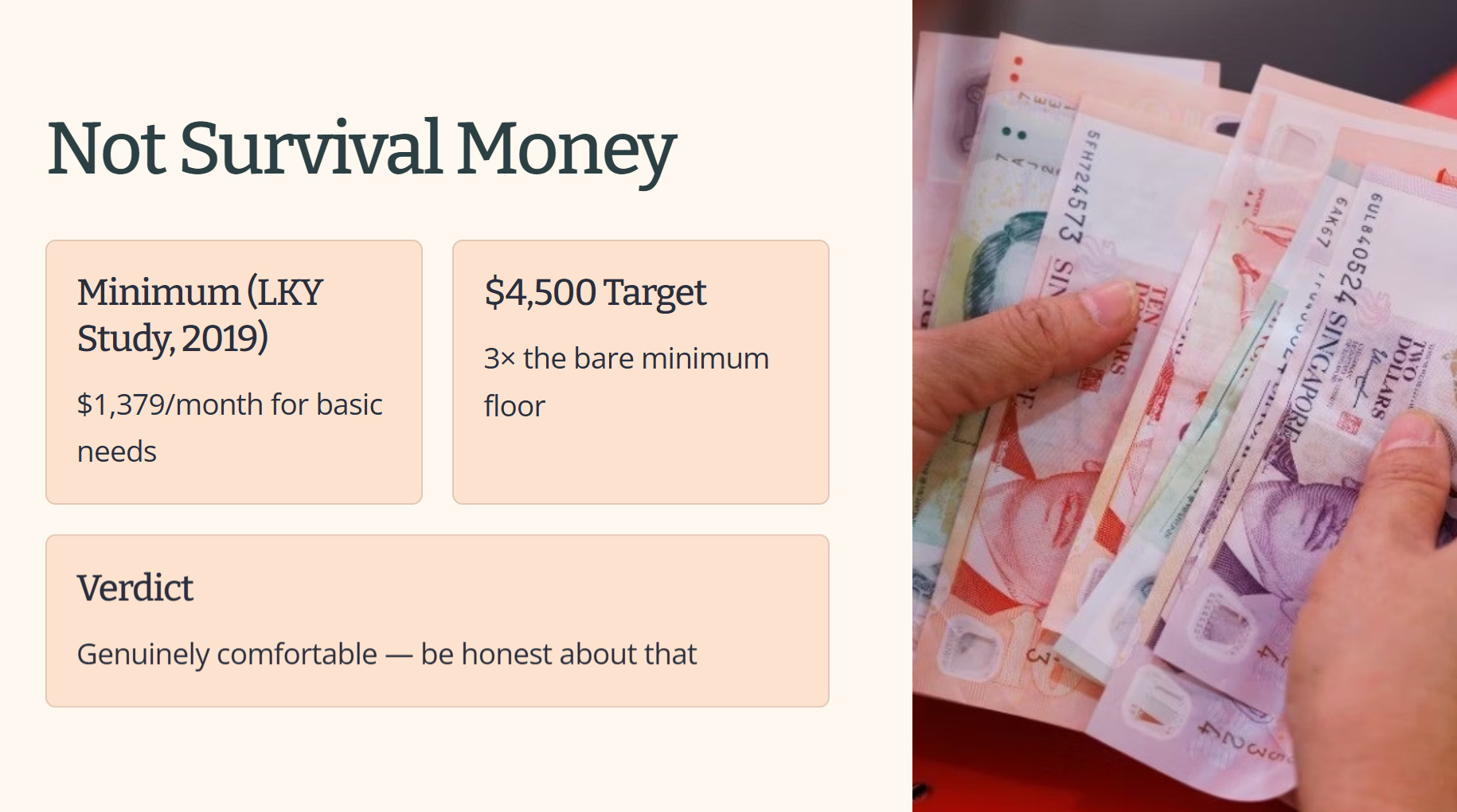
That framing matters, because $4,500 a month is not a bare minimum figure. A 2019 Minimum Income Standard study, led by researchers at the Lee Kuan Yew School of Public Policy, found single elderly Singaporeans need $1,379 a month for basic needs, for someone without a chronic health condition. $4,500 sits a little over three times that floor. This isn’t survival money. It’s a genuinely comfortable number, and it’s worth being honest about that up front rather than letting the framing imply otherwise.
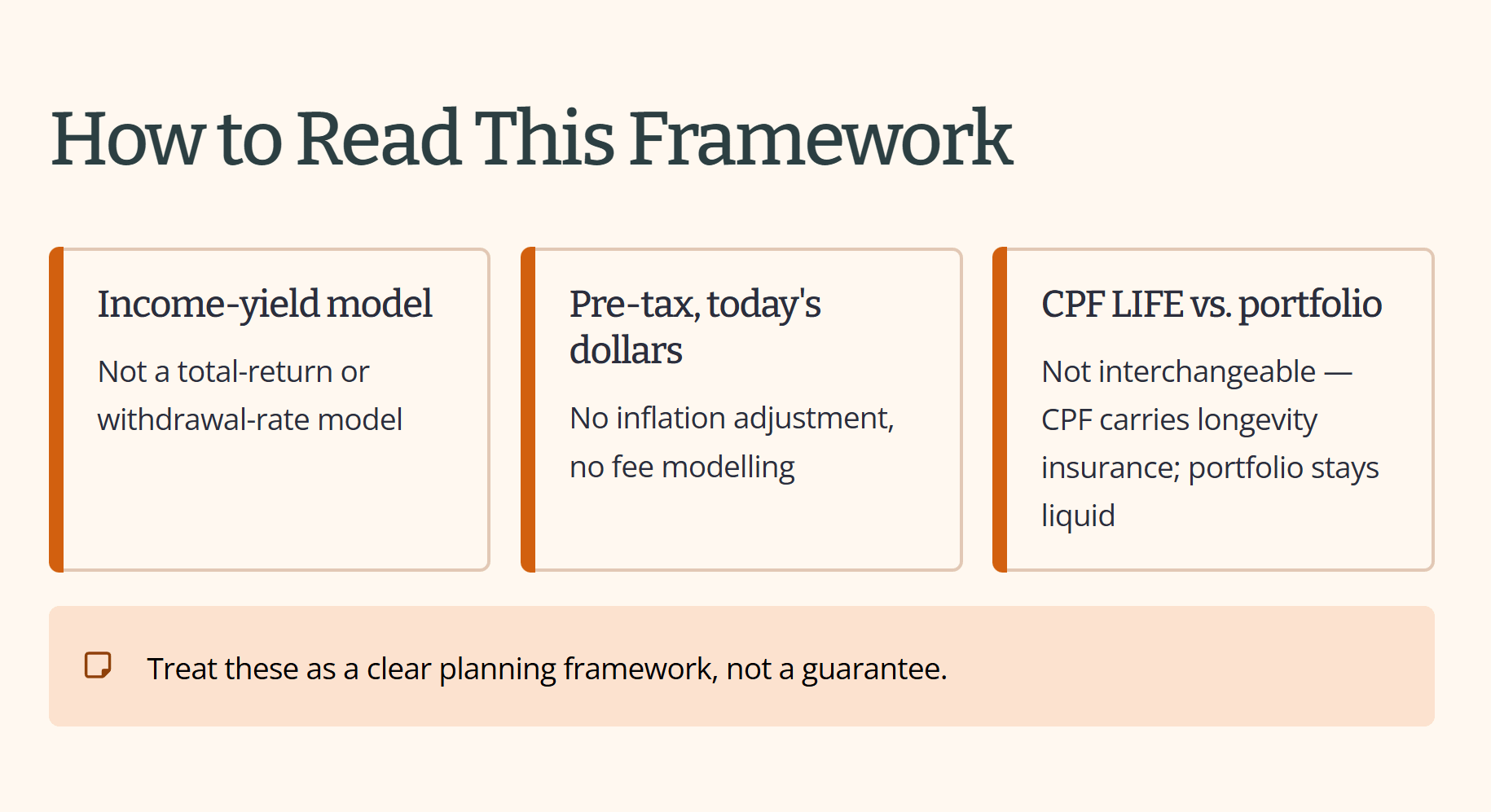
A word on how to read everything that follows. This is a simplified income-yield calculation, not a total-return or withdrawal-rate model. It’s pre-tax, stated in today’s dollars rather than inflation-adjusted, and it doesn’t account for fees, market volatility, or the order in which good and bad years happen to arrive.
CPF LIFE and a market portfolio aren’t perfectly interchangeable either, CPF LIFE carries longevity insurance and no investment risk once it starts paying, a portfolio carries neither of those but stays liquid and leaves something behind. Treat the numbers below as a clear, honest planning framework, not a guarantee.
🔒 Insight
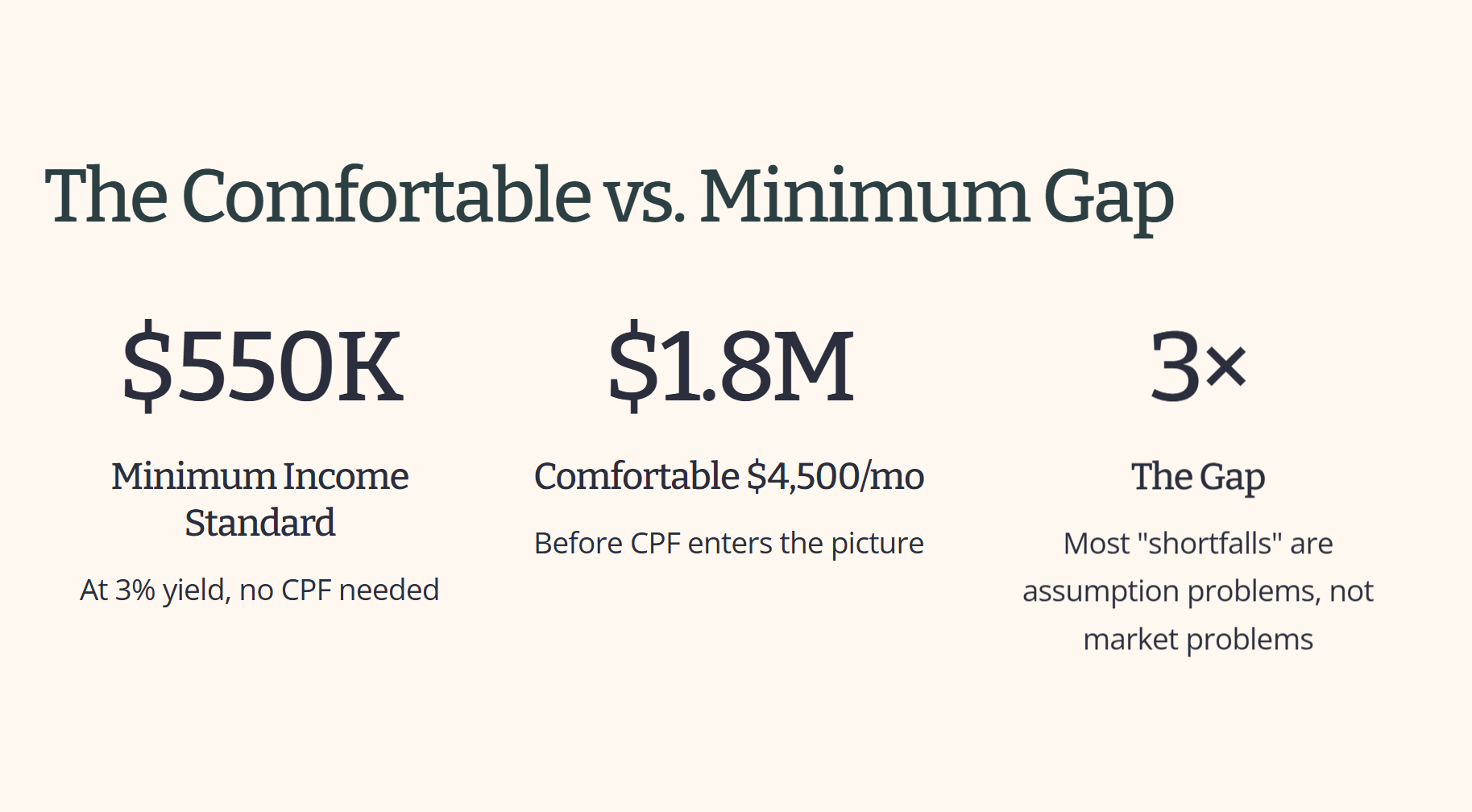
The comfortable-versus-minimum gap matters more than it looks. At the same conservative 3% low risk yield used below, a retiree targeting only the bare Minimum Income Standard, no CPF required at that level, needs roughly $550,000. Push the target to a comfortable $4,500 a month and the number more than triples, to $1.8 million, before CPF ever enters the picture. Most of what looks like a retirement shortfall isn’t a market problem or a CPF problem. It’s a gap between what a plan assumes “comfortable” means and what the household actually spends. Fix the assumption first. The arithmetic downstream of it is the easy part.
The Number Without CPF In The Picture
A comfortable $4,500 a month is $54,000 a year.
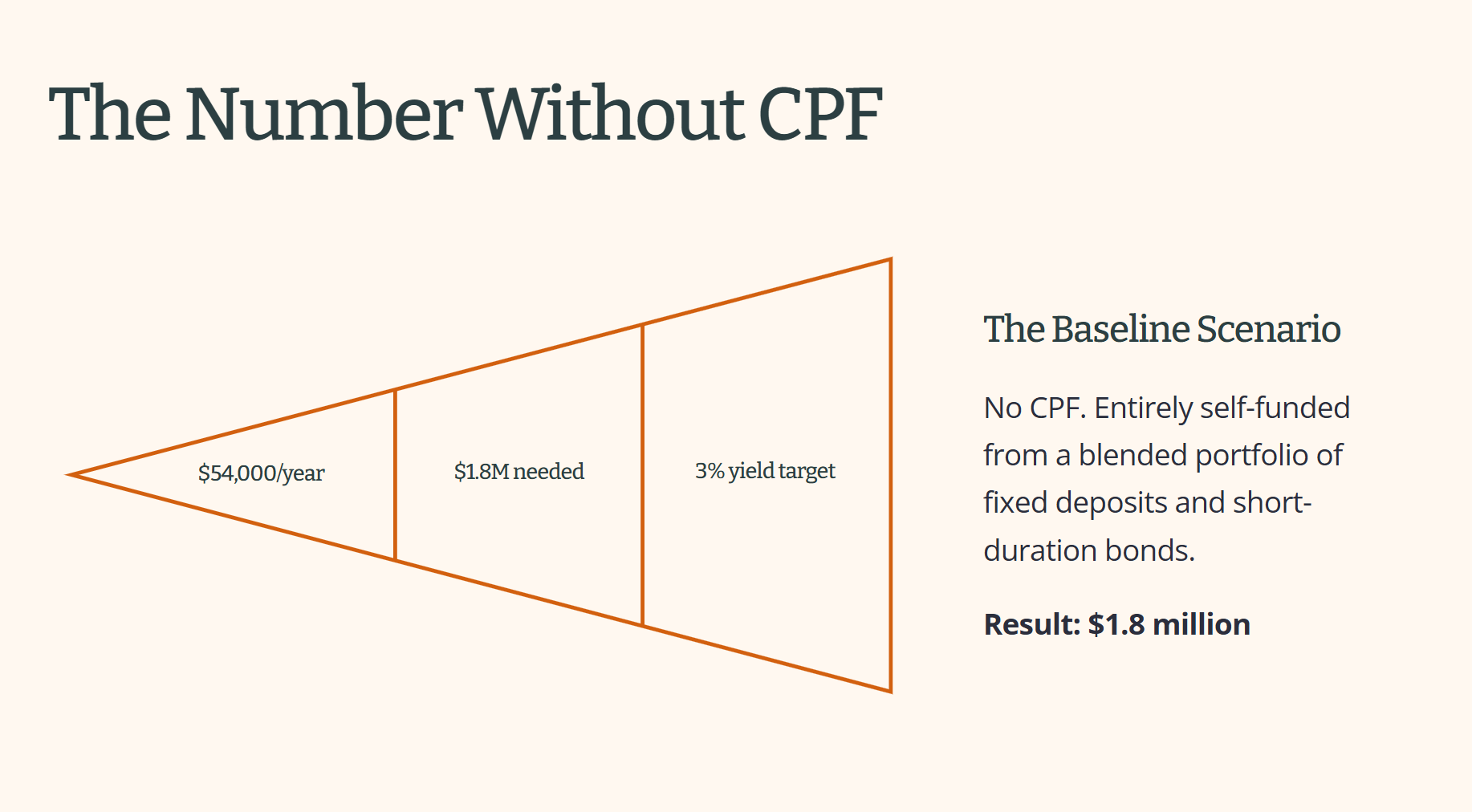
At a conservative 3% low risk yield, an illustrative assumption for a blended mix of fixed deposits and short duration bonds rather than any specific product’s actual rate, funding that entirely from a portfolio with no CPF involvement at all needs $1.8 million.
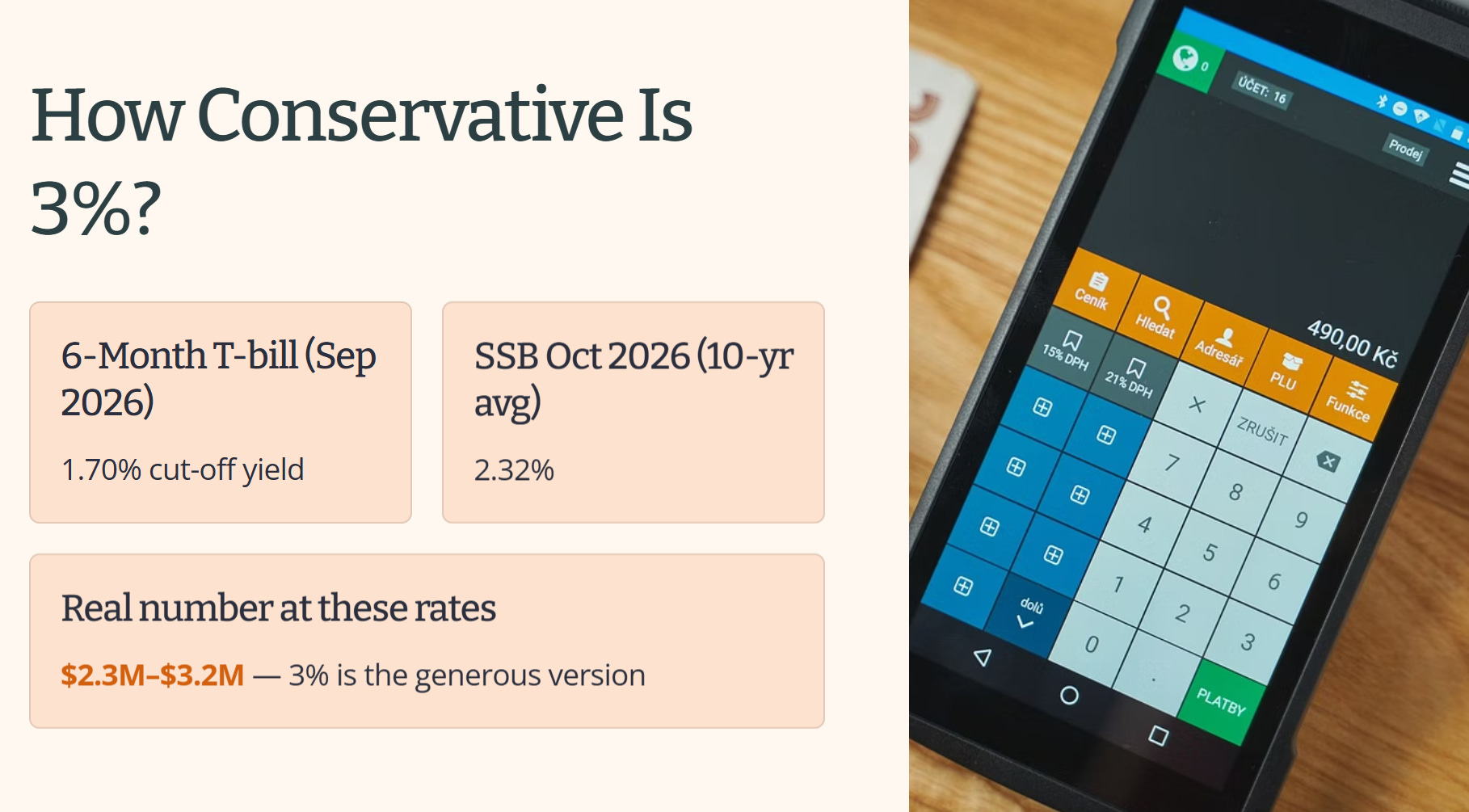
Worth being honest about how conservative that 3% actually is right now. The 6-month T-bill printed 1.70% at the 10 September 2026 auction, the highest cut-off yield of the year to that point. The Singapore Savings Bond issue for October 2026 averages 2.32% if held the full ten years. Fund this purely from either of those and the real number is roughly $2.3 million to $3.2 million, not $1.8 million. The 3% figure is the generous version of this scenario, not the realistic one.
That’s the state of doing this entirely alone. It assumes CPF, the one piece of the Singapore retirement system built specifically to turn a lump sum into guaranteed lifetime income, contributes nothing at all. It doesn’t stay that large once CPF actually gets counted.
What CPF Actually Replaces
CPF LIFE exists precisely to provide a lifetime income stream that can replace part of the portfolio income in this comparison. The obvious next question is how much of that $1.8 million CPF genuinely offsets, and the answer is not small.
The Three Numbers That Matter: BRS, FRS, and ERS
For someone turning 55 in 2026, CPF’s three retirement sum tiers come with an estimated CPF LIFE Standard Plan payout, based on 2026 cohort assumptions, level for life once it starts at age 65.
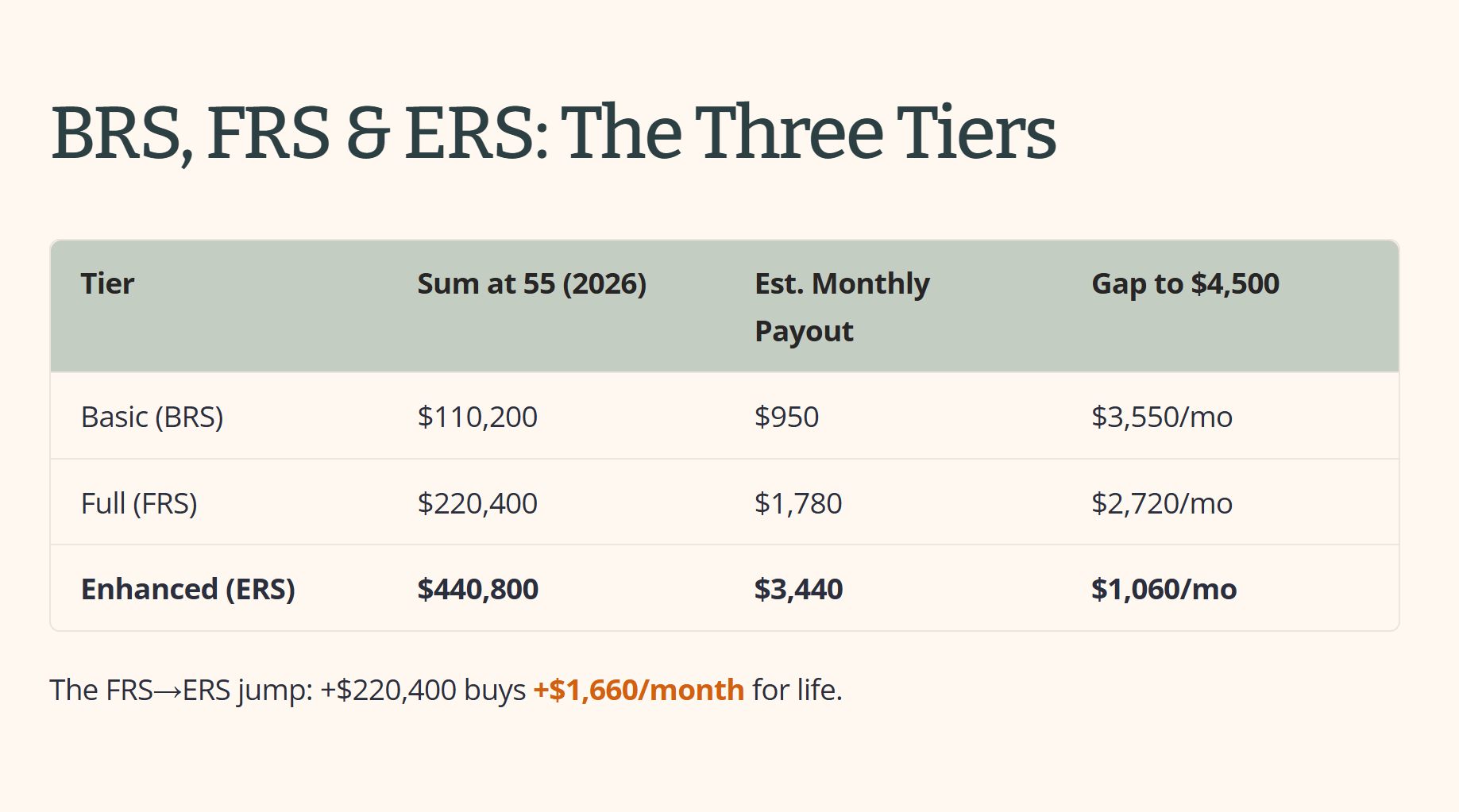
The jump from the Full Retirement Sum to the Enhanced Retirement Sum is the one worth sitting with. Committing another $220,400 to CPF buys an extra $1,660 a month, $19,920 a year. That works out to an annual payout equivalent to roughly 9.0% of the additional amount committed, delivered as estimated guaranteed income for life, not a market return that can fall.
🔒 Insight
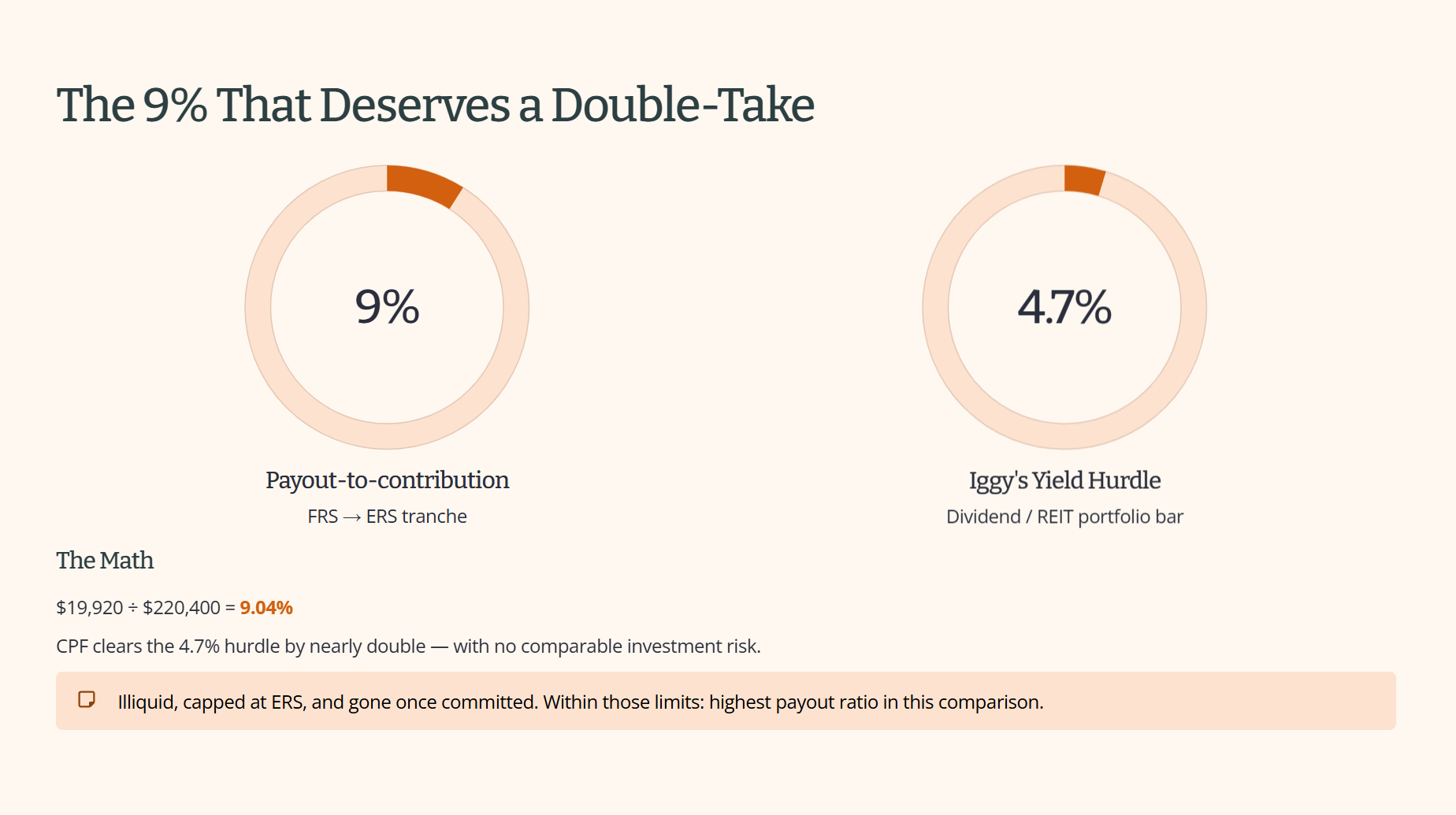
A 9% figure sounds too good to check, so check it. $220,400 buying $19,920 a year in estimated lifetime income is $19,920 divided by $220,400, which is 9.04%. My own Minimum Yield Hurdle, the bar I hold a dividend or REIT portfolio to, is 4.7%. The CPF top-up from FRS to ERS clears that bar by almost double. It isn’t free money, and it isn’t a market return in the conventional sense, there’s no comparable investment risk and no ability to sell the position. It’s illiquid, it’s capped at the Enhanced Retirement Sum ceiling, and it’s gone once it’s committed. Within those limits, it’s the highest payout-to-contribution ratio in this entire comparison.
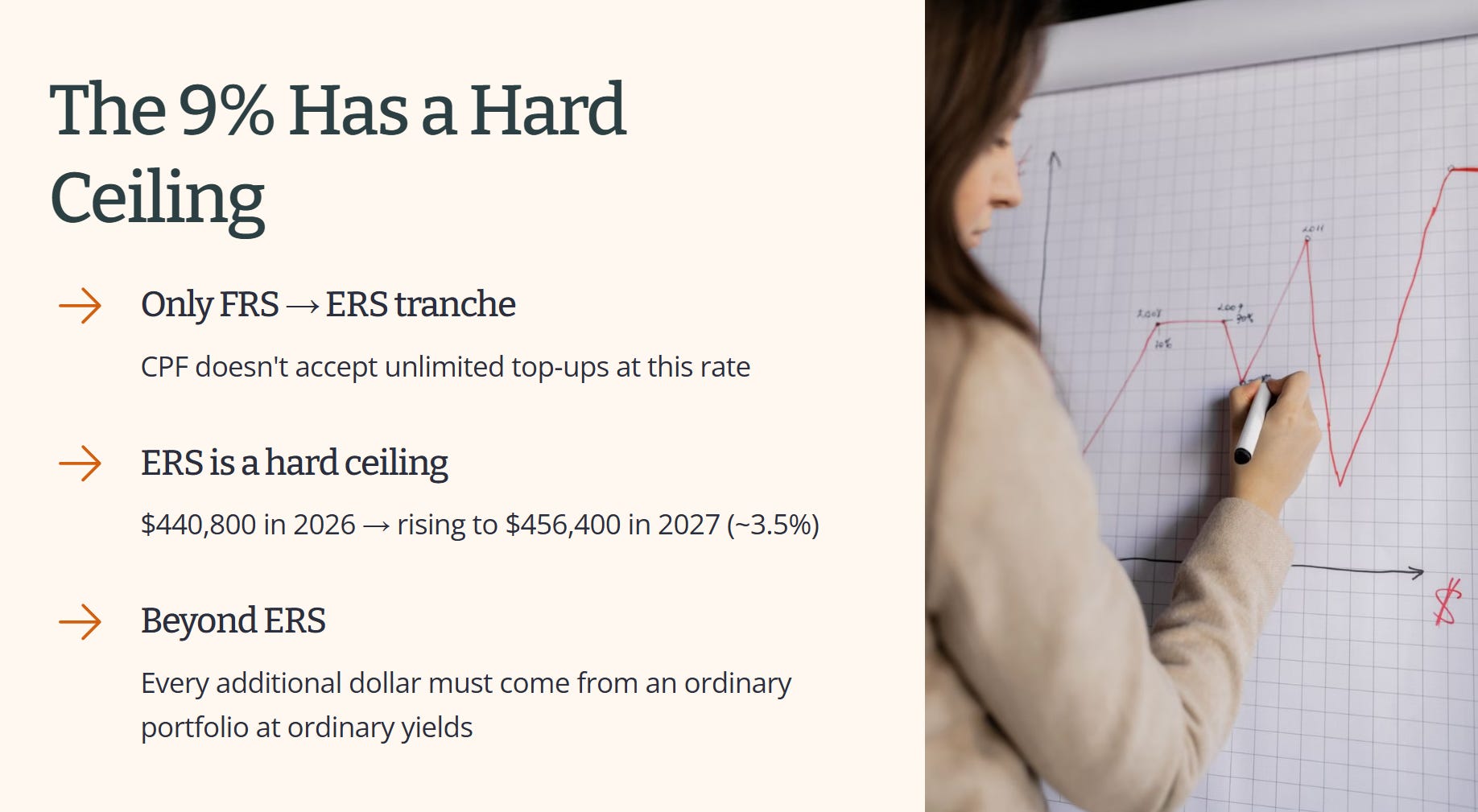
That 9% figure only applies to the specific tranche between the Full and Enhanced Retirement Sums, and it stops the moment the Enhanced Retirement Sum is reached. CPF doesn’t accept unlimited top-ups at this rate. The 2026 Enhanced Retirement Sum is a hard ceiling, not a floor, and it’s scheduled to rise to $456,400 in 2027, an increase of about 3.5% in that one year specifically, not a confirmed ongoing annual pattern. Once the ceiling is hit, every additional dollar toward $4,500 a month has to come from an ordinary investment portfolio, at ordinary investment yields.
No One Pays Him To Be Right
Every finance channel says “unbiased.” Most of them also have a sponsor, an affiliate link, or a subscriber count to protect deciding what gets softened. Iggy doesn’t. This channel started as, and still is, a passion project, not an income source.
That’s not a slogan, it’s the actual reason a Zone 4 verdict stays a Zone 4 verdict even when it’s the stock in every uncle’s portfolio.

YouTube/Substack Combo members aren’t paying for faster access to opinions that were always going to be diplomatic anyway. You’re paying for the version of this analysis that exists because it doesn’t need to please anyone: full-length videos, the complete Red Zone watchlist, and institutional-grade cheatsheets built without a single sponsor’s name attached to the verdict.
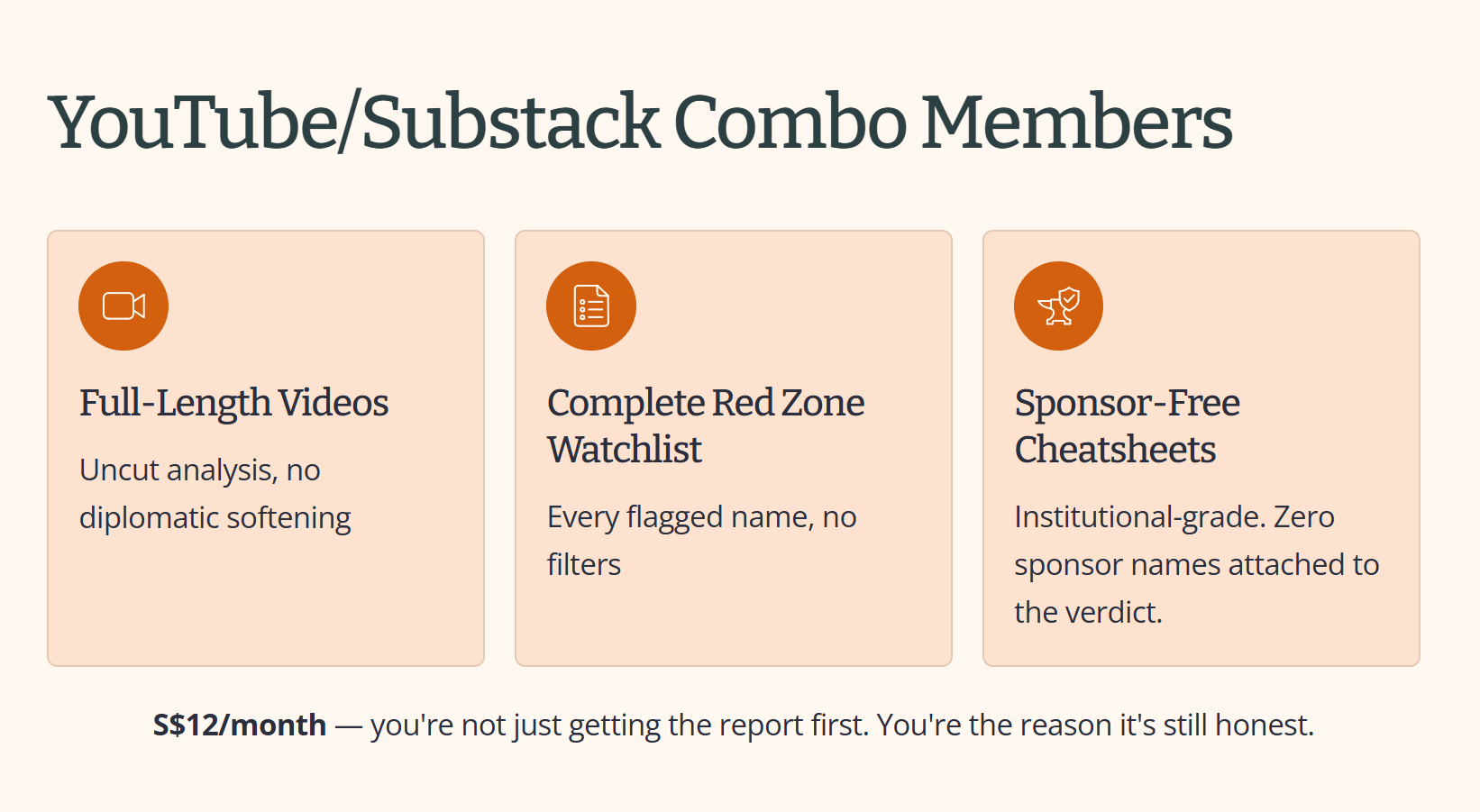
For S$12/month, you’re not just getting the report first. You’re the reason it’s still honest.
🔒 What's Next
The Enhanced Retirement Sum tranche pays close to 9%, against my own 4.7% hurdle. The next section turns that gap into the exact portfolio size needed to close it.
