




The SGX Dividend Stocks Closest to Passing My Forensic Floor (And Why None Have Cleared It Yet)
No SGX dividend stock currently clears every hard gate. These are the ones sitting nearest the line, and exactly what would need to happen for that to change.
Every income name I track on SGX right now misses this framework’s floor by at least one measure. The closest miss is 49 basis points. The furthest is well over a hundred. That gap matters more than it sounds.
I get asked some version of “what are the best dividend stocks to buy right now” more than almost anything else, and I’ve never been comfortable giving a clean list, because right now, a clean list doesn’t exist. What I can give you is something more useful, the names that are genuinely closest to clearing the bar, what’s actually standing in their way, and what a near-miss looks like compared to a real one. This isn’t a buy list. It’s a map of the gap.

One honest limit before we start.
This covers four names, the ones with recent enough data on file to make a real comparison, not a scan of every SGX dividend stock. If there’s a REIT or trust you’re holding that isn’t here, it doesn’t mean it clears the floor or fails it, it means it hasn’t been through this specific screen yet. Worth asking about directly rather than assuming either way.

Why “Best Dividend Stocks” Doesn’t Have a Clean Answer Right Now
The Closest Miss: DBS at 49 Basis Points
Second Closest, With a Real Caveat: Parkway Life REIT
What “Closest” Doesn’t Mean
What Would Actually Need to Happen
DBS: The Clock Is Already Running
Parkway Life REIT: Waiting on One Number
UOB: A Base Effect, Not a New Problem
SingTel: The Widest Gap Needs the Biggest Move
Where This Leaves You
Why “Best Dividend Stocks” Doesn’t Have a Clean Answer Right Now
The honest version of this story isn’t that SGX’s big income names are weak businesses.
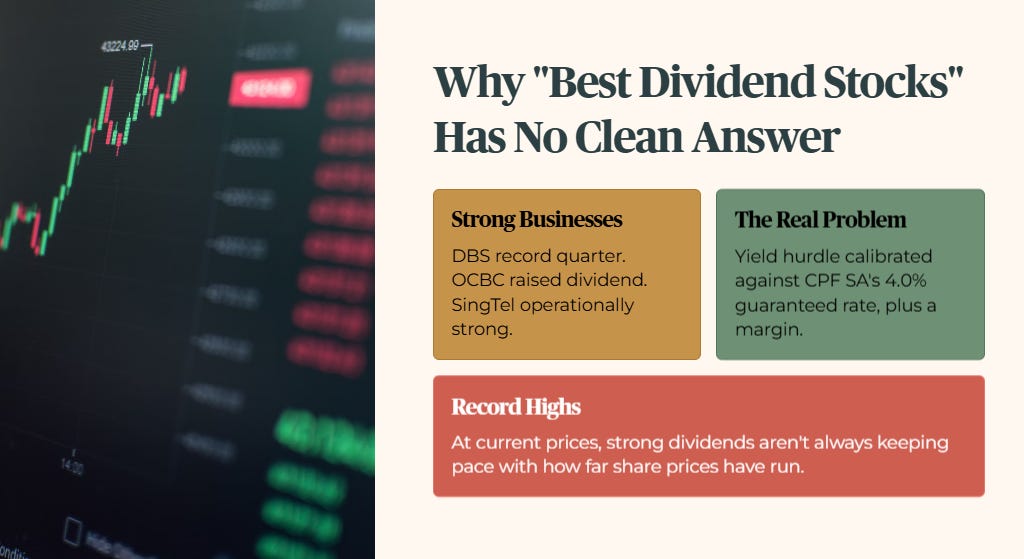
Most of them aren’t. DBS just posted a record quarter. OCBC raised its dividend. SingTel’s operating business is genuinely strong. The problem isn’t earnings quality, it’s that this framework’s yield hurdle is deliberately calibrated against CPF Special Account’s 4.0% guaranteed rate, plus a margin, as the toughest realistic benchmark available in the system. At current prices, near-record highs across the board for Singapore’s biggest names, even strong dividends aren’t always keeping pace with how far share prices have run.

That’s not a flaw in the framework. It’s the framework doing exactly what it’s built to do. But it does mean that right now, “best dividend stocks” and “stocks that actually clear the floor” are two different questions, and this piece is about the second one.
Here’s where things actually stand, all figures as at their most recently confirmed results:
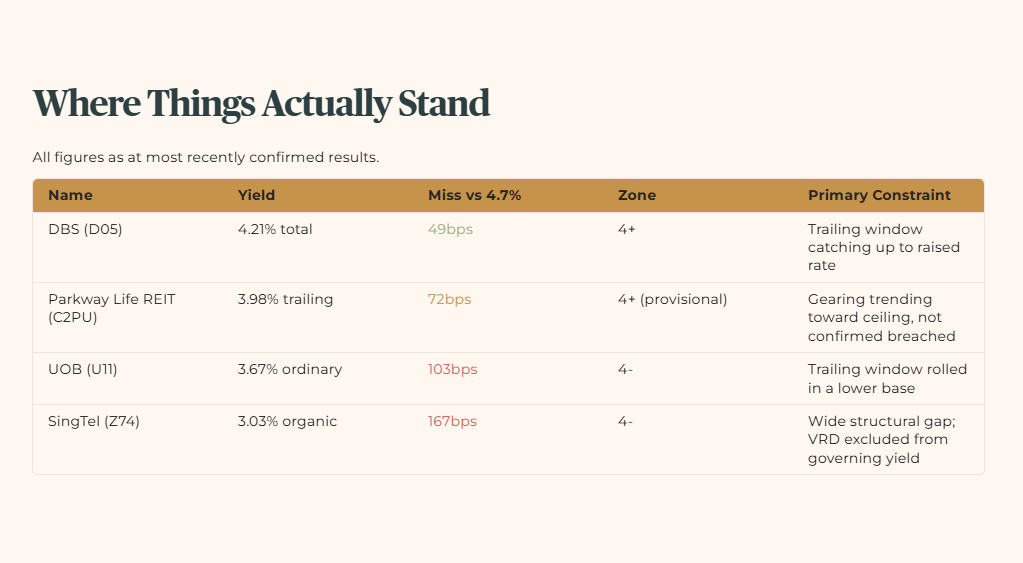
The table alone tells you something the individual headlines don’t: one name sits inside a 50-basis-point band of actually clearing the bar, a second sits close behind it, and the remaining two are meaningfully further out. That gap is the difference this piece is really about.
The Closest Miss: DBS at 49 Basis Points
DBS is currently the narrowest miss on the board.
At a share price of S$75.57, trailing ordinary dividend per share works out to a 3.41% yield, and trailing total yield, including the ongoing capital return, comes to 4.21%.
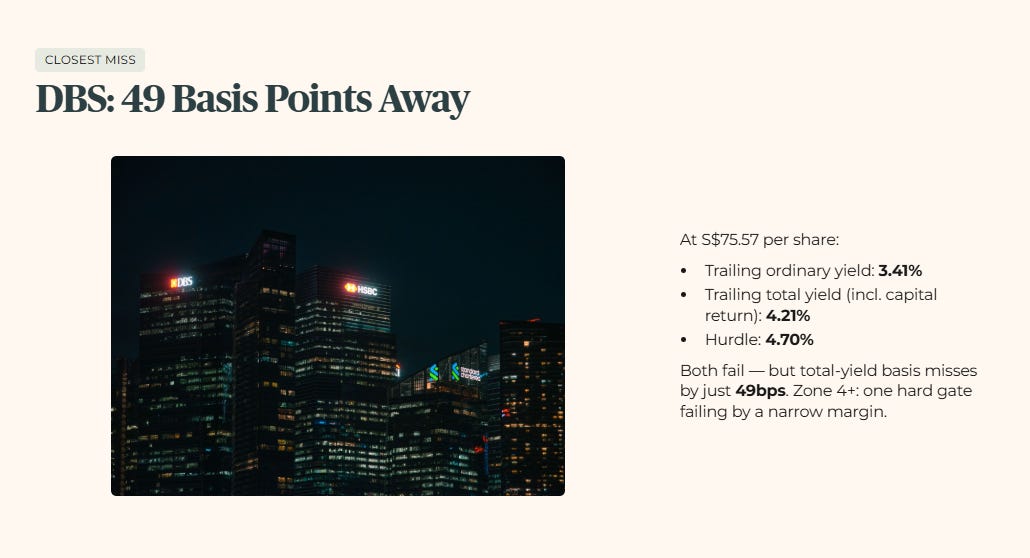
Both fail the 4.7% hurdle, but the total-yield basis misses by just 49 basis points, narrow enough that this framework’s suffix system marks it Zone 4+, one hard gate failing by a narrow margin, rather than a wider miss.
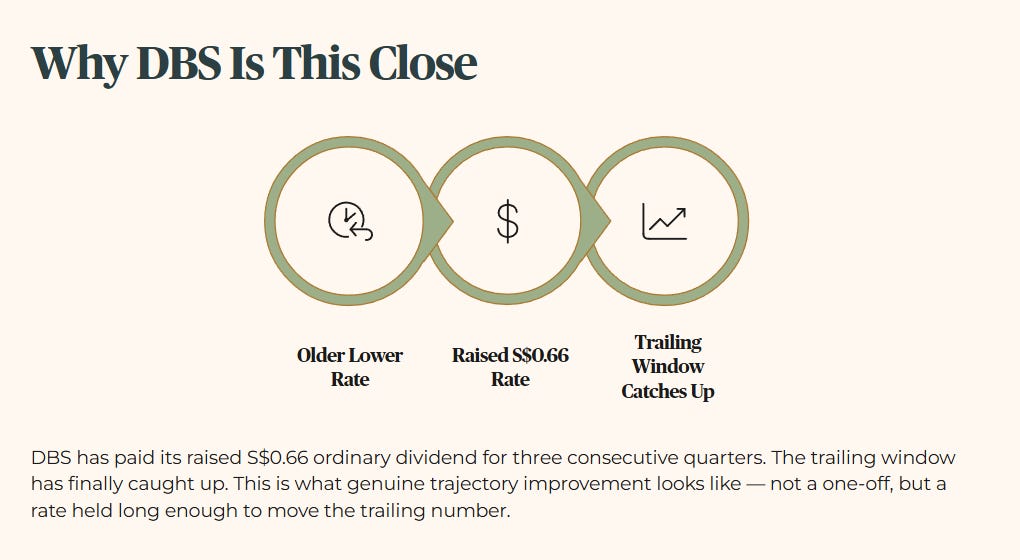
The reason it’s this close isn’t a new announcement. DBS has now paid its raised S$0.66 ordinary dividend for three consecutive quarters, and the trailing twelve-month window has finally caught up to that raise. A year ago, the same calculation would have mixed in an older, lower quarterly rate and missed by more. This is what a genuine trajectory improvement looks like inside this framework, not a one-off, but a rate that’s held long enough to actually move the trailing number.
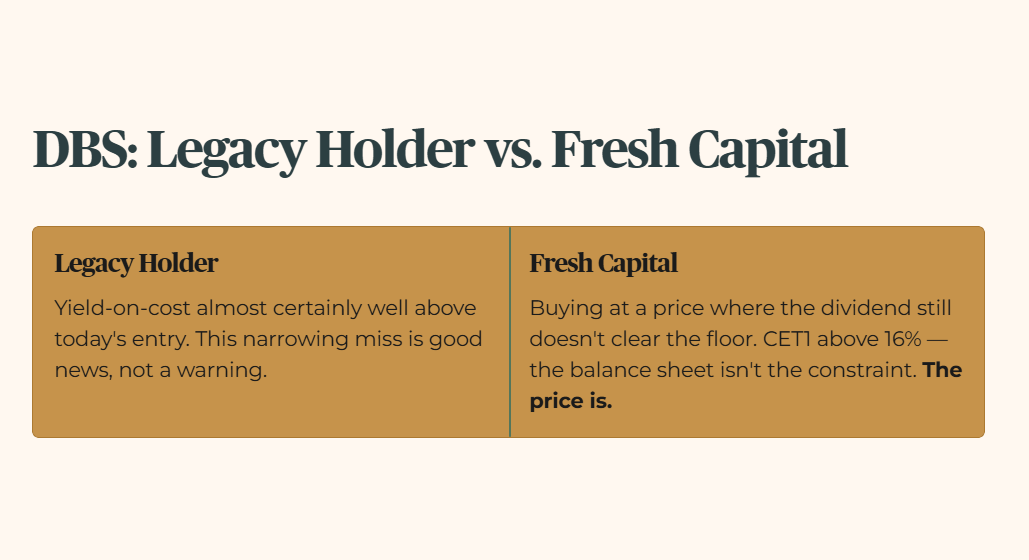
If you’re a Legacy Holder who bought DBS before this raise took effect, your yield-on-cost is almost certainly well above what a fresh buyer sees today, and this narrowing miss is good news for your position, not a warning.
If you’re considering fresh capital, you’re buying in at a price where the dividend, even after three quarters of a raised rate, still doesn’t quite clear this framework’s floor, and CET1 sitting comfortably above 16% tells you the balance sheet isn’t the constraint here, the price is.
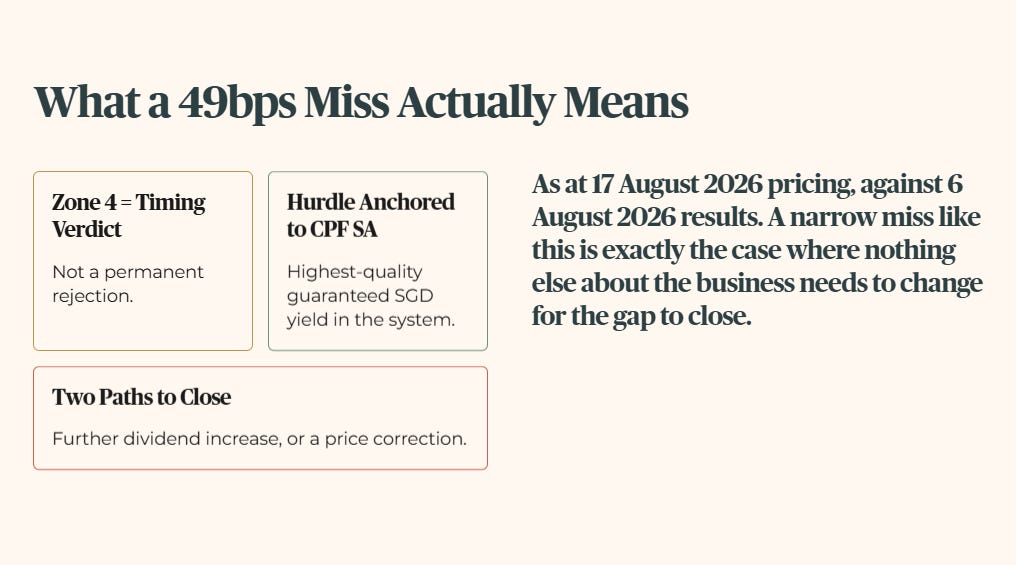
It’s worth being direct about what a 49-basis-point miss actually means. This framework treats Zone 4 as a timing verdict, not a permanent rejection. The 4.7% hurdle is benchmarked against the highest-quality guaranteed SGD yield in the system, CPF SA, not framed as a literal redirect option for every reader’s specific capital. A narrow miss like this one is exactly the kind of case where a further dividend increase, or a price correction, could close the gap without anything else about the business needing to change. As at 17 August 2026 pricing, against the 6 August 2026 results.
Second Closest, With a Real Caveat: Parkway Life REIT
Parkway Life REIT sits close behind DBS, with a trailing yield of 3.98% at a unit price of S$4.12, a 72-basis-point miss against the 4.7% hurdle.
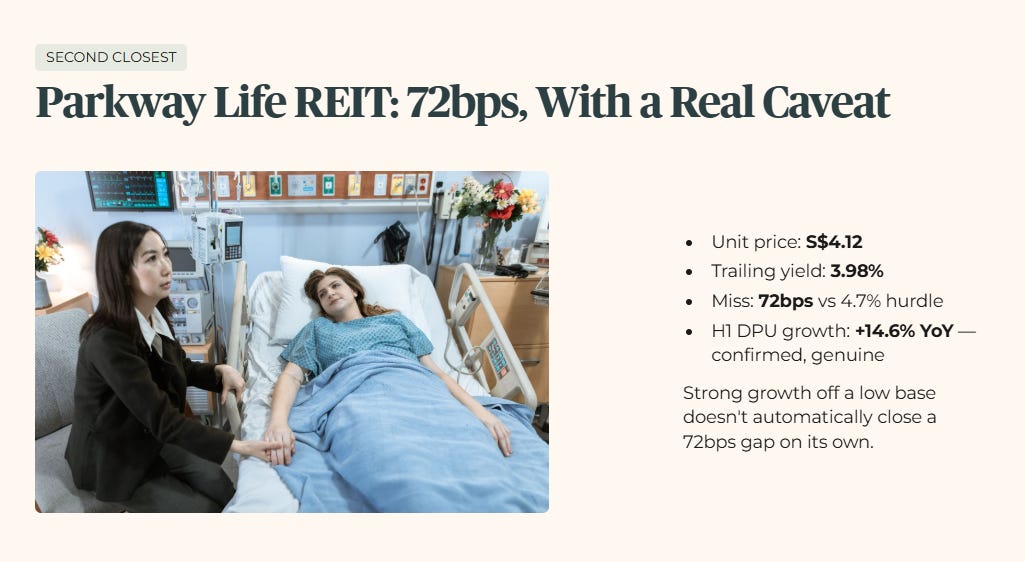
That’s a wider gap than an earlier forward-looking estimate on this name suggested, the difference between annualising a strong first-half distribution and using the actual trailing twelve-month payout, and the trailing figure is the more conservative, more current read. First half DPU growth this year was genuinely strong, up 14.6% year on year, and that’s a real, confirmed number from the trust’s own results, but strong growth off a low base doesn’t automatically close a 72-basis-point gap on its own.
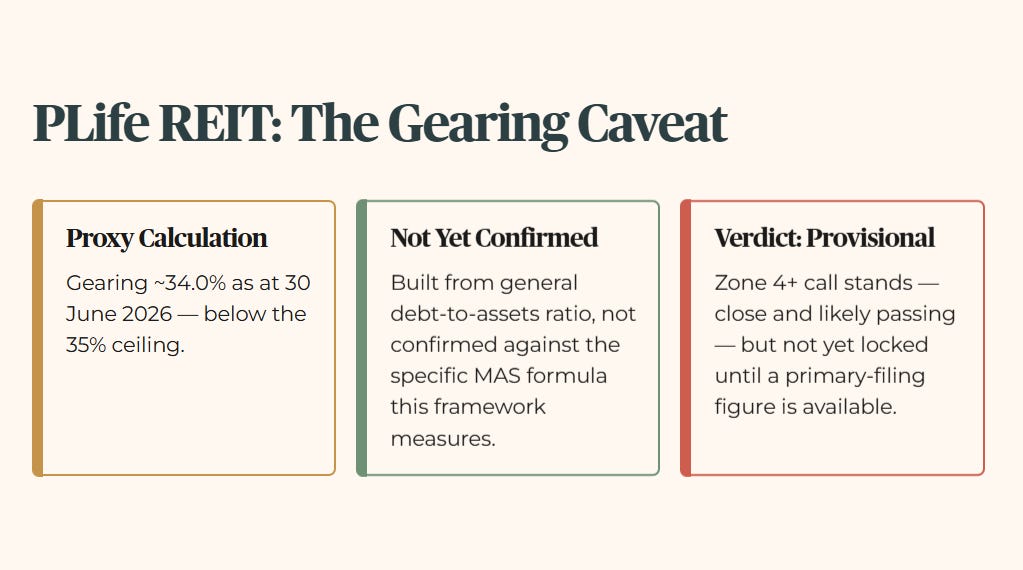
Here’s the caveat that matters. A proxy calculation puts gearing around 34.0% as at 30 June 2026, still below the 35% ceiling, consistent with the trajectory already on file, creeping up but not yet crossing. That’s more reassuring than an earlier, unverified pass on this name had suggested, but it’s still not the confirmed figure on this framework’s exact basis. Until a primary-filing number is available, treat this Zone 4+ call as provisional on gearing specifically, close and likely still passing, but not yet locked.
What “Closest” Doesn’t Mean
It’s worth being precise about what separates a 49-basis-point miss from a real structural gap, because not every “Zone 4” name is failing by the same margin, and collapsing that distinction is exactly the kind of thing this framework’s suffix system exists to prevent.
SingTel currently misses the hurdle by 167 basis points on its core organic yield basis, more than three times DBS’s gap, and that reading holds even before stripping out the value realisation dividend component from its headline payout.
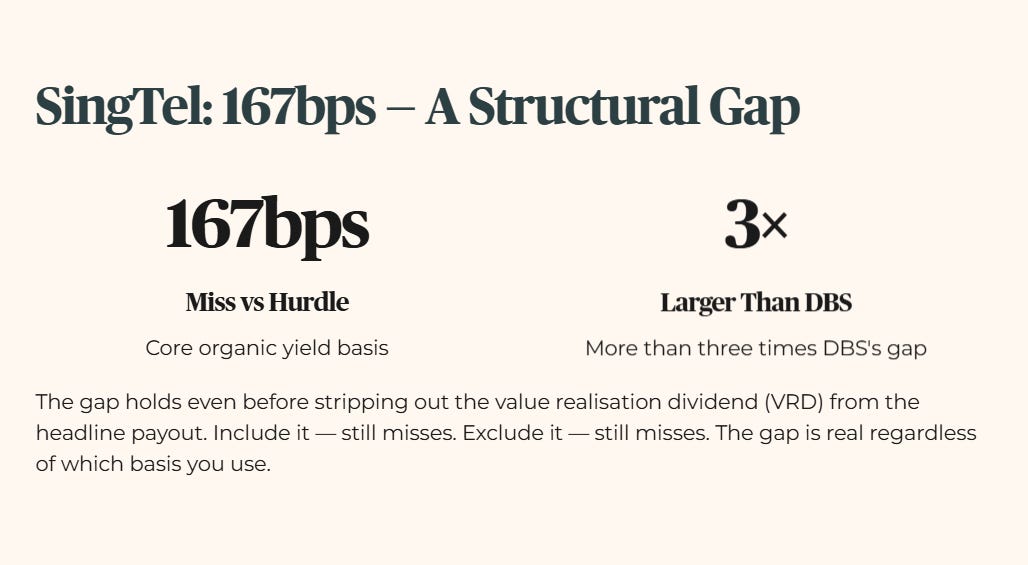
Include that component and the headline yield still misses, just by a narrower margin, which tells you the gap isn’t an artifact of how the yield is calculated, it’s real regardless of which basis you use.
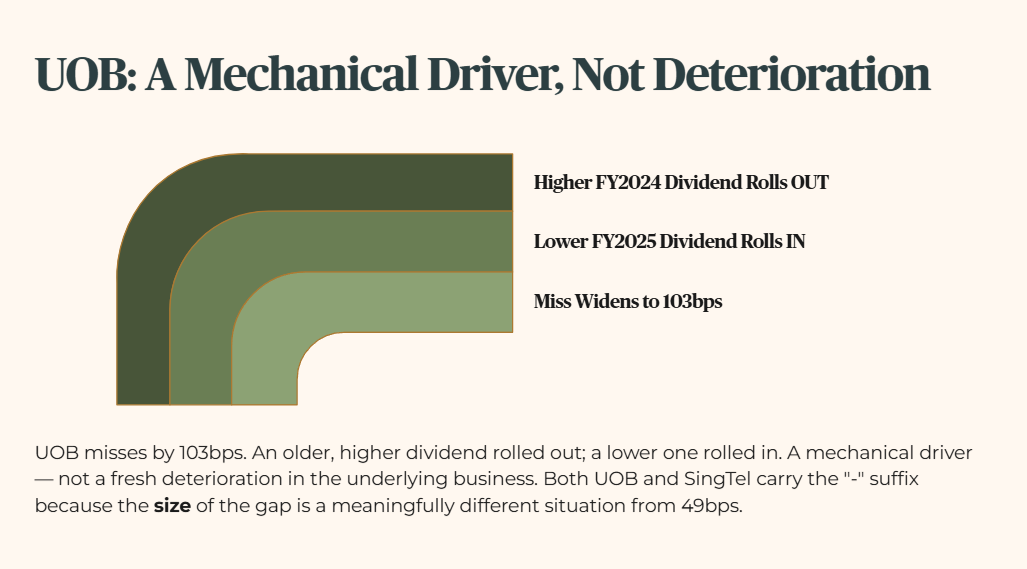
UOB’s most recent read misses by 103 basis points, driven by trailing-window mechanics as an older, higher dividend rolled out of the calculation and a lower one rolled in, a mechanical driver rather than a fresh deterioration in the business itself. Both of these get the “-” suffix under this framework, not because the underlying businesses are in worse shape than DBS, SingTel’s operating performance this quarter was genuinely strong, but because the size of the yield gap itself is a meaningfully different situation from a 49-basis-point miss.
The 49-basis-point and 167-basis-point gaps share the same zone number. The calculation that separates a timing verdict from a structural gap comes next.
