



The Share Price Fell. Did Your Dividend? Three Questions Before You Read Anything Into the Red 🦖
A falling price does not tell you what the company paid or what it can afford to pay. Three questions separate the price from the payout, with made-up numbers throughout.
Open your brokerage app on a red day and the first thing you see is a loss. It sits beside your holding in red, in a bigger font than anything else, and it is easy to read it as the number that matters most.
The dividend, the number that pays for groceries and the utilities bill, is somewhere else. Nothing on that screen says whether it moved.
If you already own a share or a trust that has dropped, the practical question is whether your income changed. If you are looking at the same fall as a possible way in, the question is what the lower price is telling you. I am not a market analyst, I take no view on where prices go next, and I do not know what you own. Every figure below is invented, so the piece works on any red day and none of it describes a real company.
What This Piece Does
It separates two numbers that share one screen, the price and the payout, and shows why the yield moves when only the price does.
It works through three questions: did the payout change, did what pays for it change, and what do you need the income for.
It uses a made-up company, Company A, for every example, and says so each time.
The sections on the price, the yield and the first two questions are free to read. The table showing what a payout cut looks like beside a price fall, the third question and the red-day record to keep are in the members’ half. Nothing here is advice on your own holdings, and no example is your figure.

What This Piece Does
Two Numbers on One Screen
The price is what the last buyer paid
The yield joins them
A higher yield can mean two different things
The objection
Question 1: Did the Payout Change?
Find the amount, the type and the period
Compare like with like
What a red price does not undo
Question 2: Did What Pays for It Change?
Earnings against the payout
Cash and borrowings
What the two answers say together
What the Screen Cannot Tell You
Question 3: What Do You Need the Income For?
Spend it or reinvest it?
The gap and the price
The objection
The Red-Day Record
Iggy’s Forensic Read
Two Numbers on One Screen
The price is what the last buyer paid
A share price is the level at which a buyer and a seller last agreed to trade. It changes every few seconds while the market is open, and it reflects what people think about the future as well as the present.
The dividend is a different kind of number. It is declared by the company’s board, or by a trust’s manager, a few times a year, out of earnings and cash. It is a decision with a date and an amount. The two numbers sit on the same screen, but they are set by different people for different reasons.
The yield joins them
Most screens work out the yield as the payments of the past twelve months divided by the current price. Take a made-up company, Company A. It paid SGD 0.20 a share in total over the past year, and its price is SGD 4.00, so the yield is 5.0%. Here is what happens if only the price moves.
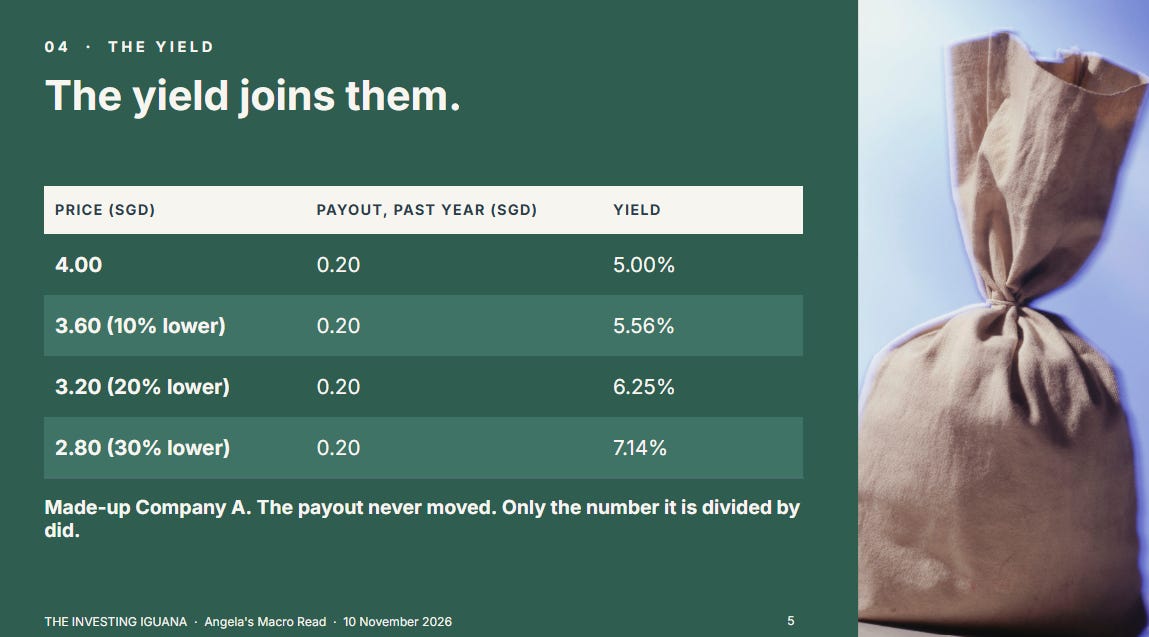
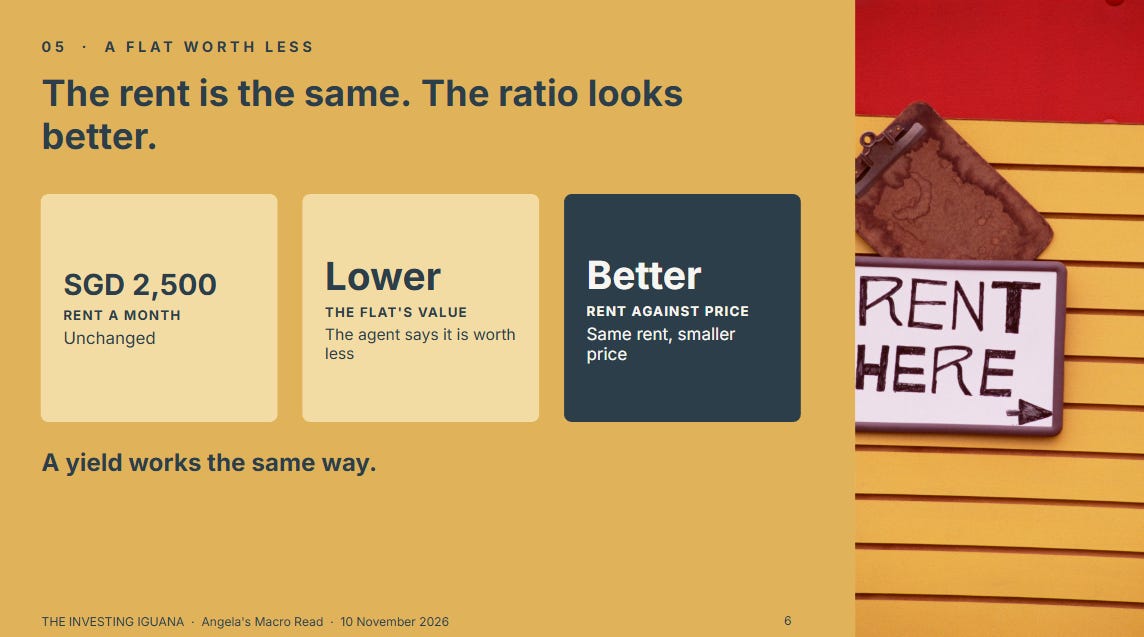
Nothing about Company A changed in that table. It paid the same SGD 0.20 each time, and the yield rose only because the number it is divided by got smaller. If your tenant pays SGD 2,500 a month on a flat and an agent tells you the flat is now worth less, the rent is still SGD 2,500. The rent compared with the price just looks better.
A higher yield can mean two different things
A higher yield after a fall has at least two explanations, and the screen does not say which one applies. In the first, buyers are simply less willing to pay for the company right now, for reasons that have nothing to do with its dividend. In the second, buyers doubt that the payout will continue at the same level, and the price is falling ahead of a decision they expect. The yield figure looks identical in both cases.
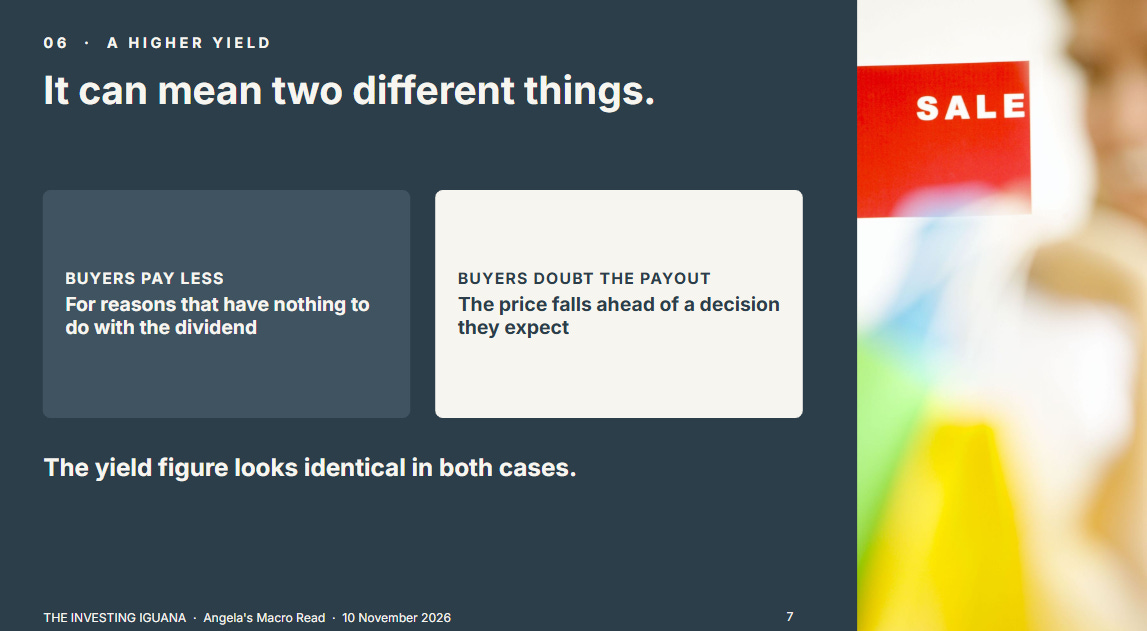
That is why the rest of this piece looks at the payout and what pays for it, and not at the price.
The objection
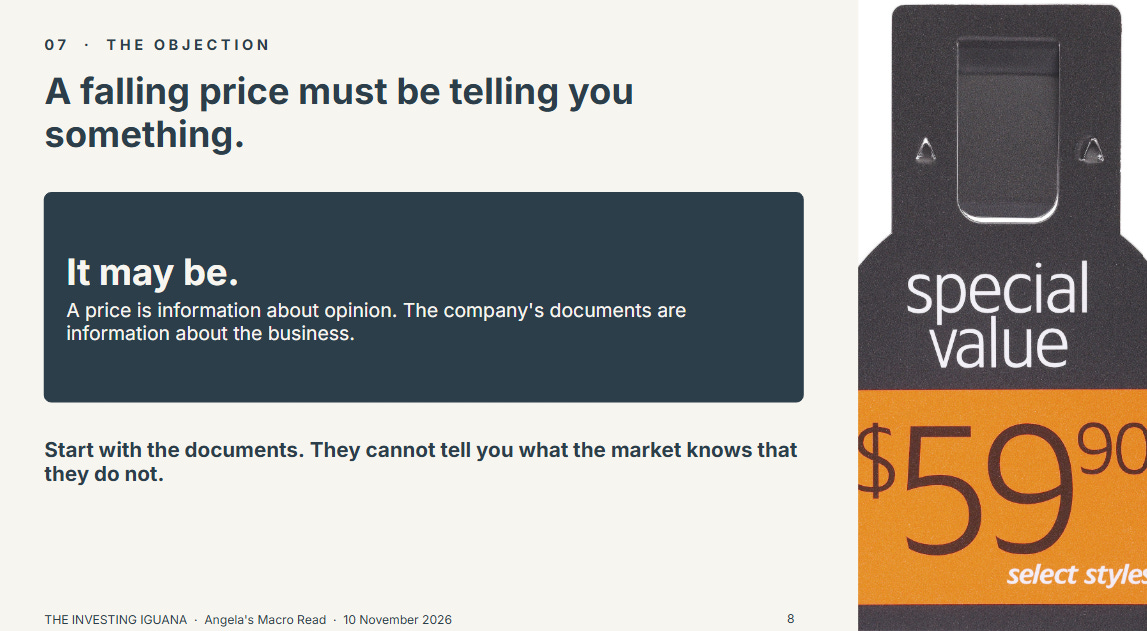
The objection I expect is that a falling price must be telling you something. It may be. A price is information about opinion, and the documents the company published are information about the business. When the two seem to disagree, the documents are where I would start, though they are not the end of the matter, and they cannot tell you what the market knows that the documents do not.
Question 1: Did the Payout Change?
Find the amount, the type and the period
Open the company’s latest results announcement or dividend announcement and find three things. The amount per share, or per unit for a trust. Whether it is ordinary or special. And which period it covers. A company that pays a special dividend one year and none the next has not necessarily cut anything it promised, and a company that declares an interim and a final payout has two numbers to add, not one.
Compare like with like
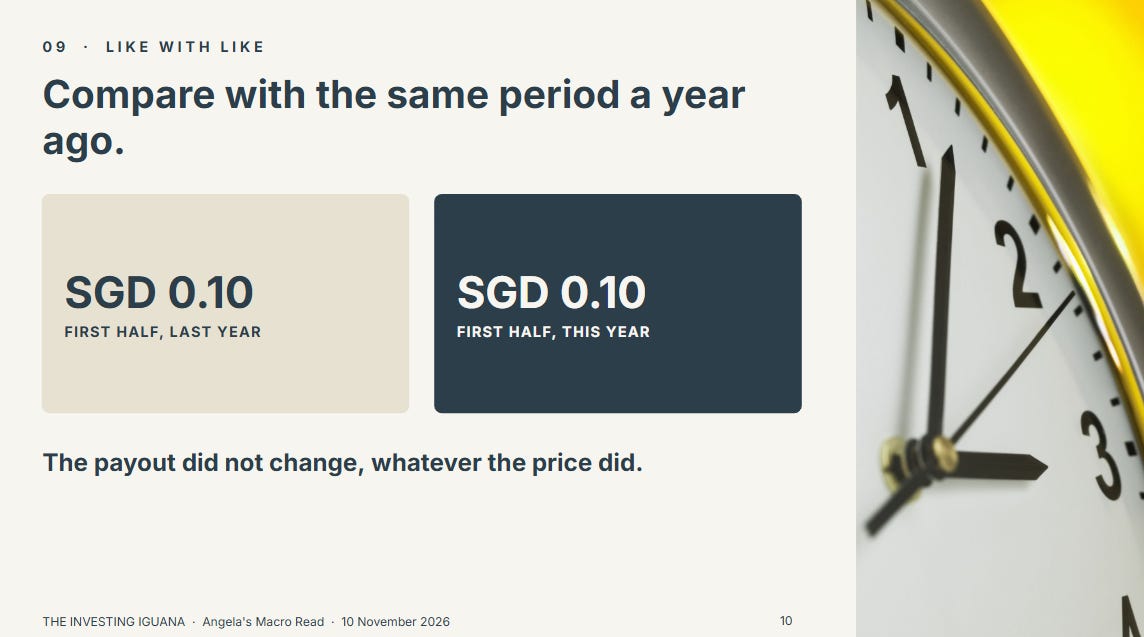
Compare the new payout with the one for the same period a year ago, and not with the one before it. Companies that pay twice a year often have a bigger final than interim, and trusts that pay each quarter may have a seasonal pattern. Say Company A declared SGD 0.10 for the first half last year and SGD 0.10 for the first half this year. The payout did not change, whatever the price did.
What a red price does not undo
A dividend that has been declared, and whose books-closing date has passed, has been decided. A price that falls afterwards does not take it back. If the first question comes back unchanged, the red price on that day tells you what buyers will pay, and nothing about the payout that was already declared.
Question 2: Did What Pays for It Change?
A payout that is unchanged can still rest on something weaker than it did last year. The second question is whether what pays for it moved.
Earnings against the payout
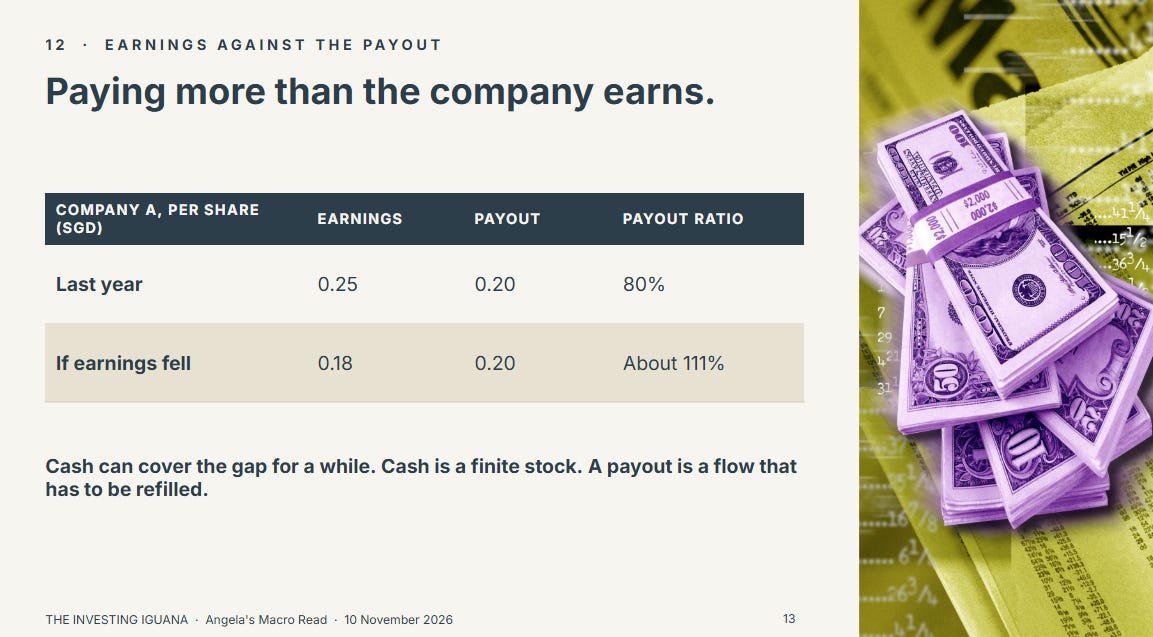
Company A earned SGD 0.25 a share over the year and paid SGD 0.20. That is a payout ratio of 80%: for every SGD 1.00 earned, SGD 0.80 went out. If earnings fell to SGD 0.18 a share and the payout stayed at SGD 0.20, the payout would be about 111% of earnings. A company can do that for a while from cash it has already built up, but cash is a finite stock, and a payout is a flow that has to be refilled.
For a trust, the matching figure is the income available for distribution per unit. For a bank, capital adequacy matters as well, and the results announcement states the relevant ratios.
Cash and borrowings
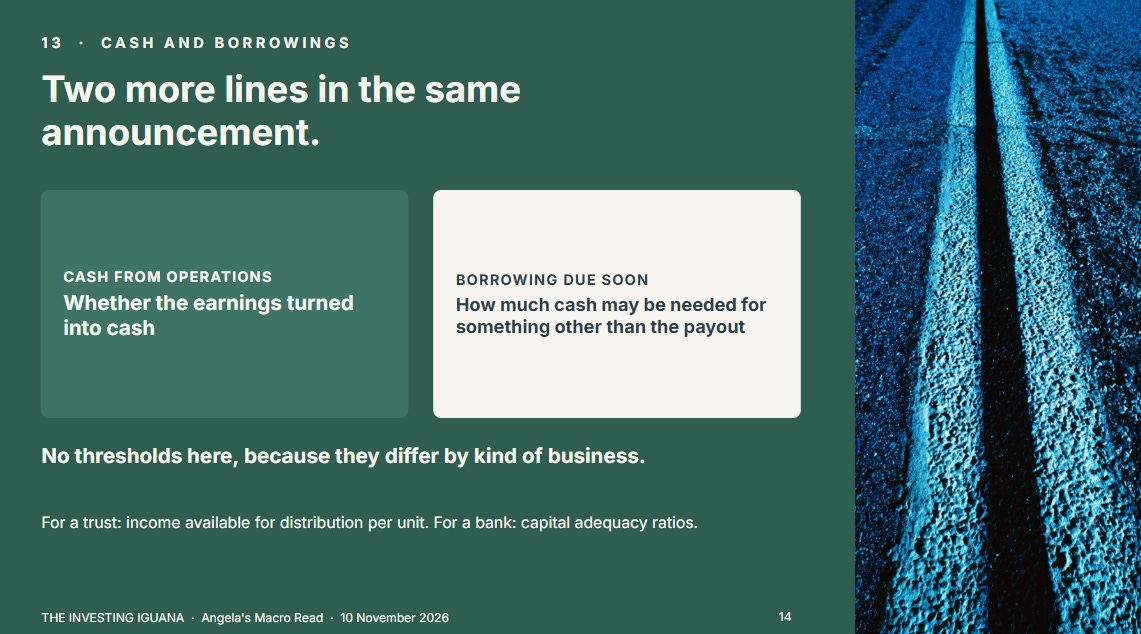
Two other lines in the same announcement help. Cash generated from operations tells you whether the earnings turned into cash. The amount of borrowing that falls due in the next year or two tells you how much of that cash may be needed for something other than the payout. I do not give thresholds for either here, because they differ by kind of business, and a figure that is normal in one sector can mislead in another.
What the two answers say together
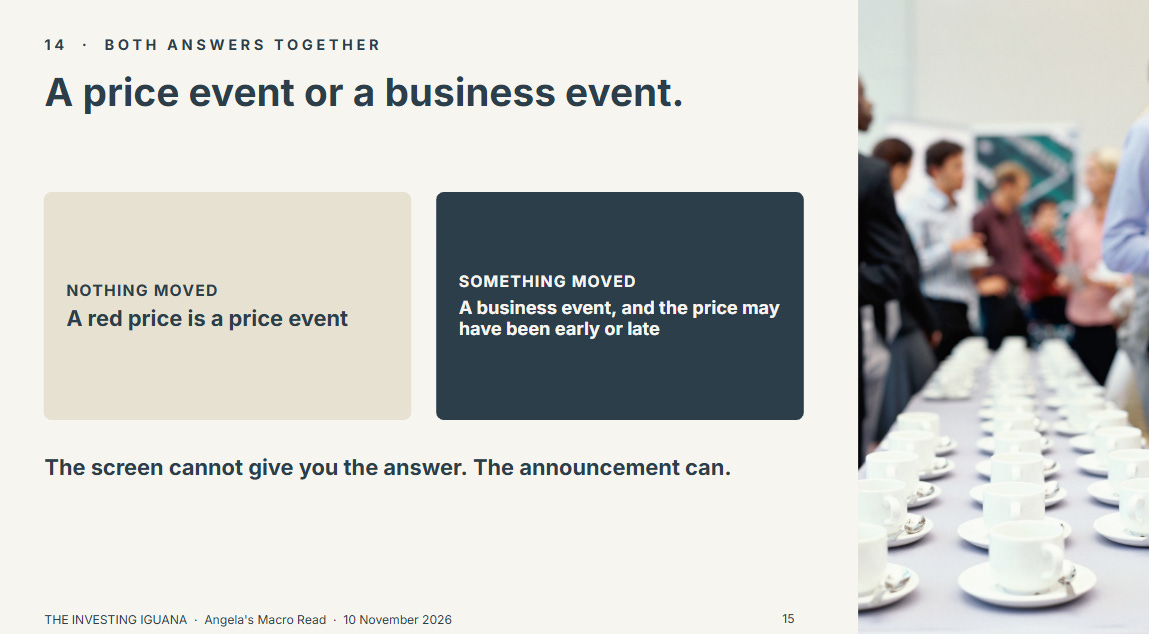
If the payout and what pays for it have both stayed where they were, a red price is a price event. If either has moved, it is a business event, and the price may have been early or late in telling you. Either way, the screen cannot give you the answer, and the announcement can.
🟠 Angela’s Observation
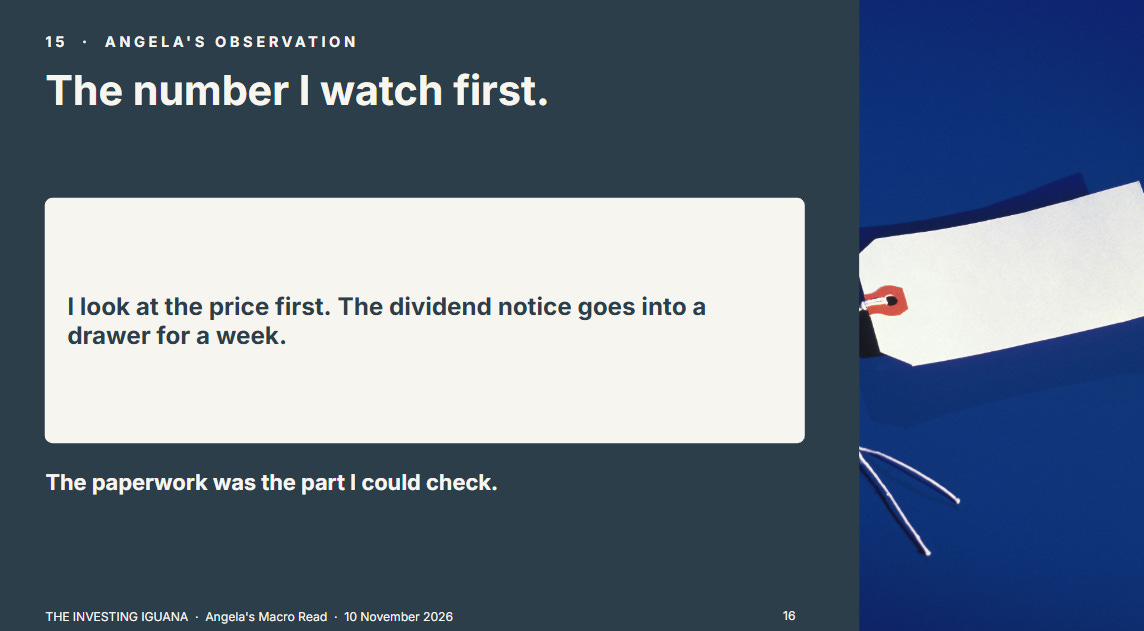
On a red day I notice that I look at the price before I look at anything else. The dividend notice, when it comes, goes into a drawer for a week, and when I do read it I look at the amount and nothing around it. For a long time I thought of the price as the news and the dividend as the paperwork. It took me a while to see that the paperwork was the part I could check, and the price was the part everyone else could see. Which of the two am I actually watching when I open the app, and which one pays for my groceries?
🔒 What’s Next
The yield on the screen reads 6.25% at the lower price, and Company A’s payout has not moved. Here is what that same figure becomes when the payout is trimmed by a quarter and the price falls by the same fifth.
This piece is free to read in full. If you would like the next one in your inbox, subscribe for free below