Editor’s Note: This post has been updated on October 21, 2025, to ensure our analysis is fresh and accurate. It now includes an expanded look at the trade war’s specific impact on the Malaysian market (Bursa Malaysia) and new, actionable advice for Singaporean CPF & SRS investors.
You’ve been watching the trade war drama unfold all year. The back-and-forth tariffs seemed almost routine by now. But what happened on October 10th changed everything. China didn’t just impose another tariff - they weaponized the global supply chain itself.
For the first time, Beijing applied what experts call the “foreign direct product rule” to rare earth elements. This means any product containing even 0.1% Chinese rare earth materials now requires Beijing’s approval for export. Think about that for a second. Your smartphone, your car’s electric motor, even wind turbines - they all depend on these materials that China controls 90% of global processing for.
Trump’s response was swift and brutal. He threatened an additional 100% tariff on Chinese goods, potentially bringing total duties to 245%. Markets didn’t just stumble - they plunged. The S&P 500 dropped 2.7% in a single day, its worst performance since April.
Here’s why this matters more than previous trade spats: This time, it’s about strategic materials, not just manufactured goods.
In This Article:

• The Rare Earth Reality Check
• The Tariff Time Bomb
• Singapore’s Market Response: Winners and Losers Emerge
• The Strategic Implications
• What This Means for Your Portfolio
The Rare Earth Reality Check
China doesn’t just mine rare earths - they’ve built an entire ecosystem around them. They control the processing, the technology, and now the export rules. The numbers are staggering.
Chinese Rare Earth Market Dominance
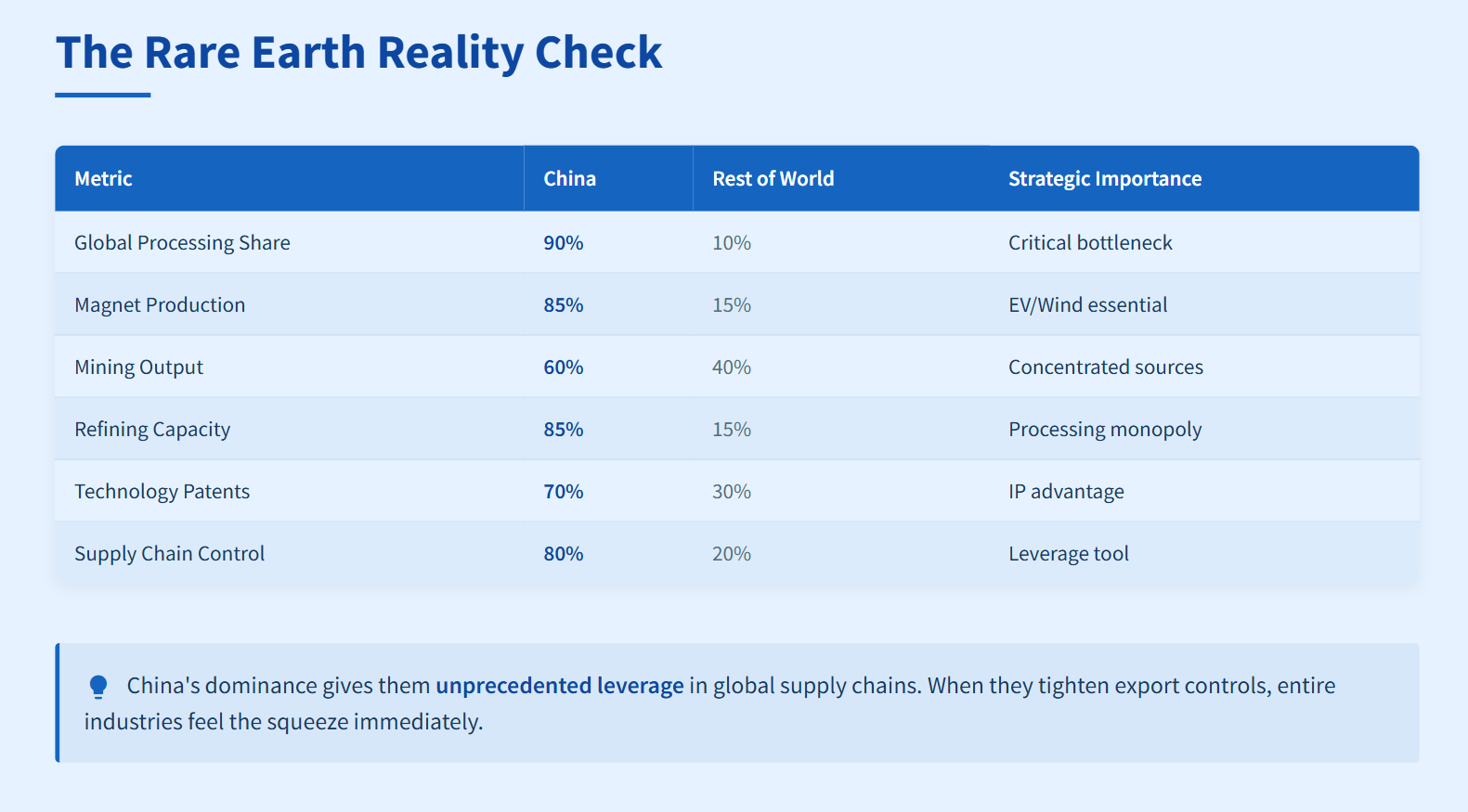
This dominance gives China unprecedented leverage. When they tighten export controls, entire industries feel the squeeze immediately. Electric vehicle manufacturers, wind turbine producers, and semiconductor companies all face potential supply disruptions.
The new export controls target 12 of the 17 known rare earth elements. China started with seven in April and just added five more in October. Each element serves critical functions across multiple industries.
Chinese Rare Earth Export Controls
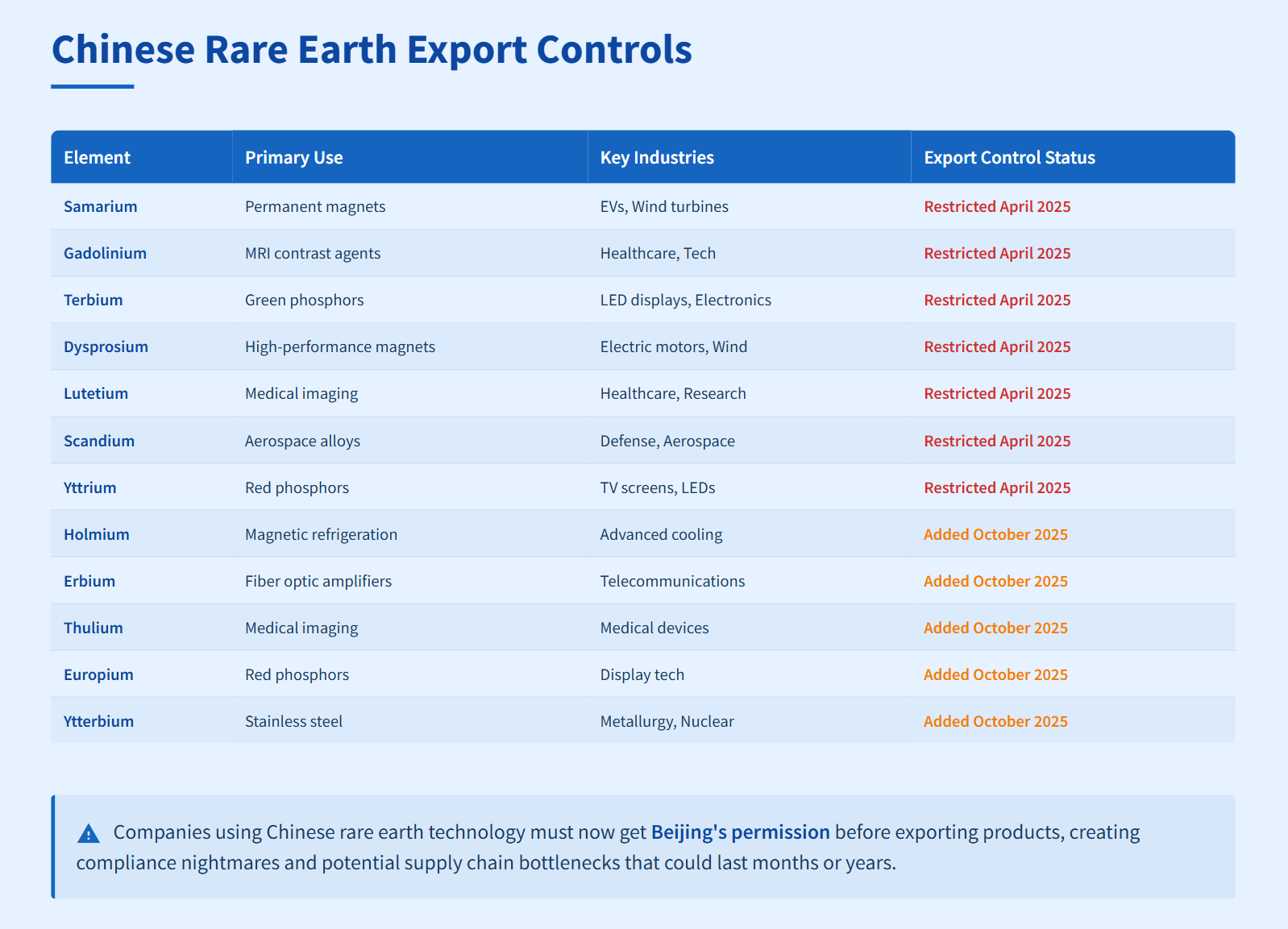
Companies using Chinese rare earth technology or materials must now get Beijing’s permission before exporting their products. This creates a compliance nightmare and potential supply chain bottlenecks that could last months or years.
The Tariff Time Bomb
Trump’s escalation follows a clear pattern, but this round feels different. The tariff increases have been rapid and severe.
Trump-China Tariff Escalation Timeline 2025
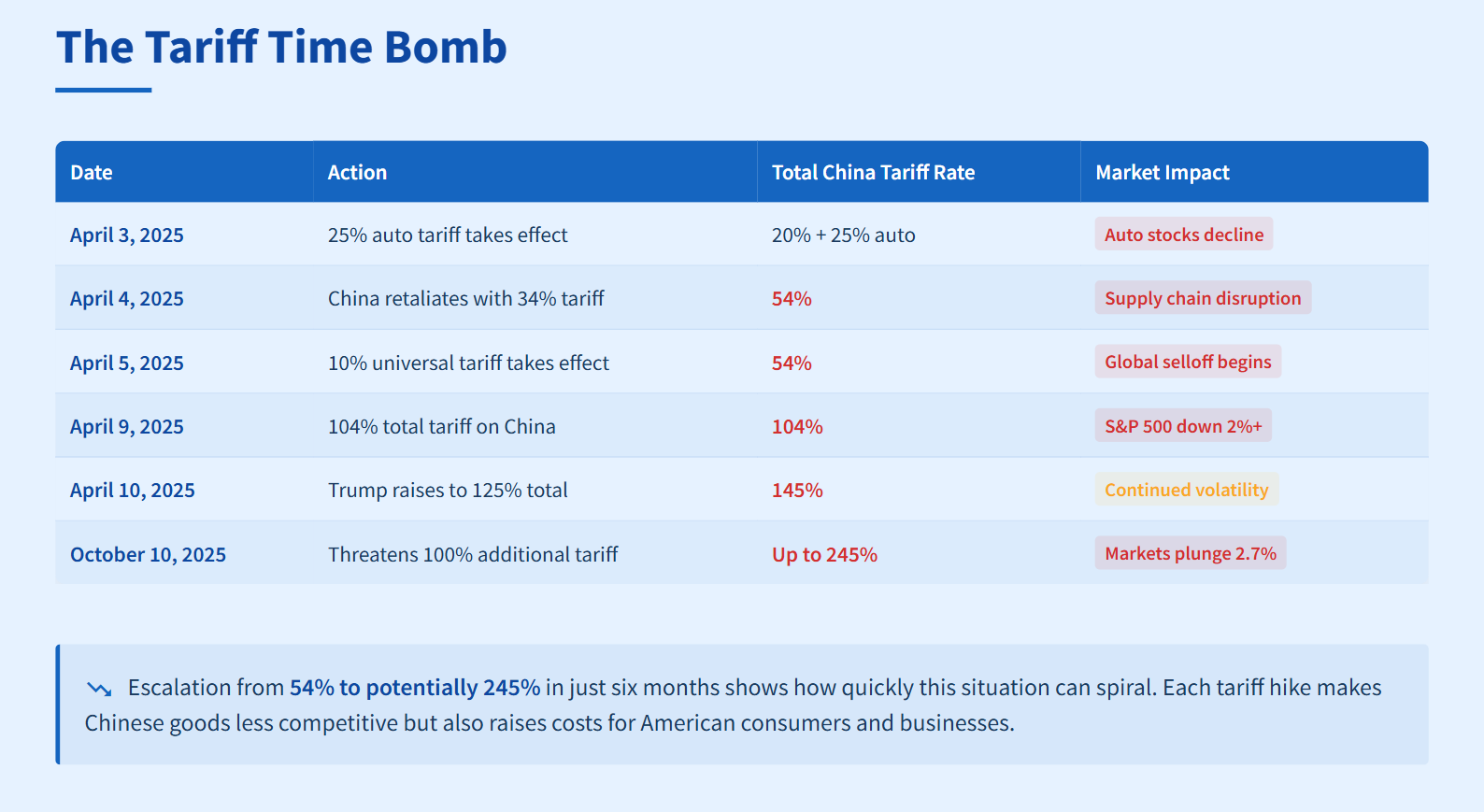
The escalation from 54% to potentially 245% in just six months shows how quickly this situation can spiral. Each tariff hike makes Chinese goods less competitive, but it also raises costs for American consumers and businesses that depend on Chinese supplies.
What makes this different from previous trade wars is the speed and the strategic focus. Trump isn’t just targeting consumer goods anymore. He’s going after the materials that power modern technology. This hits at the heart of supply chains for everything from smartphones to electric vehicles.
Singapore’s Market Response: Winners and Losers Emerge
Singapore’s stock market has shown remarkable resilience compared to regional peers, but clear patterns are emerging. The STI has managed a 23.88% gain year-to-date despite the trade tensions. However, not all sectors are weathering the storm equally.
Singapore Market Performance During Trade Tensions
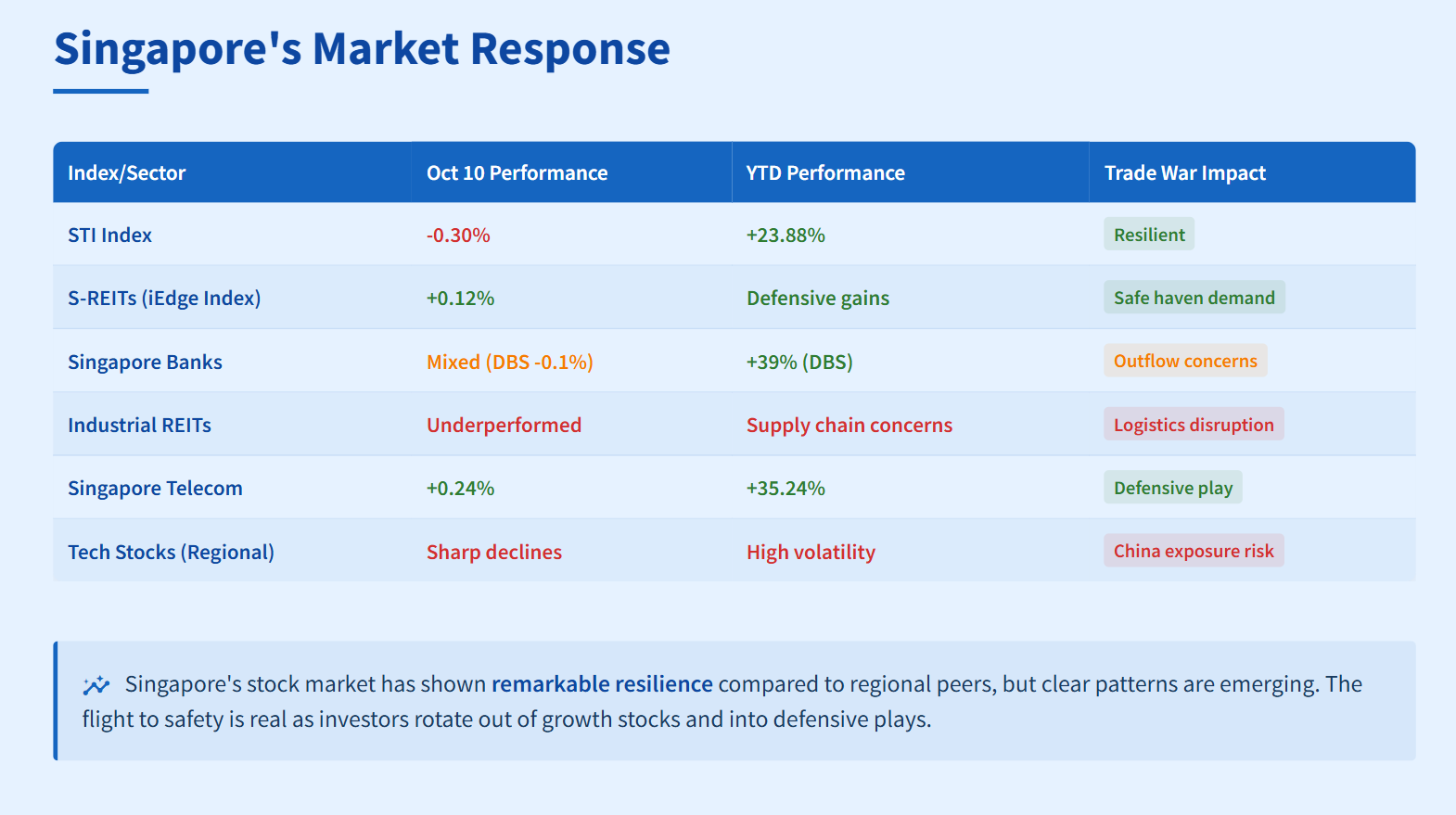
The flight to safety is real. Investors are rotating out of growth stocks and into defensive plays. Singtel has surged 35% this year as investors seek stable dividend yields in uncertain times. Meanwhile, industrial REITs face headwinds as supply chain disruptions threaten logistics demand.
Banking stocks present a mixed picture. DBS has gained 39% year-to-date, but institutional investors have pulled S$259 million from the three major Singapore banks over two weeks in October. This suggests concerns about economic slowdown affecting loan growth and credit quality.
The sector rotation is becoming more pronounced with each escalation. Defensive sectors are clearly benefiting from the uncertainty.
Singapore Sector Performance - Trade War Impact
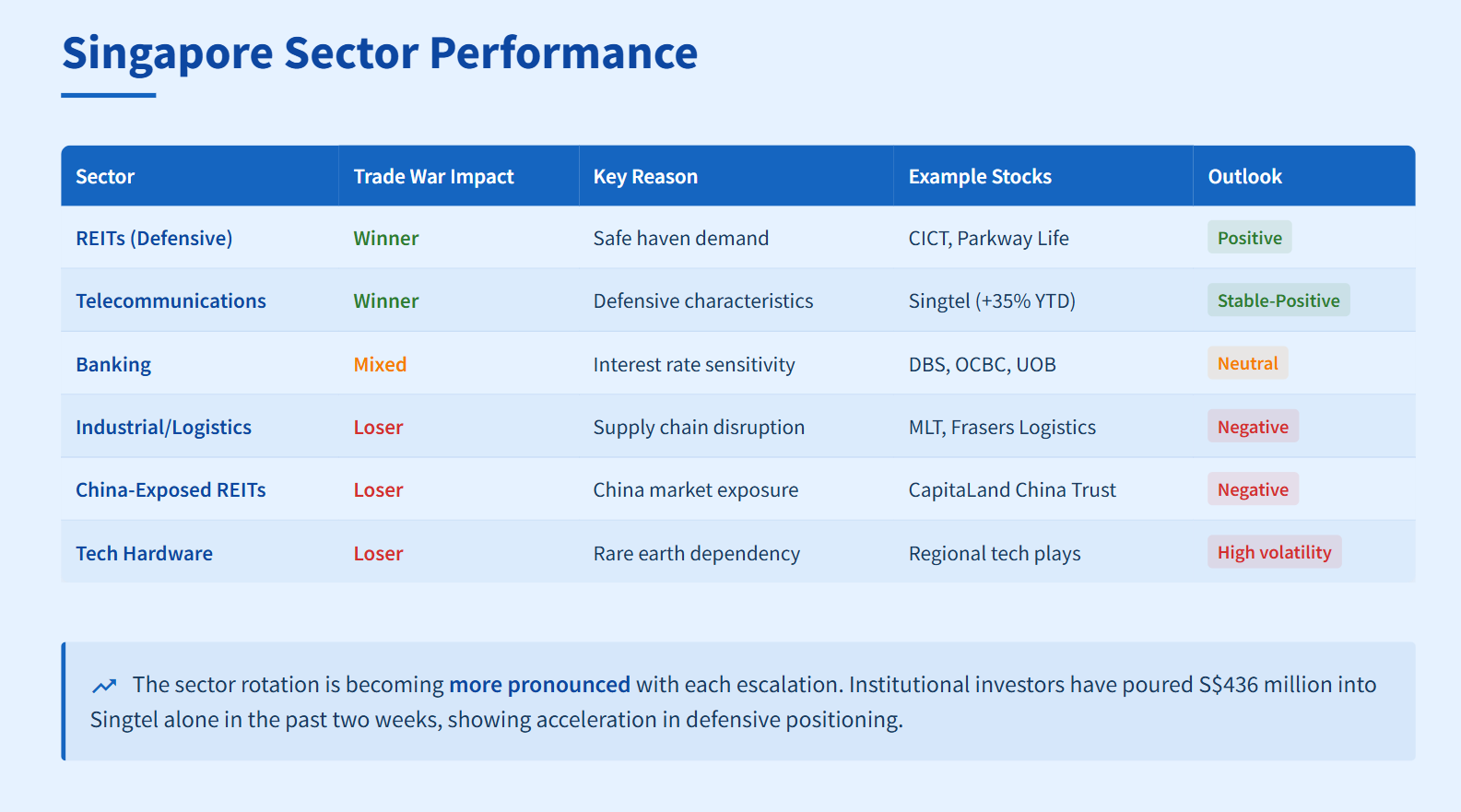
REITs have emerged as the clear winners, with institutional investors pouring S$436 million into Singtel alone in the past two weeks. This compares to S$297 million for the entire first quarter, showing the acceleration in defensive positioning.
Malaysia’s Market Response: A Different Kind of Defensive Play
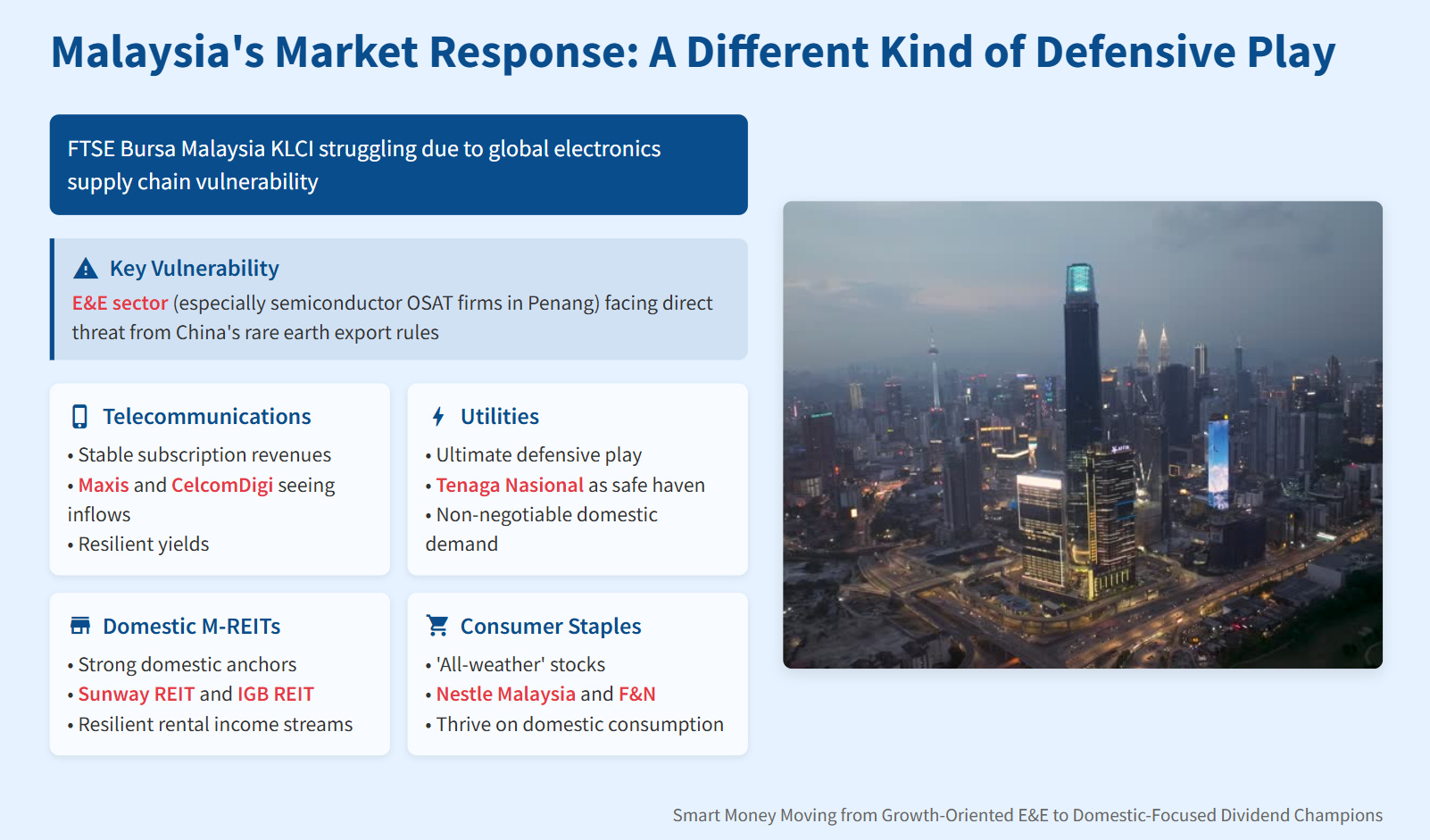
Across the causeway, the Malaysian market is facing a more direct and painful reality. The FTSE Bursa Malaysia KLCI has struggled to stay positive, reflecting the country’s deep integration into the global electronics supply chain that is now under direct threat.
The epicentre of this vulnerability is Malaysia’s massive Electrical & Electronics (E&E) sector, particularly the cluster of semiconductor (OSAT) firms in Penang. While these companies don’t process rare earths themselves, their major clients—global tech giants—are entirely dependent on them. With China’s new export rule, the entire semiconductor food chain is at risk. Companies like Inari Amertron, MPI, and Unisem have seen significant sell-offs as investors price in potential order cancellations from their US and European customers.
As a result, Malaysian investors are mirroring their Singaporean counterparts by rotating into classic defensive sectors known for stable cash flow and domestic demand, which are insulated from this global supply chain chaos:
Telecommunications: Stable subscription revenues are a safe bet. Maxis and CelcomDigi are seeing inflows as investors hunt for resilient yields.
Utilities: This is the ultimate defensive play. Tenaga Nasional, the national power provider, offers a true safe haven as domestic electricity demand is non-negotiable, regardless of trade tensions.
Domestic-focused M-REITs: Like in Singapore, M-REITs with strong domestic anchors are attractive. Sunway REIT and IGB REIT, which own major, locally-focused shopping malls (like Sunway Pyramid and Mid Valley Megamall), offer resilient rental income streams protected from the global tech war.
Consumer Staples: Companies selling essentials are also benefiting. Nestle (Malaysia) and Fraser & Neave (F&N) are prime examples of ‘all-weather’ stocks that thrive on domestic consumption.
The key takeaway for Malaysian investors is clear: the trade war is no longer an abstract concept. It poses a direct threat to the country’s key economic engine. The smart money is moving from the growth-oriented E&E sector to domestic-focused dividend champions.
The Strategic Implications
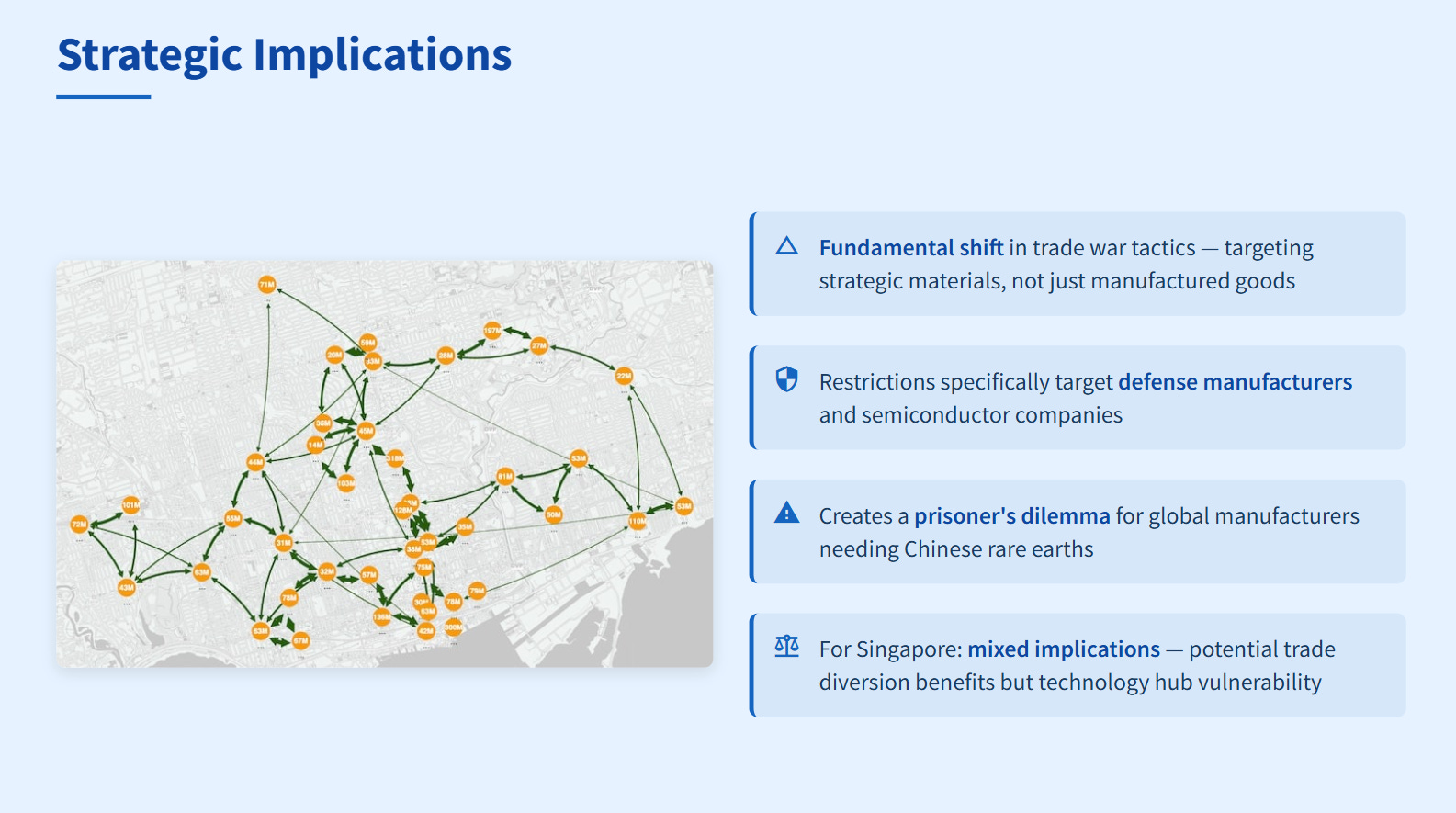
China’s rare earth restrictions represent a fundamental shift in trade war tactics. Previous rounds focused on manufactured goods where alternative suppliers existed. Rare earths are different - there are no quick substitutes, and China’s processing monopoly took decades to build.
The restrictions specifically target defense manufacturers and semiconductor companies, areas where China wants to limit Western capabilities. By requiring licenses for exports containing even trace Chinese materials, Beijing can effectively control who gets access to critical technologies.
This creates a prisoner’s dilemma for global manufacturers. They need Chinese rare earths to produce their goods, but using them subjects them to Chinese export controls. Companies may need to redesign products or find alternative suppliers - processes that take years and cost billions.
For Singapore, the implications are mixed. As a trading hub with relatively low direct tariffs (7.8% effective rate), Singapore may benefit from trade diversion. Companies looking to avoid high China tariffs might route more business through Singapore. However, slower global trade growth would hurt Singapore’s export-dependent economy.
The rare earth issue also highlights Singapore’s vulnerability as a technology hub. Many of Singapore’s key industries - from semiconductors to renewable energy - depend on Chinese rare earth supplies. Any disruption could cascade through Singapore’s economy.