



Underlying Profit Up 21%, Reported Profit Down 72%: What SingTel’s Q1 Numbers Actually Mean
A genuinely strong operational quarter, a confusing headline number, and why the yield verdict is still waiting on November.
SingTel’s headline profit number fell 72 percent this quarter. Read that as a warning and you’d be reading it wrong. The business underneath it actually grew.
Whether you’re already holding SingTel or watching from the sidelines waiting for the yield case to firm up, this quarter’s numbers deserve a closer look than the headline gives them. A 72 percent profit decline sounds like exactly the kind of thing that should worry a retirement portfolio. It isn’t, not this time, and understanding why matters more than the number itself.
What this quarter doesn’t do is move the actual yield verdict. That’s still waiting on the H1 results in November.

The Number That Looks Bad, and Why It Isn’t
A Tough Comparison, Not a Weak Quarter
What Actually Grew
Where the Growth Actually Came From
One Open Item Worth Flagging
Insight Box: A Headline Number and an Operating Result Are Not the Same Thing
Capital Management: The Asset Recycling Programme Keeps Moving
Insight Box: A Rising Capital Return Programme Isn’t the Same as a Rising Governing Yield
What This Means for the Zone Verdict
The Number That Looks Bad, and Why It Isn’t
A Tough Comparison, Not a Weak Quarter
SingTel’s Q1FY27 results, covering the quarter ended 30 June 2026 and released 13 August, show reported net profit of S$818 million, down 71.6 percent year on year (70.1 percent constant currency).
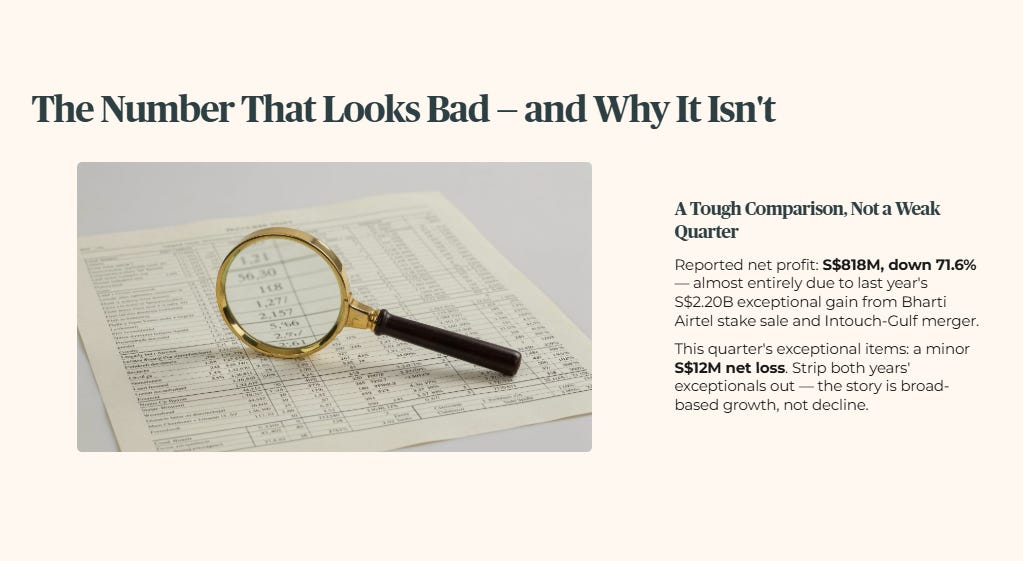
That decline has almost nothing to do with this quarter’s operating performance. Last year’s comparison quarter carried a S$2.20 billion exceptional gain, primarily from the sale of a partial stake in Bharti Airtel and the Intouch-Gulf Energy merger. Neither of those repeated this year. This quarter’s own exceptional items amounted to a comparatively minor S$12 million net loss, including an S$18 million dilution loss after Airtel raised its stake in Airtel Africa through a new share issuance, and S$8 million in staff restructuring costs.
Strip both years’ exceptional items out of the picture entirely and the actual story this quarter is one of broad-based growth, not decline.
What Actually Grew
Underlying net profit, the figure from which SingTel’s core dividends are actually paid, came to S$831 million, up 21 percent year on year, or 27.3 percent on a constant currency basis.
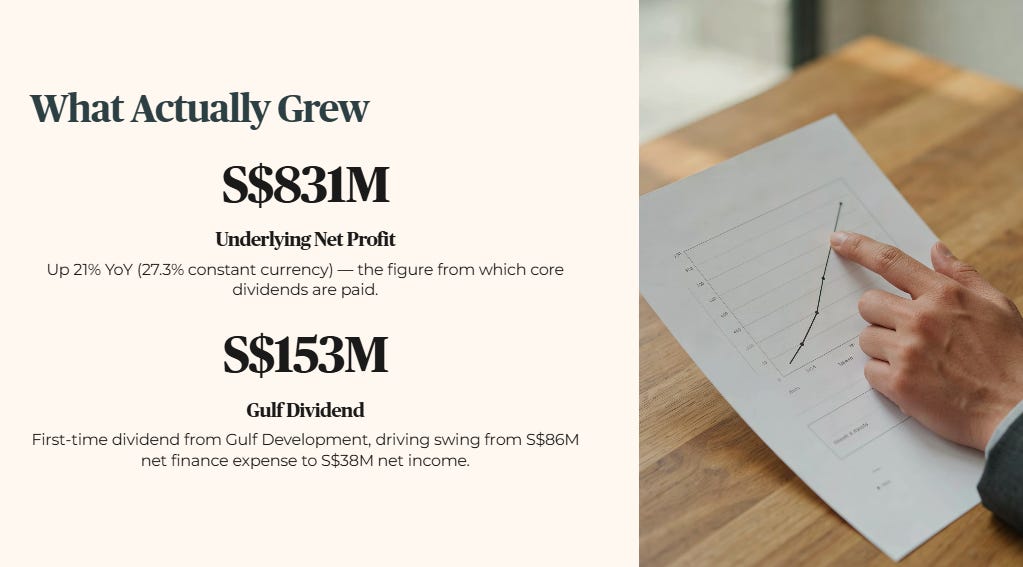
Part of that growth came from a genuine swing in net finance income, from a S$86 million net expense a year ago to S$38 million of net income this quarter. That was driven mainly by a first-time S$153 million dividend received from Gulf Development following Singtel’s partial divestment of its stake there in June. That Gulf dividend is itself treated as a one-off and excluded on a normalised basis.
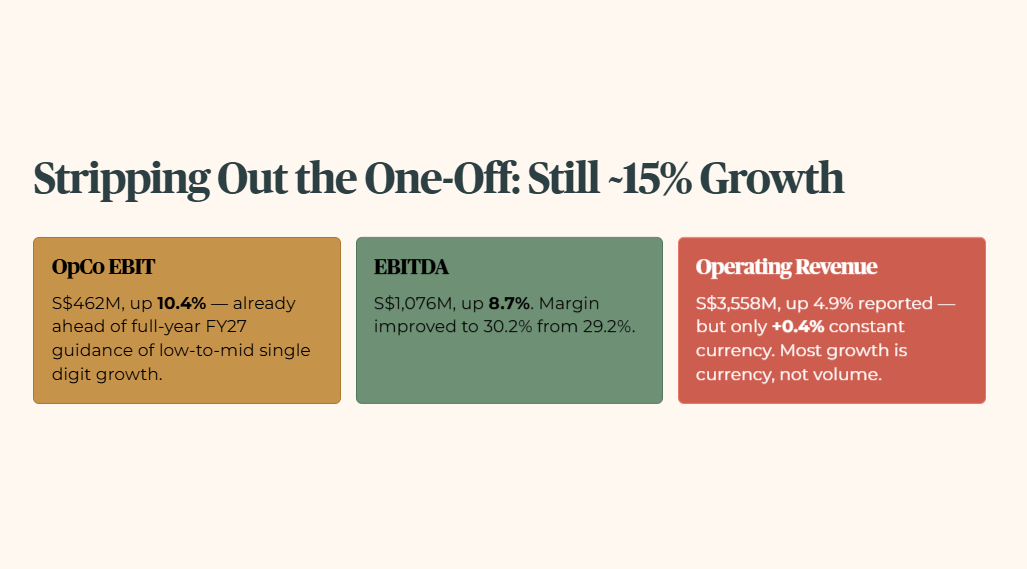
Even stripping it out, underlying profit growth still came in around 15 percent. OpCo EBIT rose 10.4 percent (7.9 percent constant currency) to S$462 million, and management flagged this as already tracking ahead of the full-year FY27 guidance band of low-to-mid single digit growth, one quarter in. EBITDA grew 8.7 percent (4.1 percent constant currency) to S$1,076 million, with EBITDA margin improving to 30.2 percent from 29.2 percent.
Operating revenue itself grew a more modest 4.9 percent to S$3,558 million. But it was roughly flat, up just 0.4 percent, on a constant currency basis. Most of the reported revenue growth here is currency, not volume.
Where the Growth Actually Came From
Regional Associates Carried Real Weight
Regional associates’ post-tax profit came to S$543 million, up 16 percent year on year, or 26 percent on a constant currency basis. The growth was led by Airtel Africa and AIS specifically, not spread evenly.
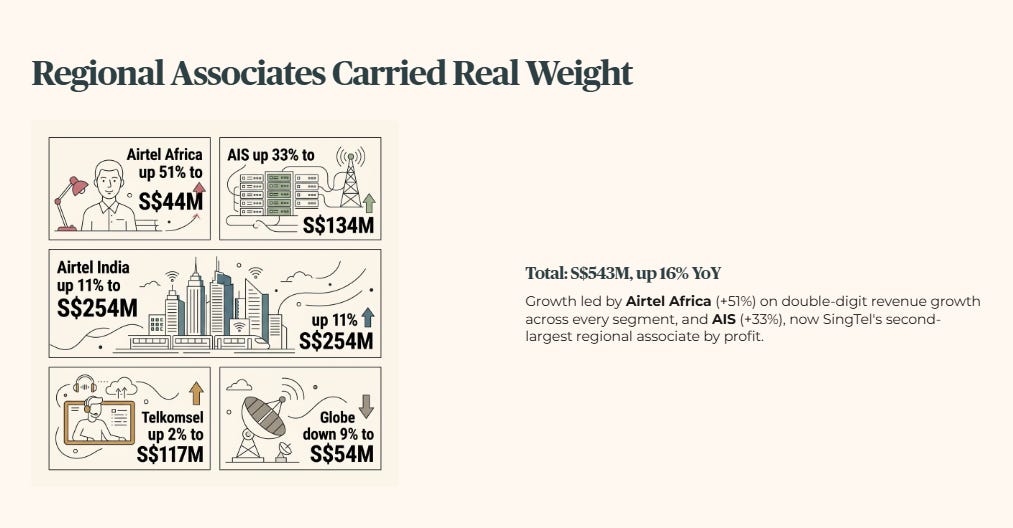
Airtel Africa’s contribution jumped 51 percent (69 percent constant currency) to S$44 million, on double-digit operating revenue growth across every business segment there. AIS grew 33 percent to S$134 million and is now Singtel’s second-largest regional associate by profit contribution. That was driven by stronger mobile and broadband services, continued cost discipline, and lower depreciation charges.
Airtel’s India and South Asia business grew a steadier 11 percent to S$254 million, with mobile ARPU up 5.4 percent and record quarterly postpaid customer additions. Telkomsel grew 2 percent to S$117 million (10 percent constant currency), boosted by higher mobile ARPU despite continued softness in legacy and fixed broadband revenue.
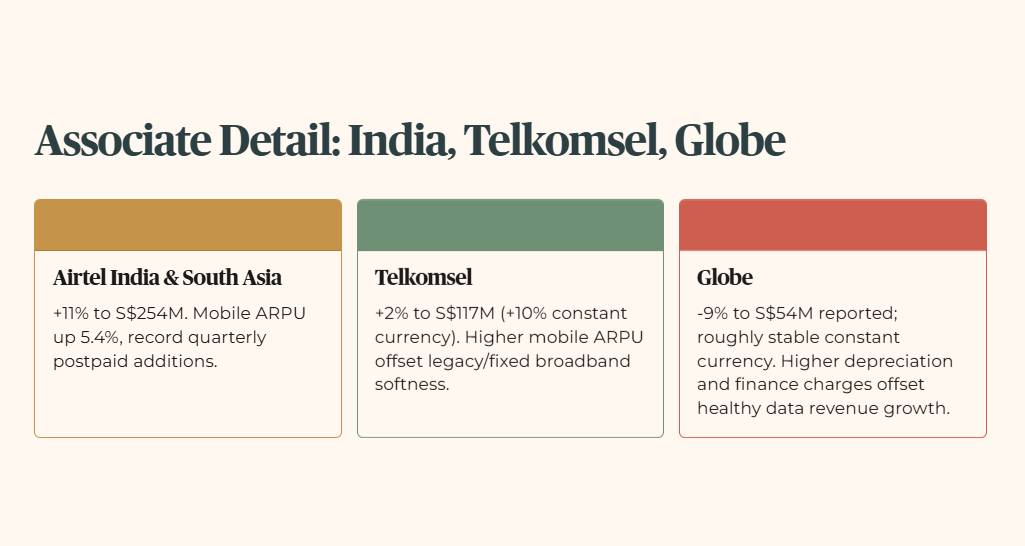
Globe’s post-tax contribution actually fell 9 percent to S$54 million on a reported basis, though it was roughly stable in constant currency. Higher depreciation and finance charges offset otherwise healthy revenue growth from data demand.
Bharti Telecom’s net loss narrowed to S$60 million on a reported basis, helped by currency movements.
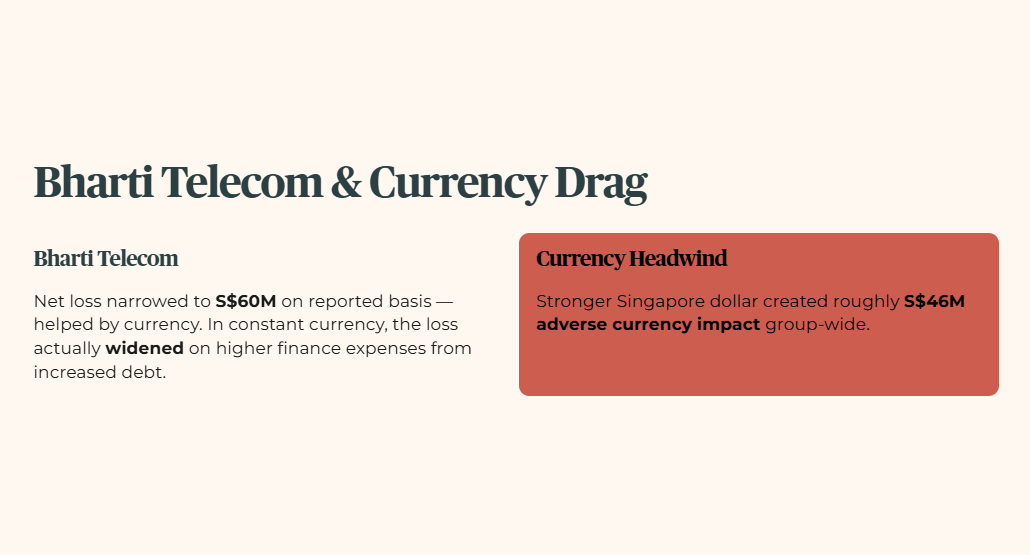
Management noted the loss actually widened in constant currency terms on higher finance expenses from increased debt. A stronger Singapore dollar worked against the whole line, with roughly S$46 million in adverse currency impact group-wide.
Optus and Singapore core telco results point in opposite directions, but the regional associates and infrastructure businesses are doing more of the earnings heavy lifting than the headline profit figure suggests.
