



UOB Has the Most to Gain From the Fed’s Return to Rate Hikes
A 43% SGD loan book and heavy reliance on net interest income put it ahead of DBS and OCBC, though the payoff builds mainly into 2027
UOB’s dividend yield sits 90 basis points below my 4.7% hurdle today, wider than it was three weeks ago. That’s after a Fed decision every headline this week called good news for Singapore’s banks. UOB has the clearest structural case of the three local banks for benefiting from what just happened, and it still failed my dividend gate for one more day.
I’ve had UOB parked at Zone 4 on my Ledger since late August, and Wednesday’s Fed decision is the first genuinely new piece of information since then that could actually move that call. If you’re already holding UOB from a lower cost basis, this rate cycle changes your total return story in a completely different way than it does for someone buying in fresh at today’s price. Either way, the underlying numbers are the same numbers. What they mean for you depends on which investor you are.

The Headline Everyone Got Right
Why UOB Specifically
How the Three Banks Actually Compare
Iggy’s Forensic Zone
The Window Is Already Open
UOB’s Own Numbers, Checked Against the Gate
Iggy’s Insights
UOB Financial Health Checklist
UOB Dividend Trajectory
What’s Next
Iggy’s Insights
Iggy’s Elite Read
Your Forensic Verdict, One Page
TOC
The Headline Everyone Got Right
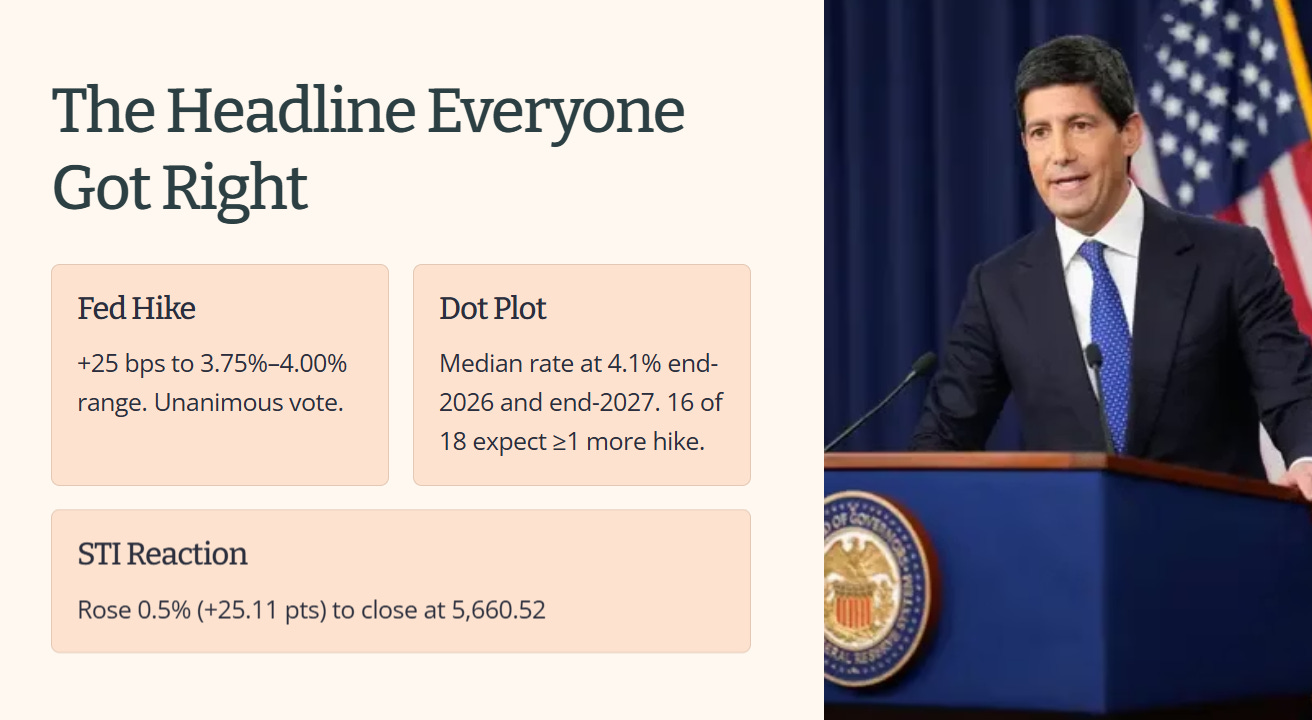
The US Federal Reserve raised its benchmark rate by 25 basis points on Wednesday, to a range of 3.75% to 4.00%, the first increase since 2023. The vote was unanimous, and the Fed’s own projections point further out than most people expected: the median policy rate forecast sits at 4.1% for both the end of this year and the end of 2027, and 16 of the 18 policymakers who submitted projections expect at least one more hike before this year is out. Singapore’s market shrugged rather than flinched. The Straits Times Index rose 0.5%, or 25.11 points, to close at 5,660.52 on Thursday.
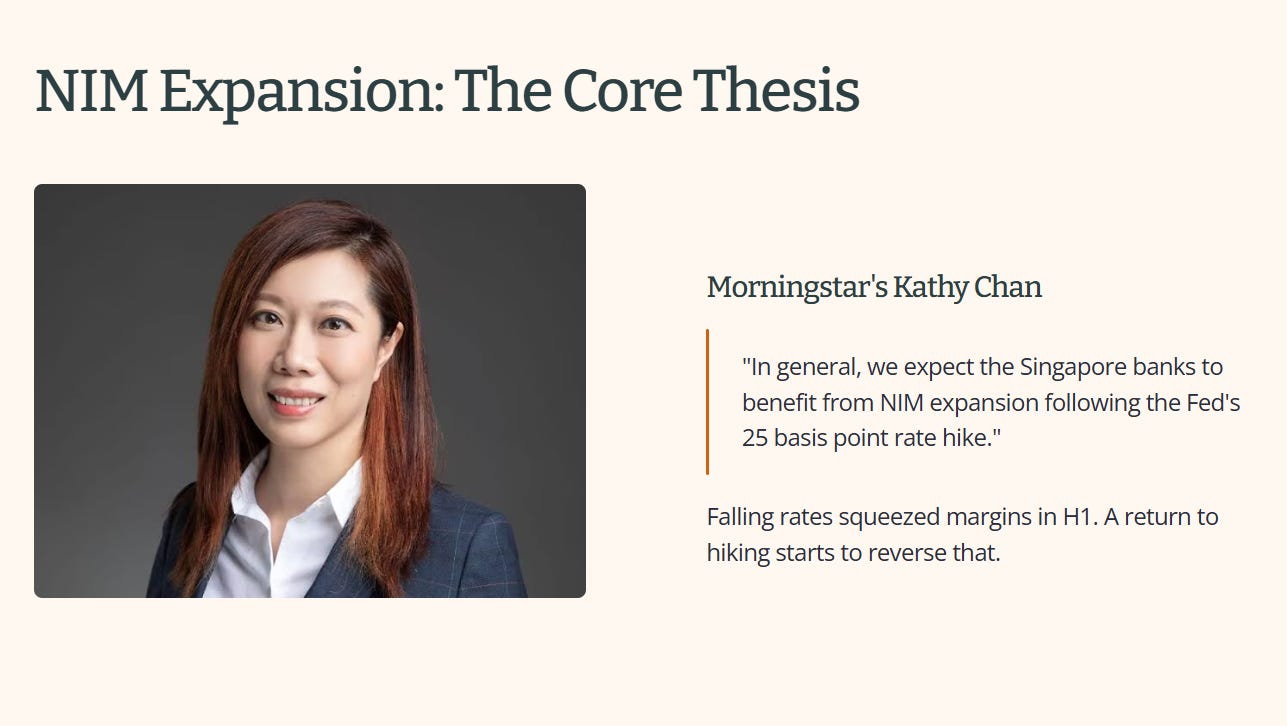
For Singapore’s three local banks, the story analysts are telling is straightforward: falling rates squeezed net interest margins through the first half of the year, and a return to hiking starts to reverse that. Morningstar’s Kathy Chan put it plainly to The Business Times: “In general, we expect the Singapore banks to benefit from NIM expansion following the Fed’s 25 basis point rate hike.” Net interest margin, or NIM, is the gap between what a bank earns on loans and what it pays out on deposits. When it widens, more of every dollar lent turns into profit.
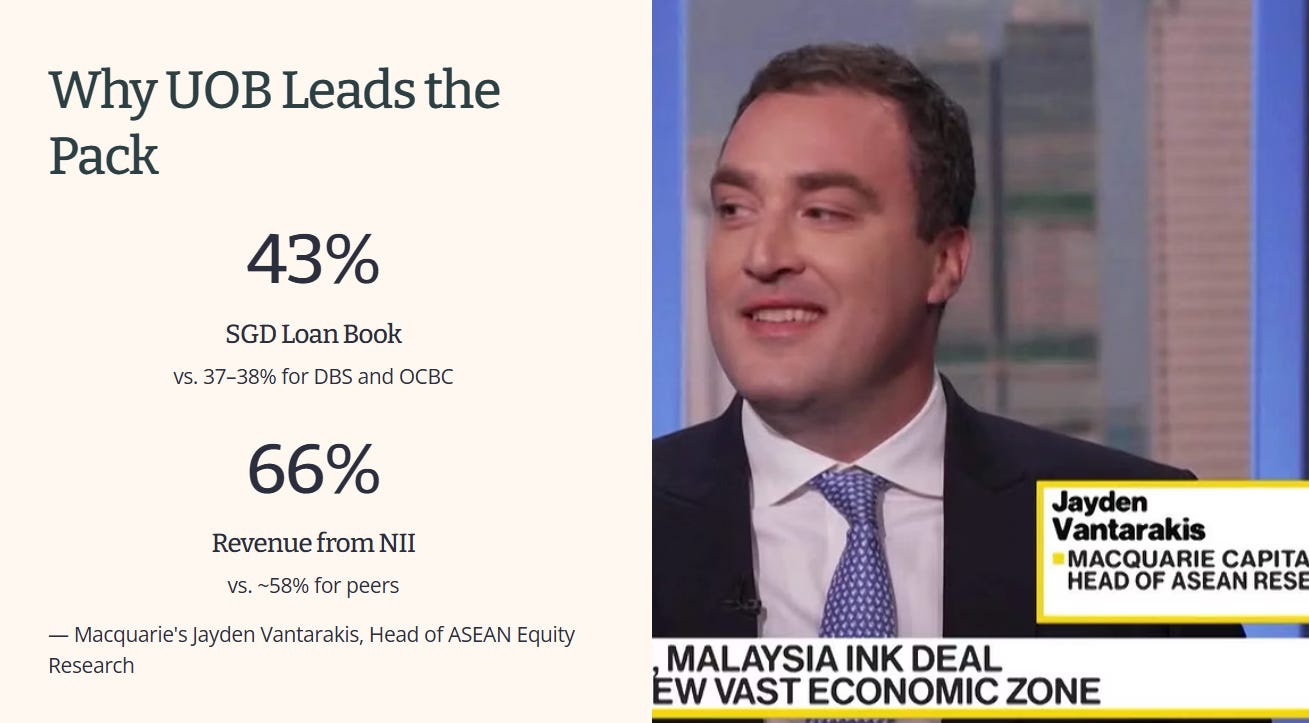
Among the three, UOB is the one analysts keep singling out. Macquarie’s head of ASEAN equity research, Jayden Vantarakis, told BT that about 43% of UOB’s loan book is denominated in Singapore dollars, against 37% to 38% for DBS and OCBC, and that net interest income makes up 66% of UOB’s revenue, versus roughly 58% for its two peers. A bank that leans harder on Singapore dollar lending and net interest income feels a Sora move more directly than one that doesn’t.
Why UOB Specifically
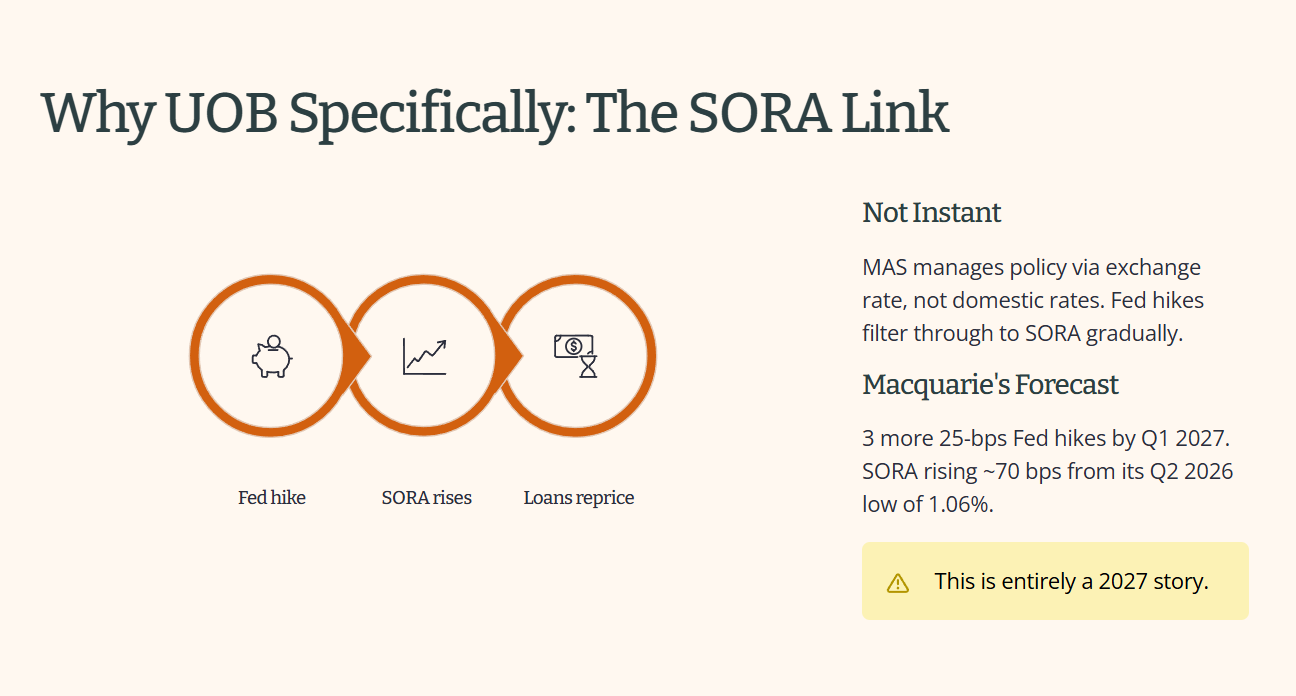
Sora, the Singapore Overnight Rate Average, is the benchmark that actually determines what UOB earns on a large share of its loan book. It doesn’t move in lockstep with the Fed funds rate. Singapore’s central bank manages policy through the exchange rate, not a domestic interest rate, so a Fed hike filters through to Sora over time rather than instantly.
Macquarie, per Vantarakis’s comments to BT, now expects three 25-basis-point Fed hikes by the first quarter of 2027, up from two previously, and projects Sora rising roughly 70 basis points from its second-quarter 2026 average low of 1.06% by the second half of 2027. UOB’s own economics desk, per BT’s 17 September report, is pricing two more hikes, one in December and one in the first quarter of 2027, before the Fed holds for the rest of that year, and flags upside risk to its own forecasts for US rates and the US dollar.
That’s the case for UOB. It’s also, entirely, a 2027 story.
What Actually Has to Happen For This to Reach the Dividend
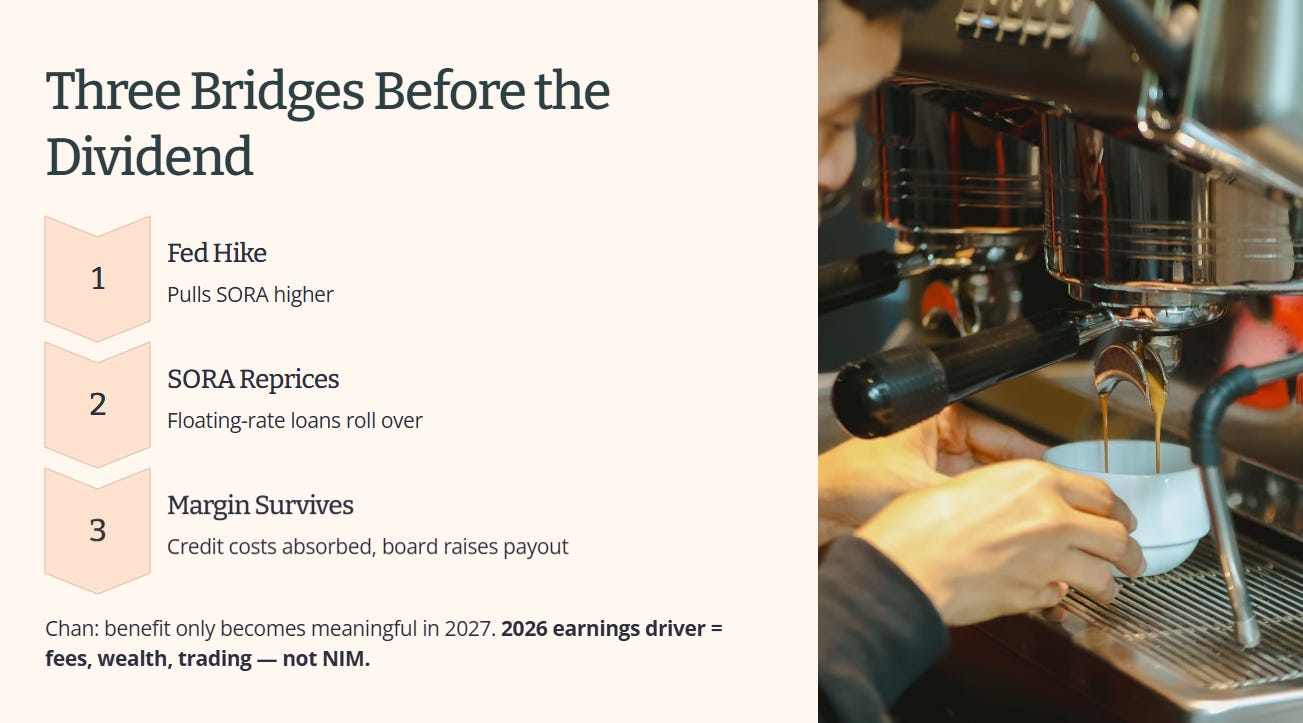
A Fed hike doesn’t walk into a Singapore bank’s dividend the way it walks into a headline. Think of it the way kopi gets made before it lands in your cup: the water has to boil, the grounds have to steep, and only then does anything pour out. Here, the Fed’s move has to pull Sora higher, Sora has to reprice UOB’s floating-rate loans as they roll over, and that wider margin has to survive credit costs and still be large enough for UOB’s board to decide it justifies raising the payout, rather than simply reporting a better net interest income line.
Chan’s own view is that the benefit only becomes meaningful in 2027, once that whole chain has had time to work through. “For 2026, we continue to expect strong non-interest income growth to be the larger earnings driver,” she said, meaning fees, wealth management, and trading, not net interest margin, are still what’s actually moving this year’s profit.
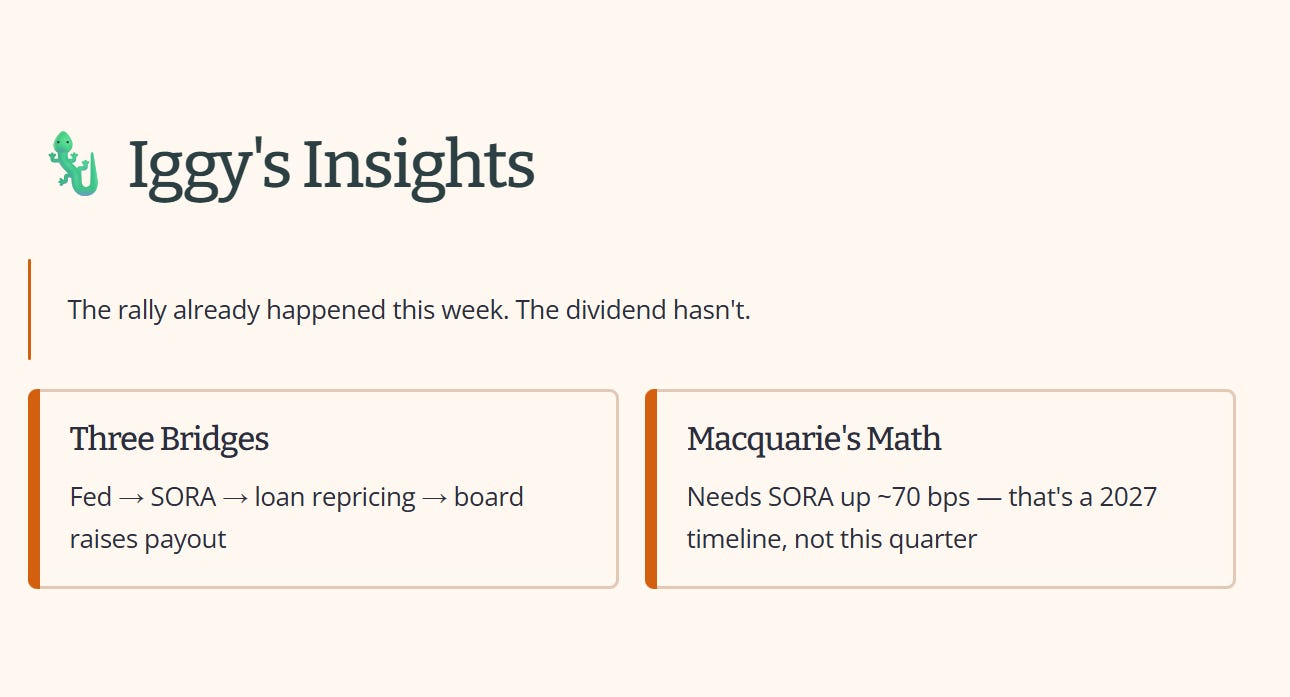
🦎 Iggy’s Insights
A Fed hike does not walk into a Singapore bank’s dividend the way it walks into a headline. It has to cross three bridges first: the Fed’s move has to pull Sora higher, Sora has to reprice UOB’s floating loan book as it rolls over, and that wider margin has to survive credit costs and stay large enough for the board to raise the payout rather than just report a better number. Macquarie’s own math needs Sora up roughly 70 basis points before UOB feels the full effect, and that’s their 2027 timeline, not this quarter’s. The rally already happened this week. The dividend hasn’t.
How the Three Banks Actually Compare
Here’s where UOB’s case gets stronger and its yield problem gets clearer at the same time. All three banks reported margin pressure in the second quarter, and all three still grew net profit on the back of fees and trading rather than lending income.
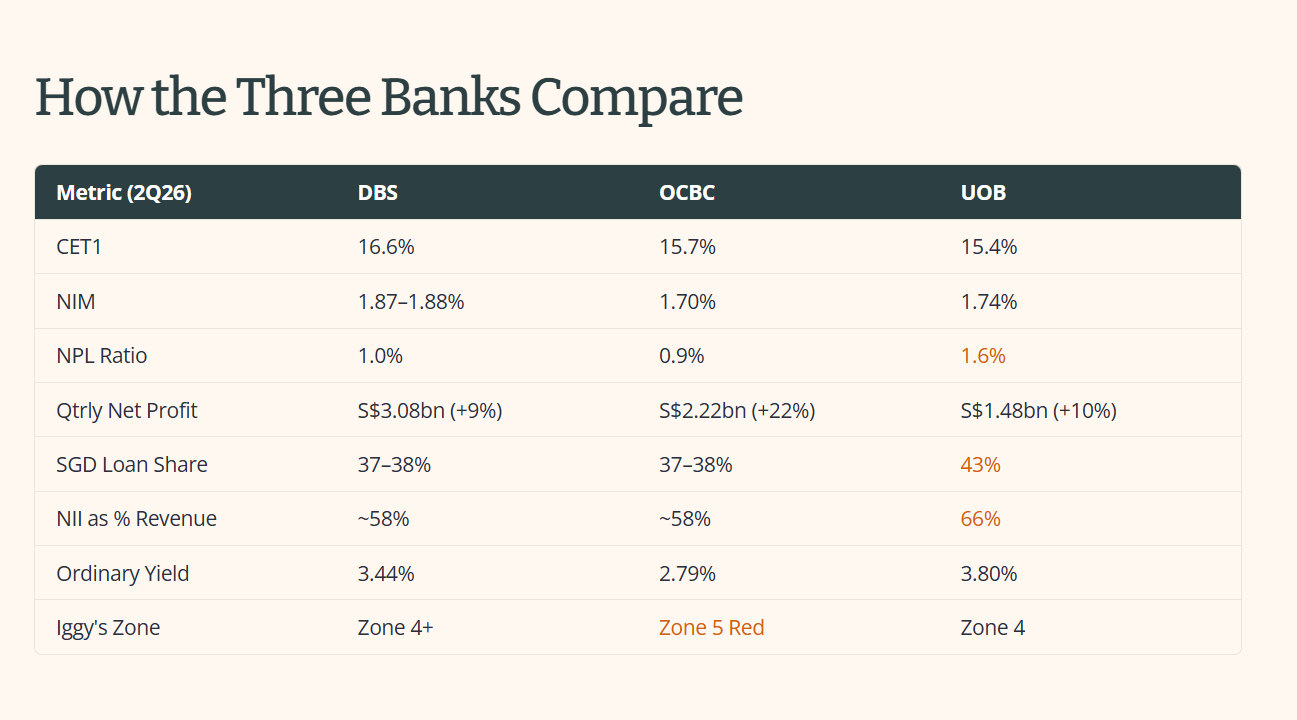
Every bank here misses my 4.7% yield hurdle right now. OCBC misses it worse than a hurdle miss, its 2.79% ordinary yield fails the 3.2% forensic floor outright, a structural failure rather than a borderline one. That 2.79% is ordinary dividends only, excluding the FY2025 special. Folding the special back in lifts total yield to 3.29%, which would technically clear the floor, but my standing policy excludes specials from the governing yield regardless, since a one-off payout isn’t a repeatable distribution and shouldn’t rescue a zone call.
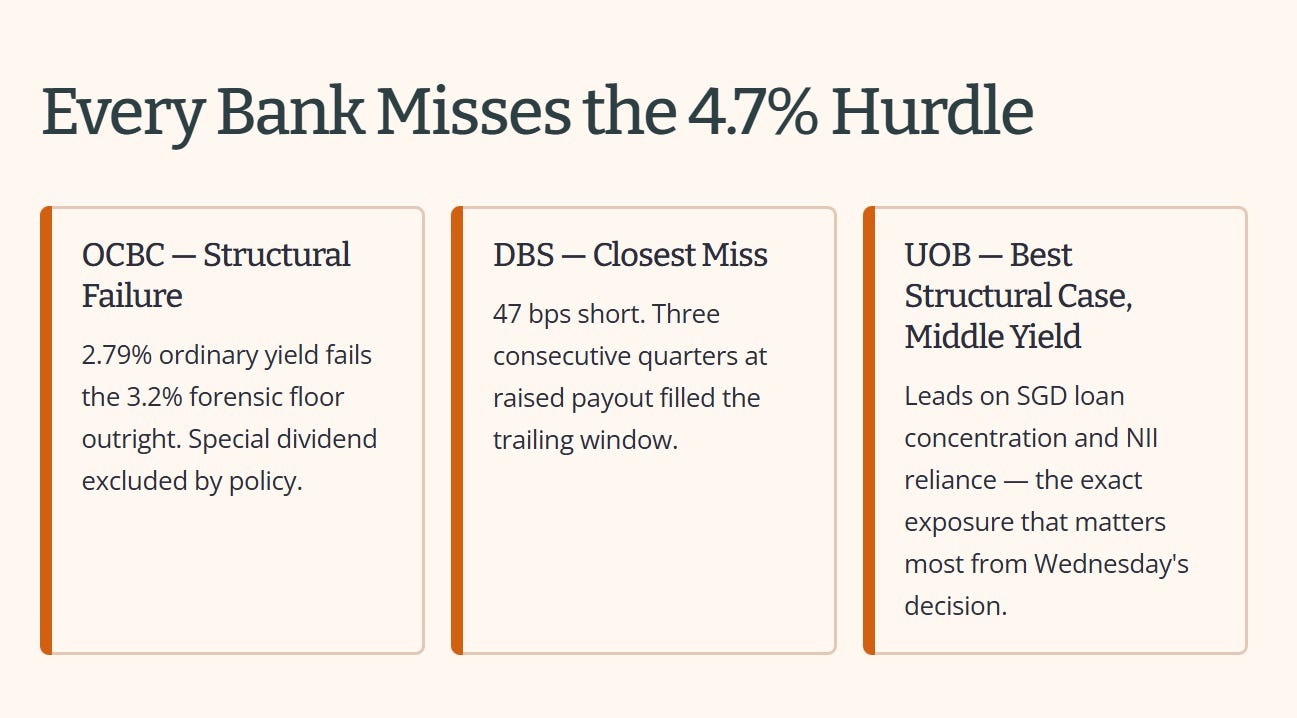
DBS sits closest to clearing the hurdle, at a 47 basis point miss, mostly because three consecutive quarters at its raised payout rate have now filled the trailing twelve-month window. UOB sits in the middle on yield, but leads all three on exactly the structural exposure, SGD loan concentration and net interest income reliance, that determines who actually benefits most from Wednesday’s decision.
The Window Is Already Open
The Window Closes Fast. In this market, the difference between a “Sanctuary” and a “Yield Trap” is decided in a single trading session. By the time this analysis reaches you as a free subscriber, the entry window Iggy identified has already opened, and often closed.
Iggy’s Elite Investors don’t just get the report earlier. They get it when the numbers still matter, zero-day forensic breakdowns, the full “Red Zone” watchlist, and institutional-grade cheatsheets at the moment the setup is live, not after the market has already priced it in.
For S$12/month, less than two kopi and kaya toast sets at Raffles Place, you stop being the Exit Liquidity and start being the Analyst.
UOB’s Own Numbers, Checked Against the Gate
Since UOB is a bank, my usual gearing and interest coverage checks don’t apply. I substitute Transitional CET1 for gearing, and NIM plus NPL for interest coverage.
UOB Financial Health Checklist
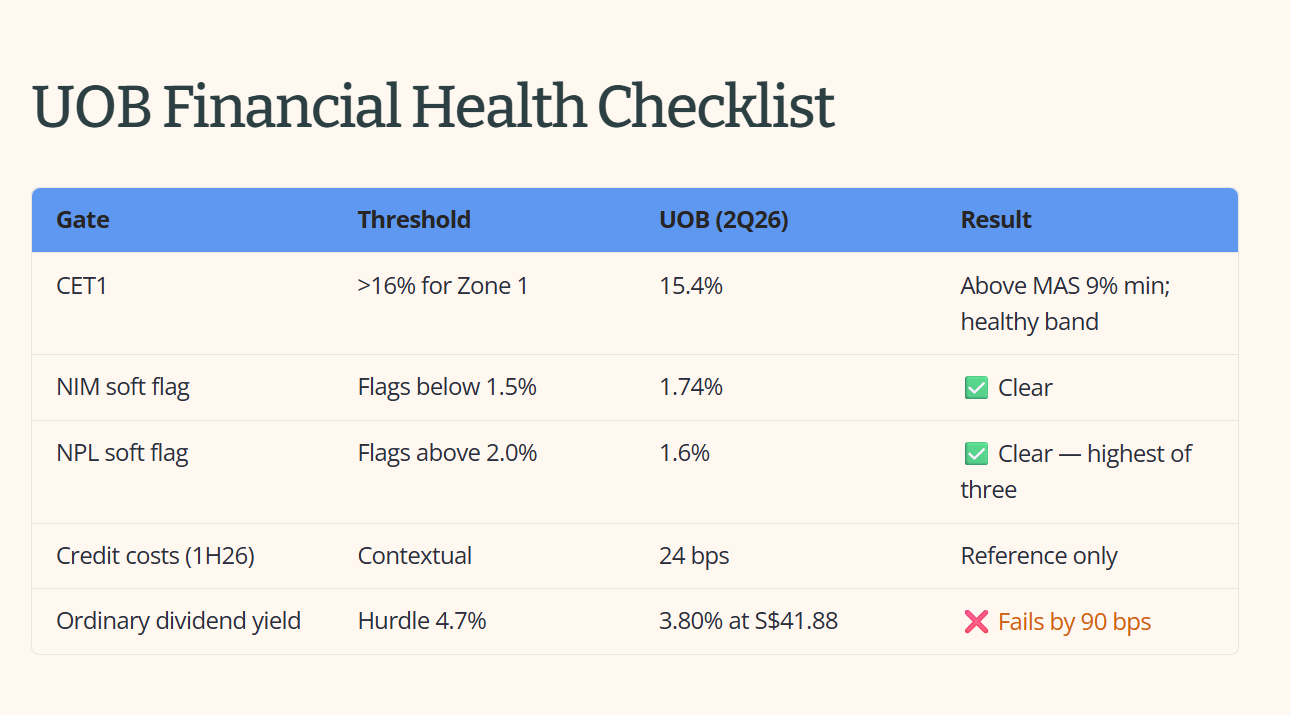
One clarification on terms, since CET1 and “zero soft flags” can otherwise read as contradicting each other: CET1 has its own banding in this framework, separate from soft flags entirely, a bank needs CET1 above 16% to even be eligible for my top zone regardless of yield. UOB’s 15.4% doesn’t itself trigger any soft flag. The actual soft-flag checklist for a bank is NIM below 1.5%, NPL above 2.0%, or two straight periods of declining revenue or profit, and UOB clears all three of those. That’s what “zero weighted soft flags” refers to.
UOB Dividend Trajectory
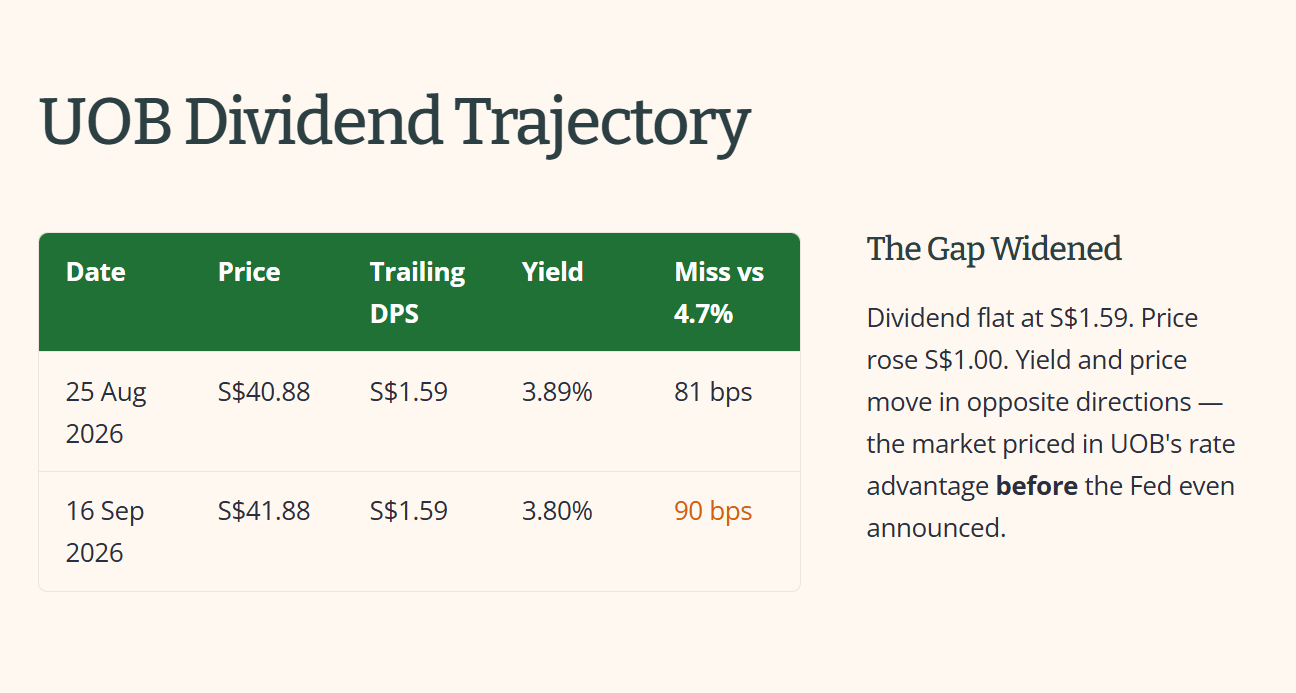
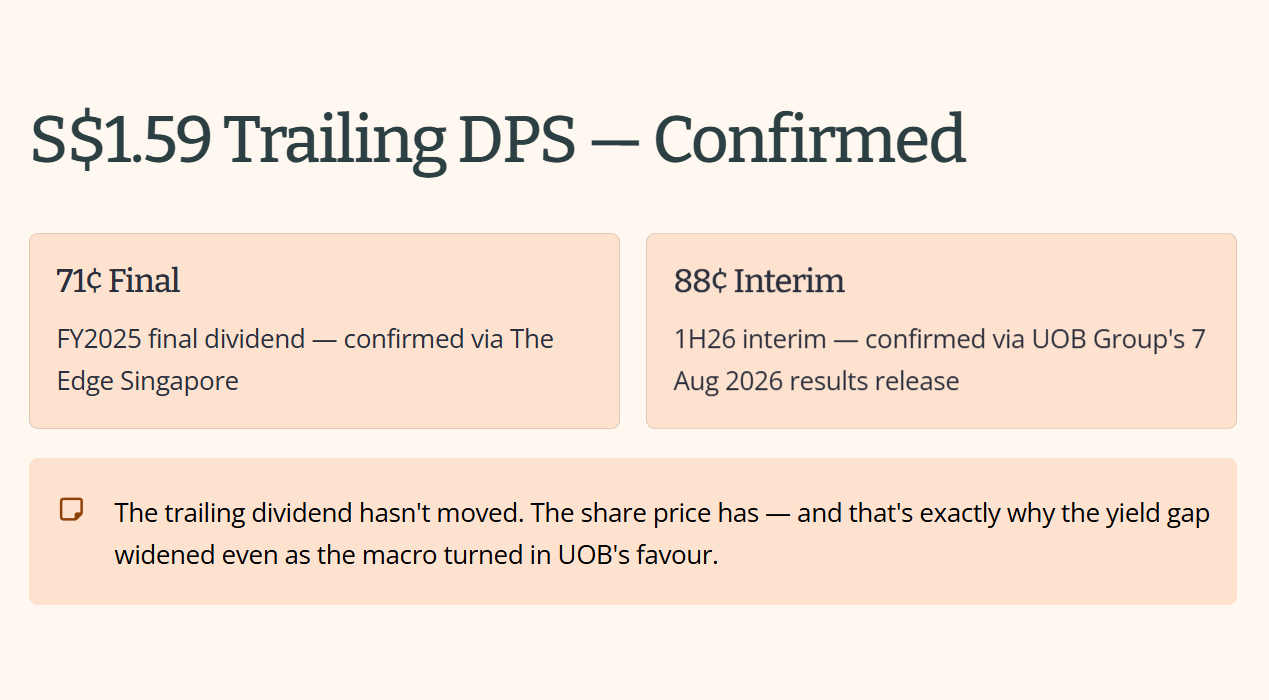
The S$1.59 trailing figure is FY2025’s 71-cent final dividend plus the 1H26 interim of 88 cents. The 71-cent final is confirmed via The Edge Singapore’s earnings coverage; the 88-cent interim is confirmed via UOB Group’s own 7 August 2026 results release. The trailing dividend hasn’t moved. The share price has, up from S$40.88 on 25 August to S$41.88 at Wednesday’s close, hours before the Fed’s decision had even reached Asian trading. Yield and price move in opposite directions when the payout stays flat, so the market was already pricing in some of UOB’s rate-hike advantage ahead of the announcement itself, which is exactly why the yield gap widened rather than closed even as the macro backdrop turned in UOB’s favour.
The obvious pushback: if UOB is really the bank best positioned to benefit from this Fed hike, why does it still fail your own dividend test? Because “best positioned to benefit” and “the benefit has already arrived” are two different claims, and this framework only measures the second one.
That 4.7% hurdle isn’t a claim that you personally can go park this exact money somewhere else at that rate today. It’s benchmarked against CPF Special Account at 4.0% per annum, the highest-quality guaranteed Singapore dollar yield that exists in the system, specifically so that a stock has to clear a genuinely hard bar before it earns a place in an income portfolio. A Zone 4 verdict is a timing verdict, not a permanent rejection. Today’s finding is that the timing on UOB’s dividend hasn’t arrived yet, not that it never will.
🔒 What’s Next
UOB’s 1.6% non-performing loan ratio already runs above both DBS’s and OCBC’s. What that means for the suffix on today’s zone call, and the specific soft-flag math behind it, is next.
