



UOB Kay Hian Puts an $11.85 Target on City Developments. Its Operating Profit Doesn’t Cover the Interest Bill.
The bet is that Friday’s strategic review unlocks the RNAV discount. The balance sheet says CDL can’t currently service its own debt without it.
An analyst just told you City Developments is worth 46% more than where it’s trading. Before you get excited about that gap, I want you to sit with one number: City Developments’ operating profit currently covers less than one times its own interest expense. Not “tight.” Below one. The company is not generating enough from its core business to pay the interest on what it owes, let alone fund the S$0.25 dividend it just handed shareholders in February.
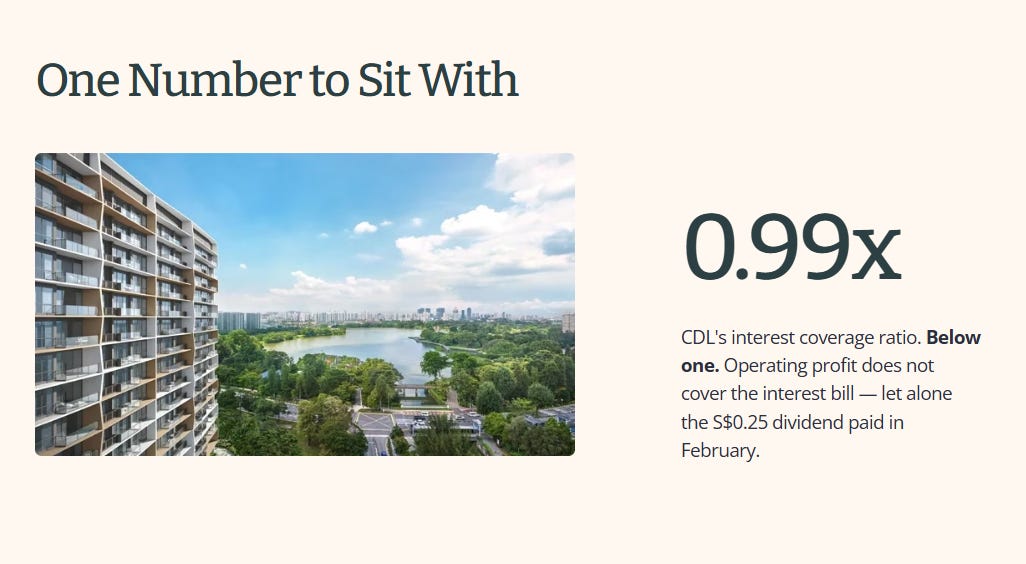
That’s the tension this piece sits inside. An institutional broker with a $16.92 RNAV model and a real, dated catalyst on the calendar, against a set of numbers that would normally stop this stock at the door of any income screen. By the end of this piece you’ll know exactly which one I think should govern how you treat CDL right now, and why.
I drove past one of CDL’s newer launches in the east a few months back, one of those glossy showflats with the queue snaking round the car park on a Saturday morning. Good product, by all accounts. Sells well. That’s never been the question with City Developments. The question this piece is actually about is what’s happening several floors up, in the finance department, far from any showflat.


Section 1: The Analyst’s Case
Beat 1: What a strategic review actually means
Beat 2: The hotel business, in more detail
Beat 3: What’s actually launching
Beat 4: Sixty years of history, and why that cuts both ways
Section 2: Iggy’s Forensic Screen
Layer 1, Raw Fact
Layer 2, Historical Benchmark
Layer 3, Peer Context
Layer 4, Forward Scenario
Layer 5, Wallet Impact
Financial Health Checklist
Section 3: The Dividend Trajectory
Section 4: The Forensic Gap
🟢 Insight Box 1
Section 5: What to Watch Next
🟢 Insight Box 2
Legacy Holders vs Fresh Capital
The Verdict
Iggy’s Forensic Zone: Zone 5, Red Zone
Iggy’s Elite Read
The Window Is Already Open
What Free Subscribers See Is the Headline. What Members See Is the Reason.
Every piece I publish gives free subscribers the zone number and the label the moment it goes live. What they don’t get is the reasoning behind it, the soft flag breakdown, the exact margin that triggered the call, the trajectory that would change it. That gap between the verdict and the reasoning isn’t something you can wait out. It’s the actual content, and it stays behind the paywall permanently, not for a week, not until the next piece bumps it down the feed.
YouTube/Substack Combo members get the complete breakdown the moment it publishes: full-length videos, the complete Red Zone watchlist, and institutional-grade cheatsheets, not a summary of the verdict, the actual forensic case for it.

For S$12/month, you’re not paying to read this sooner. You’re paying to stop reading headlines and start reading the case.
Section 1: The Analyst’s Case
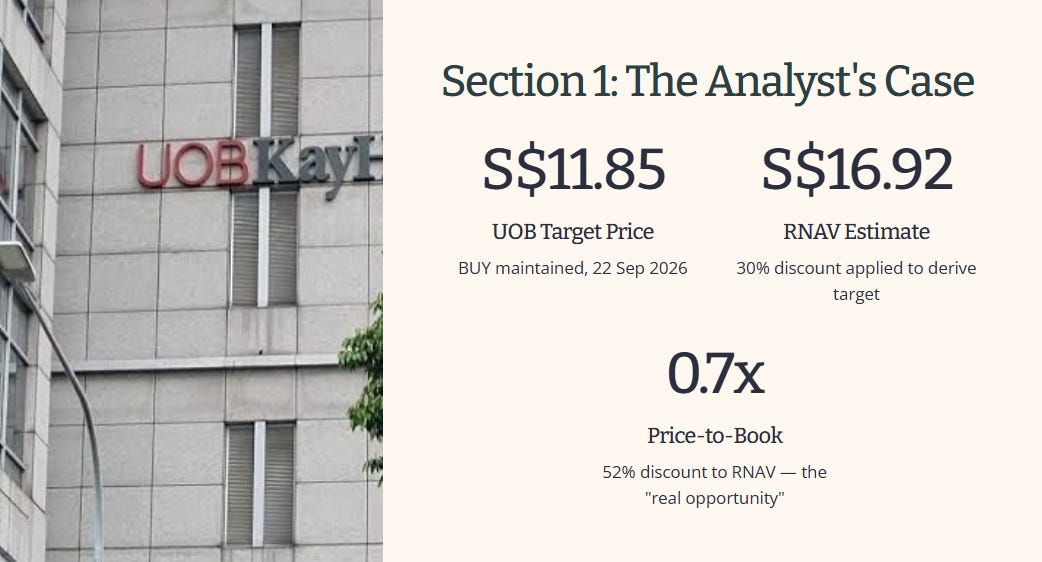
UOB Kay Hian’s Lock Mun Yee maintained a BUY on City Developments on 22 September 2026, lifting the target price to S$11.85. That figure isn’t a standalone number pulled from a model in isolation, it’s derived from a S$16.92 RNAV estimate, discounted 30% to reflect the market’s usual skepticism toward how quickly a property group can actually turn paper asset value into cash. UOB values the group at 0.7 times price-to-book, a 52% discount to that RNAV, which the broker frames as the real opportunity here: not that CDL’s underlying assets are worth less than they look, but that the market isn’t crediting the company for owning them.
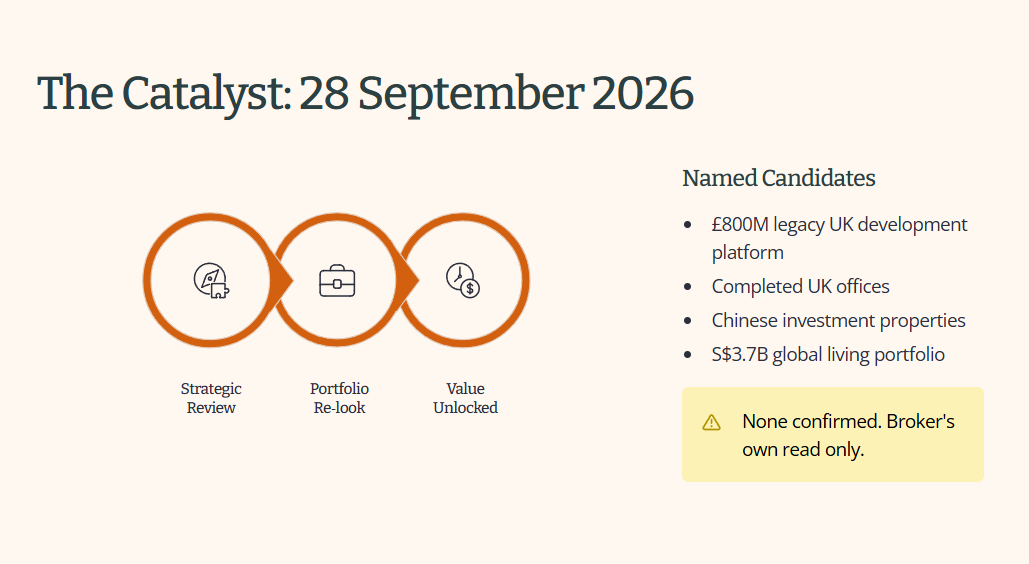
The specific catalyst is dated and concrete, which is part of why this deserves a serious look rather than a dismissal. CDL’s strategic review outcomes are expected on 28 September 2026, three days after this piece publishes. UOB’s report frames it as a “holistic portfolio re-look” that could deliver disposals, redevelopments, or other value-unlocking moves. Named candidates include an estimated £800 million legacy UK development platform, completed UK offices, Chinese investment properties (Hong Leong Hongqiao Center, Hong Leong Technology Park), and the possibility of monetising the S$3.7 billion global living portfolio through private funds or a REIT platform. None of these are confirmed transactions. They’re the broker’s own read of what a serious review would target.
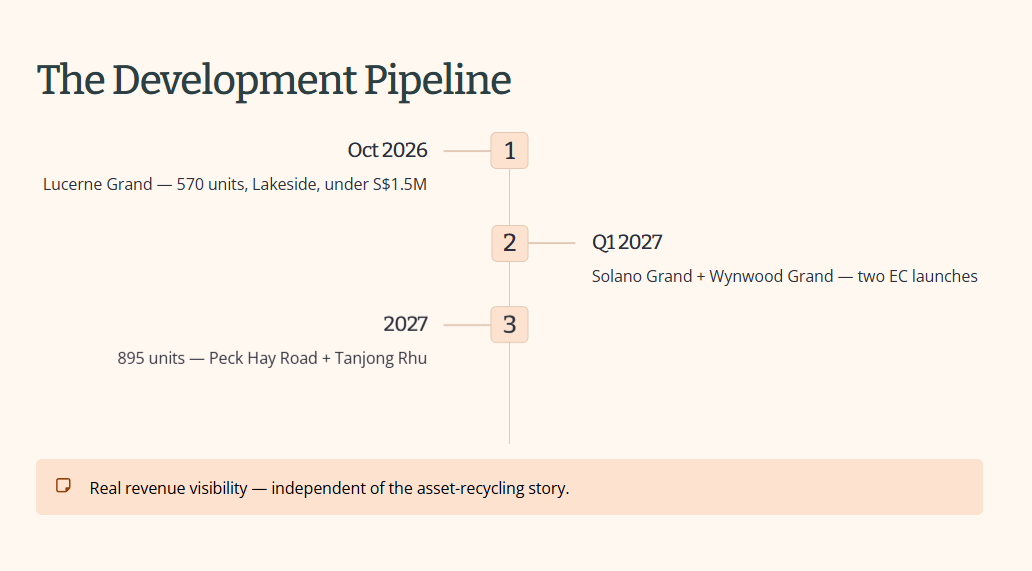
There’s also a real, near-term development pipeline underpinning the bull case that isn’t dependent on the review at all: the 570-unit Lucerne Grand launches early October below S$1.5 million per unit, with two more executive-condominium launches and 895 further units at Peck Hay Road and Tanjong Rhu scheduled through 2027. That’s genuine revenue visibility, separate from the asset-recycling story.
Here’s the load-bearing assumption underneath all of it: UOB’s target only works if the strategic review converts paper asset value into cash and lower leverage, at prices close to what the RNAV model assumes, on a timeline fast enough to matter. If the review delivers a modest, cautious set of targets, or takes years rather than quarters to execute, or the assets in question sell at a discount to their carrying value because CDL is a motivated rather than a patient seller, the RNAV discount doesn’t close. It’s just a number on a spreadsheet that never becomes cash in anyone’s hands.
Beat 1: What a strategic review actually means
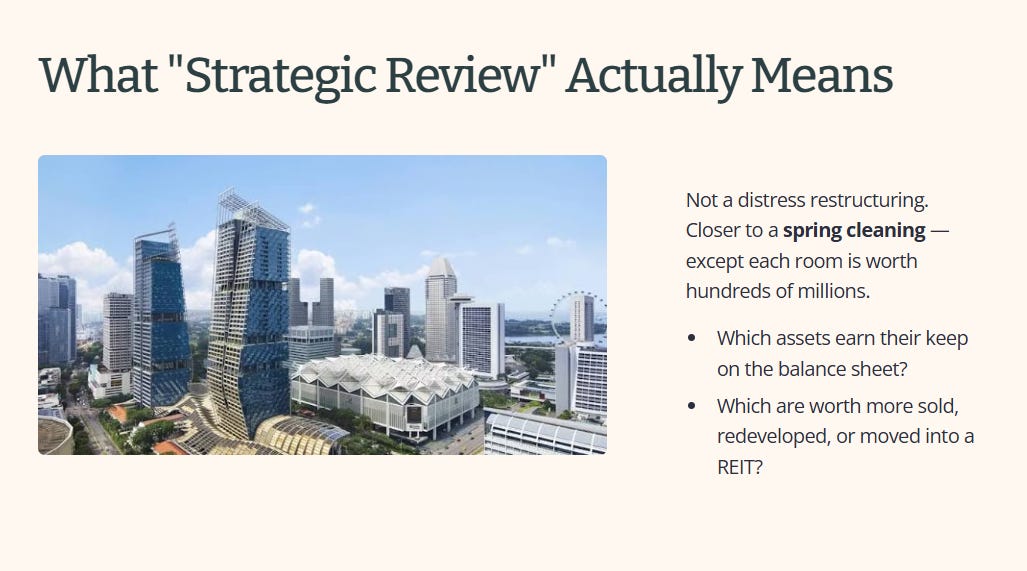
“Strategic review” gets thrown around a lot in Singapore corporate news, and it’s worth being specific about what it usually covers before we get to CDL’s version. It typically means a company looking hard at every asset it owns and asking which ones earn their keep sitting on the balance sheet versus which ones would be worth more sold, redeveloped, or moved into a separate structure entirely, a private fund, a REIT platform, that kind of thing. It’s not a restructuring in the distress sense. It’s closer to a spring cleaning exercise, except the rooms are worth hundreds of millions of dollars each.
Beat 2: The hotel business, in more detail
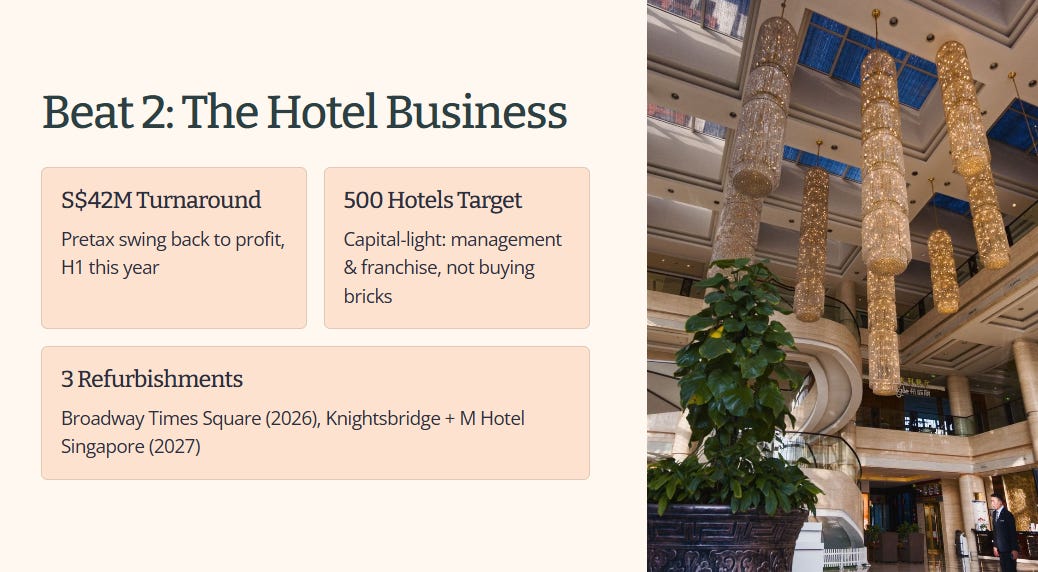
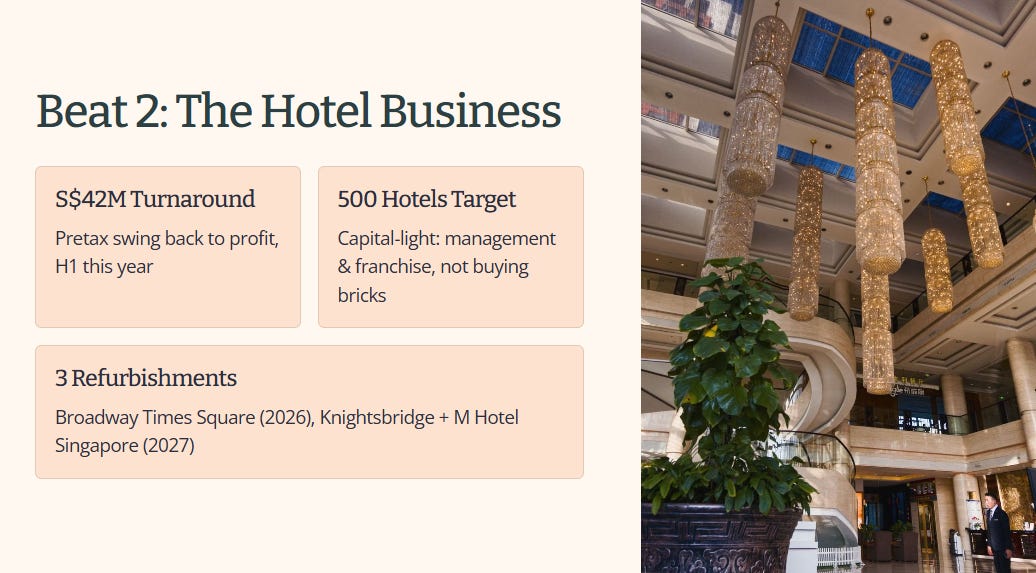
One part of CDL’s story that doesn’t get enough attention is the hotel portfolio. It swung back to profit in the first half of this year, a S$42 million pretax turnaround from a loss the year before. The group’s stated ambition is to grow toward 500 hotels globally, and the way they’re planning to get there matters, capital-light management and franchise contracts rather than buying more buildings outright. That’s a meaningfully different model from owning bricks and mortar, it means growing fee income and brand reach without the balance sheet having to carry every new property. Three of their hotels are also mid-refurbishment right now, Broadway Times Square finishing this year, London Knightsbridge and M Hotel Singapore both slated for 2027.
Beat 3: What’s actually launching
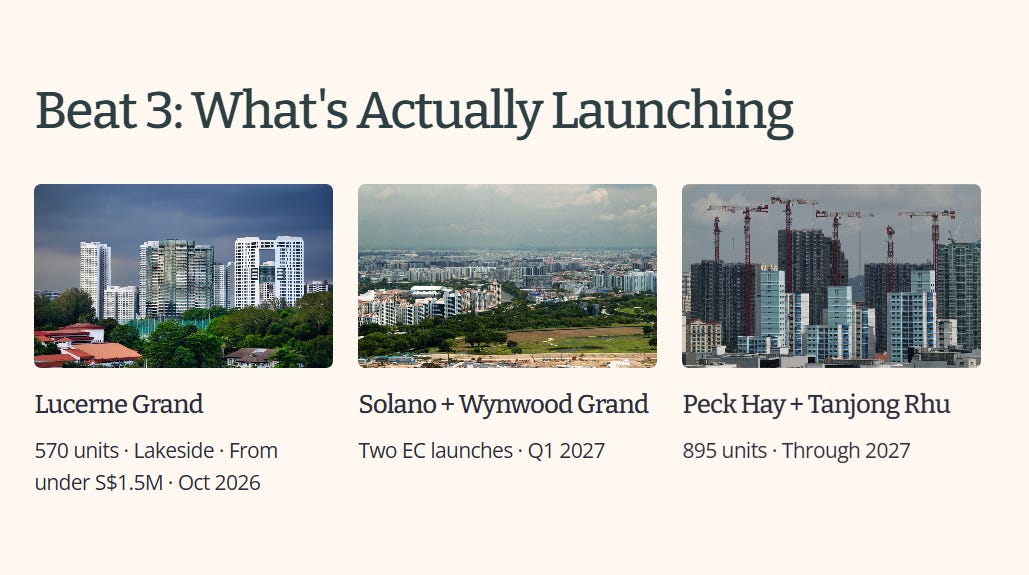
On the residential side, this isn’t a story about future promises, there’s a real, dated pipeline. Lucerne Grand, 570 units at Lakeside, previewed last week and launching early October, with starting prices under one and a half million dollars. Behind that, two executive condominium launches lined up for the first quarter of 2027, Solano Grand and Wynwood Grand, plus another 895 units across Peck Hay Road and Tanjong Rhu through the rest of that year. Whatever else is going on with this company, home buyers in Singapore are going to keep seeing the CDL name on new launches for the next two years at minimum.
Beat 4: Sixty years of history, and why that cuts both ways
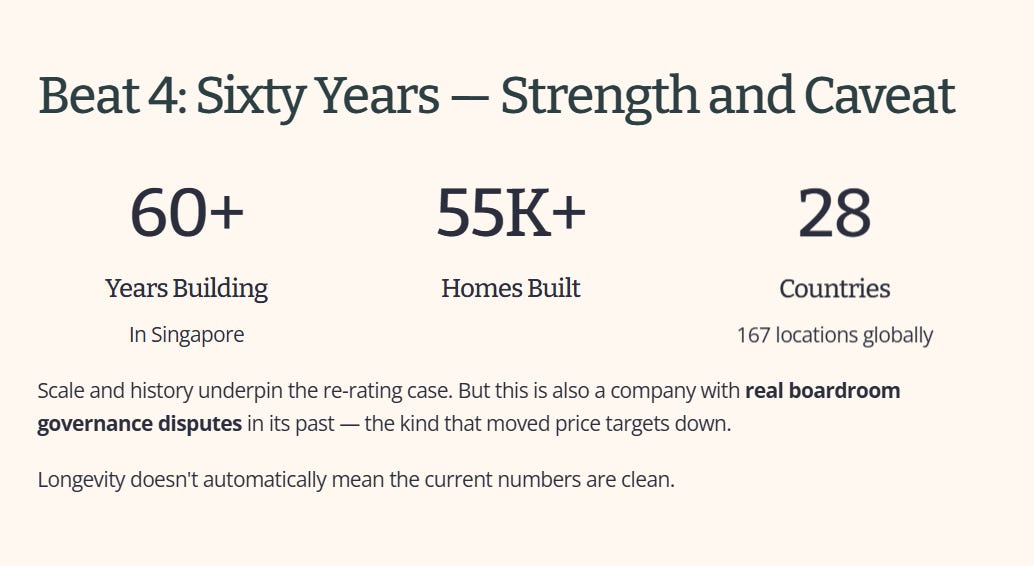
CDL isn’t a young company figuring things out, it’s been building homes in Singapore for over sixty years, more than 55,000 of them, with a footprint that now spans 167 locations across 28 countries. That kind of scale and history is genuinely a strength, it’s part of why an analyst can build a credible re-rating case around this name at all. But history here isn’t only good news. This is also a company that’s had real boardroom governance disputes in the past, the kind that shook investor confidence and moved price targets down at the time. Scale and longevity don’t automatically mean the current numbers are clean, and that’s exactly where this piece is headed next.
🔒 What’s Next
The 0.99x interest coverage figure above only tells you today’s problem. The next section shows you why it’s been getting worse for two straight years, not one.
