



UOB Kay Hian Says DBS Is Too Expensive. My Screen Says the Real Problem Is the Yield.
A downgrade to Hold cites a stretched valuation. My screen finds the stock still missing its own income hurdle by 52 basis points, price up, yield down.
UOB Kay Hian downgraded DBS to Hold this week, and every headline ran with the same number: 2.97 times 2027 book value, apparently too rich. That’s not the number that fails my own screen. The one that actually breaks it isn’t about price at all.
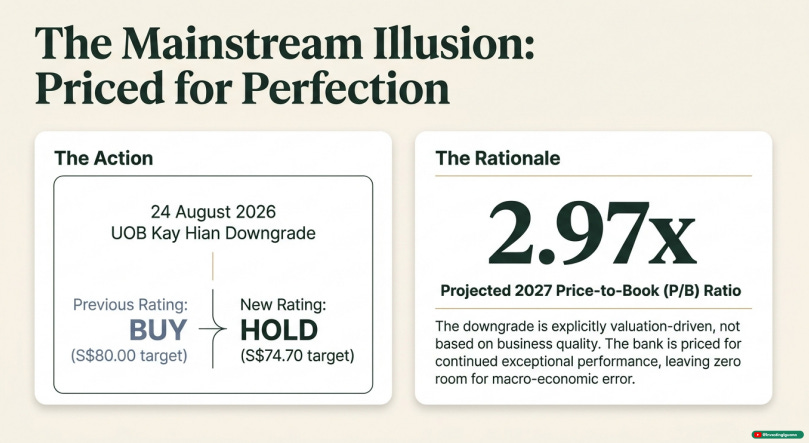
I get why the valuation story is the easy one to write. DBS just posted a record quarter, the share price is near the top of its range, and “too expensive” practically writes itself. But when I ran my own numbers, the stock passed every solvency test I threw at it and still failed the one test that actually matters to someone drawing income off this position: the yield. That’s a different kind of caution than the one making headlines this week.

The Analyst’s Case
Iggy’s Forensic Screen
Layer 1: Raw Fact
Layer 2: Historical and Sponsor Benchmark
Layer 3: Peer Context
Layer 4: Forward Scenario
Layer 5: Wallet Impact
Financial Health Checklist
The Dividend Trajectory
The Forensic Gap
Iggy’s Insight
What To Watch Next
Iggy’s Insight
Iggy’s Forensic Zone: Zone 4, Caution
Legacy Holders vs Fresh Capital
Iggy’s Elite Read
The Analyst’s Case
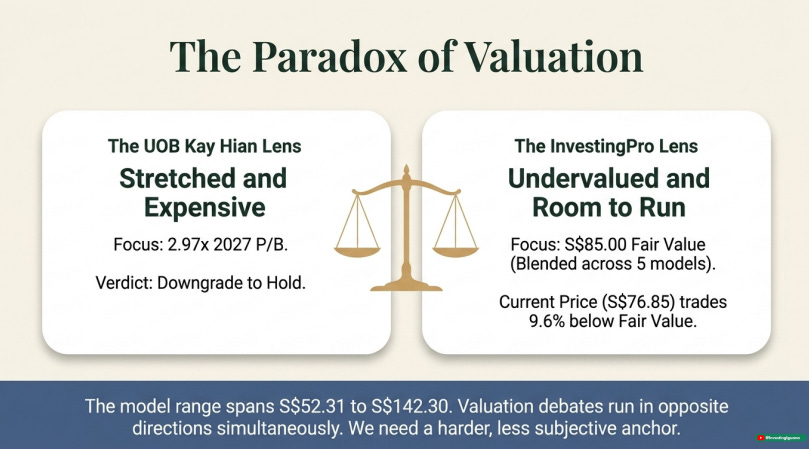
UOB Kay Hian, in a note dated 24 August 2026, downgraded the Singapore banking sector to Market Weight, citing a less supportive macro backdrop and elevated bond yields, the latter linked partly to sustained energy price pressure from the Middle East conflict. Within that call, DBS itself was downgraded to Hold.
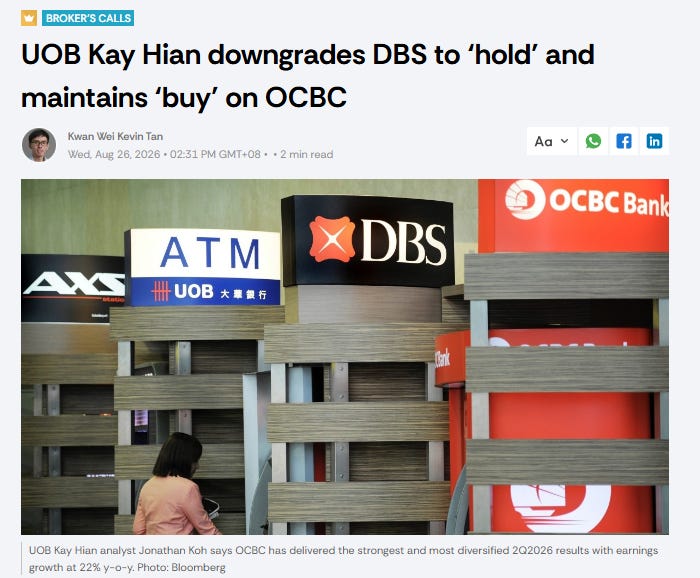
The stated reason is valuation, not business quality. The note’s core claim is that DBS trades at 2.97 times its projected 2027 price to book value, a level UOB Kay Hian considers stretched relative to what the bank’s earnings trajectory justifies. Sector-wide, the broker’s preferred pick shifted to OCBC instead, on the basis of a more diversified earnings mix, wealth management alone contributes 63% of OCBC’s fee income. No specific company-level rating or price target for UOB itself was visible in the excerpt reviewed for this piece.
This is worth taking seriously on its own terms. A stock trading at nearly three times book value is being priced for continued exceptional performance, and any bank facing margin compression has to keep clearing an increasingly high bar to justify that multiple. THE LOAD-BEARING ASSUMPTION is that DBS’s price has already run ahead of what its projected 2027 earnings can support.
Iggy’s Forensic Screen
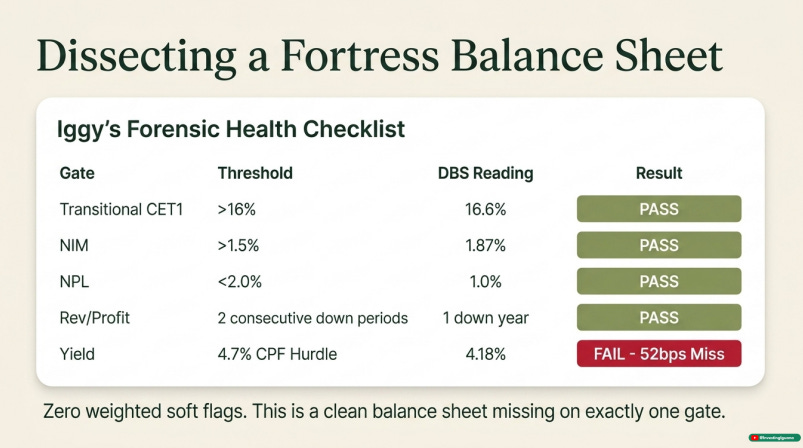
My own screen doesn’t test the same thing UOB Kay Hian tested. I don’t have a verified read on DBS’s forward price to book multiple this session, so I can’t confirm or dispute the 2.97 times figure directly. What I can do is run DBS through my own five hard gates and see where it actually lands.
Layer 1: Raw Fact
At S$76.85 (31 August 2026, delayed quote), DBS’s trailing twelve-month dividend yield sits at 4.18%, built on an annualised payout of S$3.18 per share. Transitional CET1 (Common Equity Tier 1, the proportion of a bank’s risk-weighted assets funded by its highest-quality capital) stands at 16.6% as at 30 June 2026. Net Interest Margin (NIM, the spread between what DBS earns on loans and pays on deposits) was 1.87% in the second quarter, down 18 basis points year on year. Non-Performing Loan ratio (NPL, the share of the loan book where borrowers are behind on payments) held at 1.0%, unchanged and low.
Layer 2: Historical and Sponsor Benchmark
Q2 2026 was a record quarter by nearly every measure: net profit of S$3.08 billion, up 9% year on year, return on equity of 17.5%, cost-income ratio holding at 39%. Zoom out to the full fiscal year, though, and the picture is less linear. DBS’s most recently completed full year saw net income actually decline 3.2%, the first down year after four consecutive years of double-digit growth. That’s not a red flag on its own, a single down year sandwiched between growth years doesn’t clear my two-consecutive-period threshold for a soft flag, but it’s a useful corrective to the idea that DBS’s growth story has been a straight line up. It hasn’t. This particular quarter was strong. The trailing year was not uniformly so.
Layer 3: Peer Context
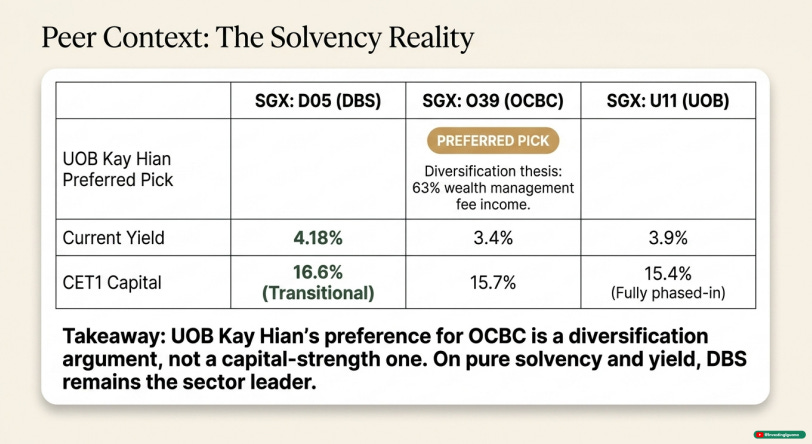
Side by side on the same delayed-quote basis, DBS’s 4.18% yield is meaningfully ahead of OCBC’s 3.4% and UOB’s 3.9%. On Transitional CET1, DBS’s 16.6% also leads OCBC’s 15.7%, though both clear my 16% Zone 1 solvency floor, with UOB’s fully phased-in figure of 15.4% suggesting a broadly similar capital position across all three, even though that’s not directly comparable to a transitional basis. On pure solvency, DBS isn’t the outlier here. UOB Kay Hian’s preference for OCBC is explicitly a diversification argument, not a capital-strength one.
Layer 4: Forward Scenario
Consensus EPS forecasts, drawn from 13 to 14 analysts, put DBS’s earnings at S$4.11 for the coming fiscal year and S$4.43 the year after, growth of 6.5% and 7.8% respectively. The corresponding forward price to earnings multiples are 18.5 times and 17.2 times, compressing as earnings catch up to price, assuming the price itself doesn’t move. That’s a different valuation lens from UOB Kay Hian’s price to book concern, and it doesn’t confirm or contradict the 2.97 times figure directly, but it’s worth naming: a forward P/E in the high teens on a bank is not an obviously cheap multiple either, so the general direction of the stretched-valuation concern isn’t coming out of nowhere, even if I can’t verify the specific figure cited.
Layer 5: Wallet Impact
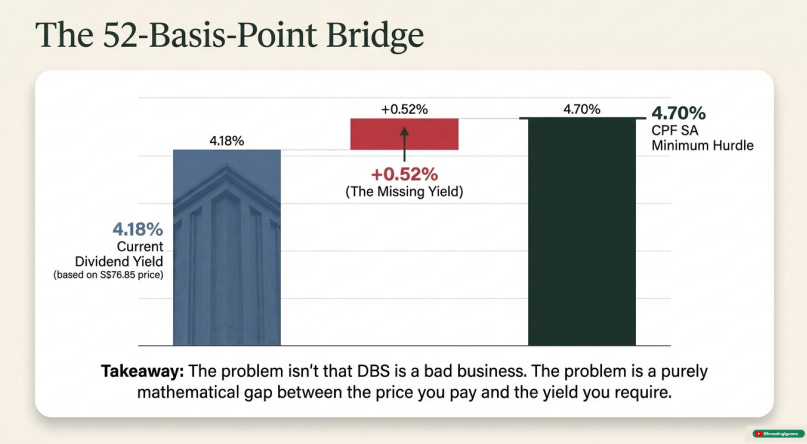
Here’s what actually matters if you’re 58, holding DBS in a CPF or SRS portfolio for income, not for a valuation call. The bank is solvent, well capitalised, and executing well operationally. None of that is in dispute. What’s in dispute is whether the price you’d pay today, S$76.85, gets you enough income to clear my own retirement-suitability bar. It doesn’t, by 52 basis points. That’s a genuinely narrow miss, not a business-quality problem, but it’s a real one, and it’s a different problem than “the stock is expensive,” even though both concerns point toward the same word: caution.
Financial Health Checklist
The Dividend Trajectory
DBS’s payout structure has two distinct components right now, and conflating them overstates the guaranteed portion of what a fresh buyer is actually locking in.
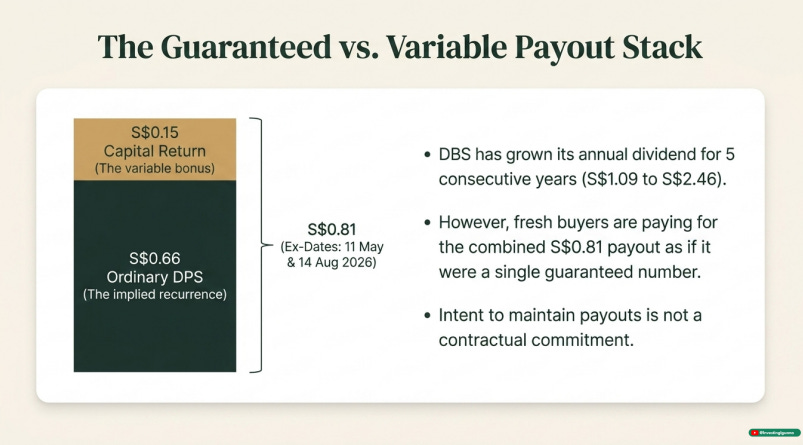
Over a longer horizon, annual dividend per share has grown every year for the last five years running, from S$1.09 to S$2.46, each year’s increase outpacing the year before in absolute terms even as the growth rate itself has moderated.
That’s a genuinely strong trajectory. The open question, and it’s one I can’t resolve from this session’s data alone, is how much of the most recent growth reflects the capital return component specifically, which by its own definition isn’t guaranteed to recur at the same rate the way an ordinary dividend increase implies.
Management has signalled intent to continue the combined payout, but intent isn’t the same as a contractual commitment, and a fresh buyer today is paying for both components as if they were one number.
The Window Is Already Open
The Window Closes Fast. In this market, the difference between a “Sanctuary” and a “Yield Trap” is decided in a single trading session. By the time this analysis reaches you as a free subscriber, the entry window Iggy identified has already opened, and often closed.
Iggy’s Elite Investors don’t just get the report earlier. They get it when the numbers still matter, zero-day forensic breakdowns, the full “Red Zone” watchlist, and institutional-grade cheatsheets at the moment the setup is live, not after the market has already priced it in.
For S$12/month, less than two kopi and kaya toast sets at Raffles Place, you stop being the Exit Liquidity and start being the Analyst.
The Forensic Gap
This is where two ways of looking at DBS’s valuation start to genuinely disagree with each other, not just use different vocabulary.
Taken at face value, InvestingPro’s blended model actually says DBS has room to run before it’s expensive, the opposite direction from UOB Kay Hian’s price to book concern. I wouldn’t lean hard on this. A model range spanning S$52 to S$142 for the same stock is wide enough that “Fair Value” here reads closer to an average of very different opinions than a precise number worth quoting on its own.
🟢 Iggy’s Insight
Two respected sources are looking at the same stock and reaching opposite conclusions on whether the price is too high. UOB Kay Hian’s price to book lens says stretched. InvestingPro’s blended model says there’s still room below fair value. Neither of these tells you what actually matters for someone holding DBS for income: whether the yield you’re locking in today clears your own bar. That’s the quiet lesson here. Valuation debates between smart people can run in opposite directions at the same time, and both can be defensible on their own terms. The yield hurdle doesn’t care which valuation camp is right. It just asks whether the income supports the price, and right now, by a narrow margin, it doesn’t.
🔒 What’s Next
The yield hurdle miss sits at 52 basis points, roughly in line with how much DBS’s forward earnings multiple has already compressed over the past year, and whether that compression alone is enough to close the gap is the calculation the next section finishes.
