


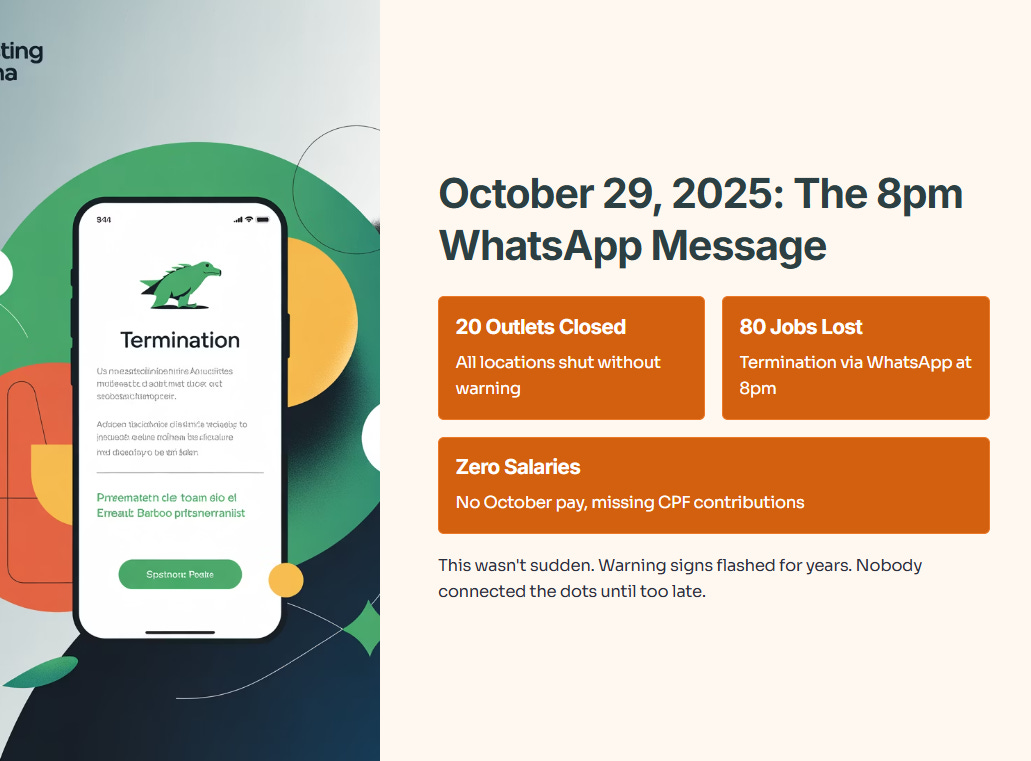
On October 29, 2025, Twelve Cupcakes shut down all 20 outlets without warning. Eighty employees lost their jobs instantly. They received termination notices via WhatsApp at 8pm. No salaries for October. CPF contributions for September and October? Missing. The company entered provisional liquidation the same day.
This wasn’t a sudden storm. The warning signs had been flashing for years. Investors, employees, and even regulators had seen pieces of the puzzle. But nobody connected the dots until it was too late.
For Singapore retail investors, this story matters. It’s not just about cupcakes. It’s about spotting systemic risk before your capital vanishes. It’s about understanding that brand recognition doesn’t equal business health. And it’s about learning to read the signals that shout “get out” before the doors lock and the lights go dark.
In This Article:

• The Timeline: From S$2.5 Million Investment to Total Collapse
• Red Flag #1: Systemic Labor Violations Spanning Multiple Management Teams
• Red Flag #2: Declining Revenue and Widening Losses Despite Stable Operations
• Red Flag #3: Corporate Governance Failures and Management Opacity
• The Human Cost: 80 Workers, Unpaid Salaries, and Missing CPF Contributions
• The Broader Singapore F&B Context: Creative Destruction or Crisis?
• The Iguana’s Toolkit: 5 Red Flags from the Twelve Cupcakes Collapse
• 1. Red Flag: Regulatory Fines Aren’t Just “Costs”
• 2. Red Flag: The “Brand vs. Business” Illusion
• 3. Red Flag: The “Revenue-Per-Outlet” Death Spiral
• 4. Red Flag: The CPF Cash-Flow Signal
• 5. Portfolio Takeaway: Check Your S-REIT Tenant Risk
• Final Thoughts: The Red Flags Were There All Along
The Timeline: From S$2.5 Million Investment to Total Collapse
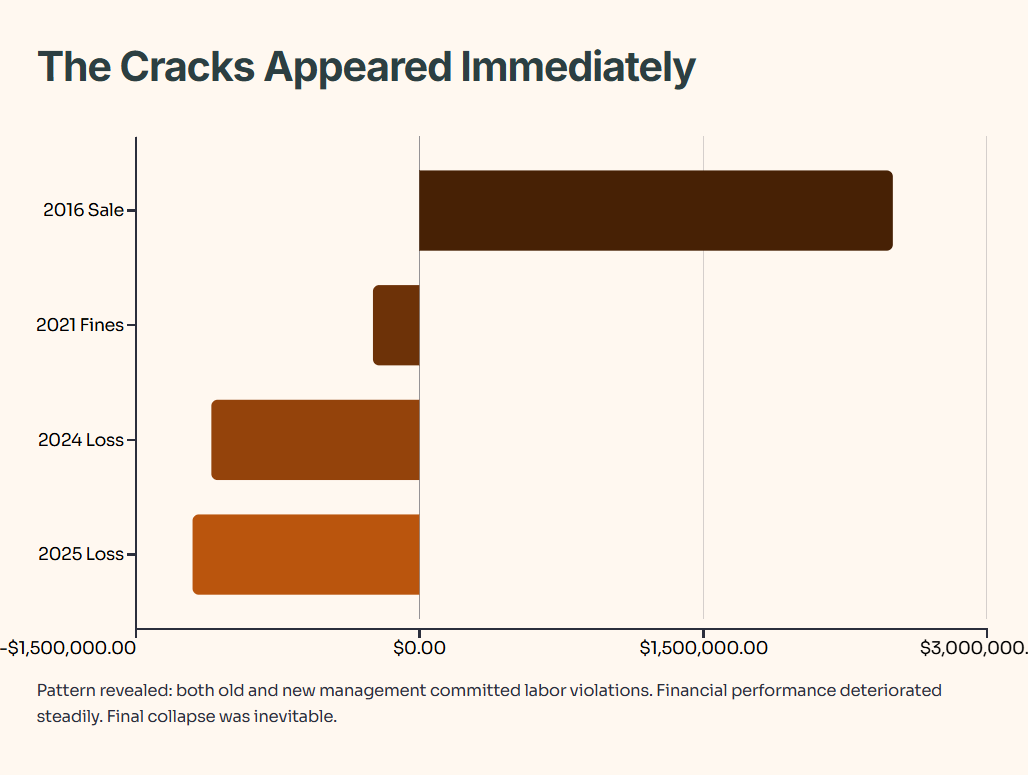
Twelve Cupcakes started in 2011. Former radio DJ Daniel Ong and actress Jaime Teo co-founded the brand. They rode the cupcake wave and expanded fast. By 2016, the chain had 17 outlets in Singapore and franchises in Jakarta, Taipei, and Hong Kong.
Then came the divorce. Ong and Teo split in late 2016. They sold the business to Dhunseri Group, an India-based tea conglomerate, for S$2.5 million in December 2016. The new owners promised expansion. They planned to grow from 17 to 24 outlets. They wanted to add cakes, cookies, and other desserts.
But the cracks appeared immediately.
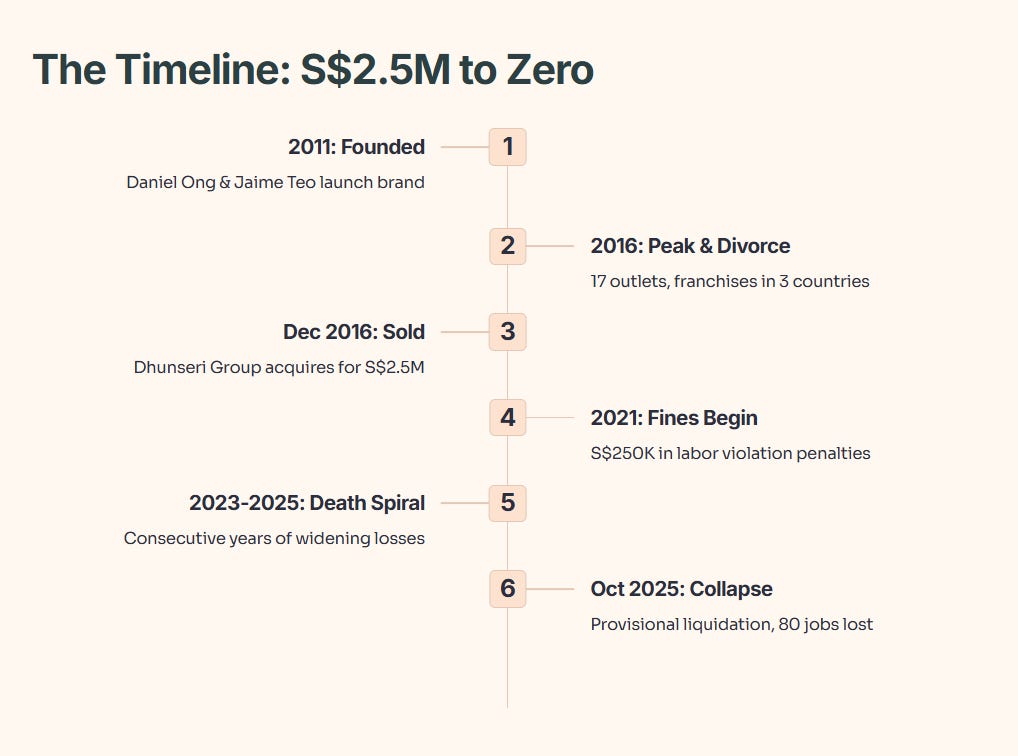
What This Table Shows: The timeline reveals a pattern. Both old and new management committed labor violations. Financial performance deteriorated steadily. The final collapse wasn’t sudden—it was the inevitable result of years of mismanagement and declining fundamentals.
Red Flag #1: Systemic Labor Violations Spanning Multiple Management Teams
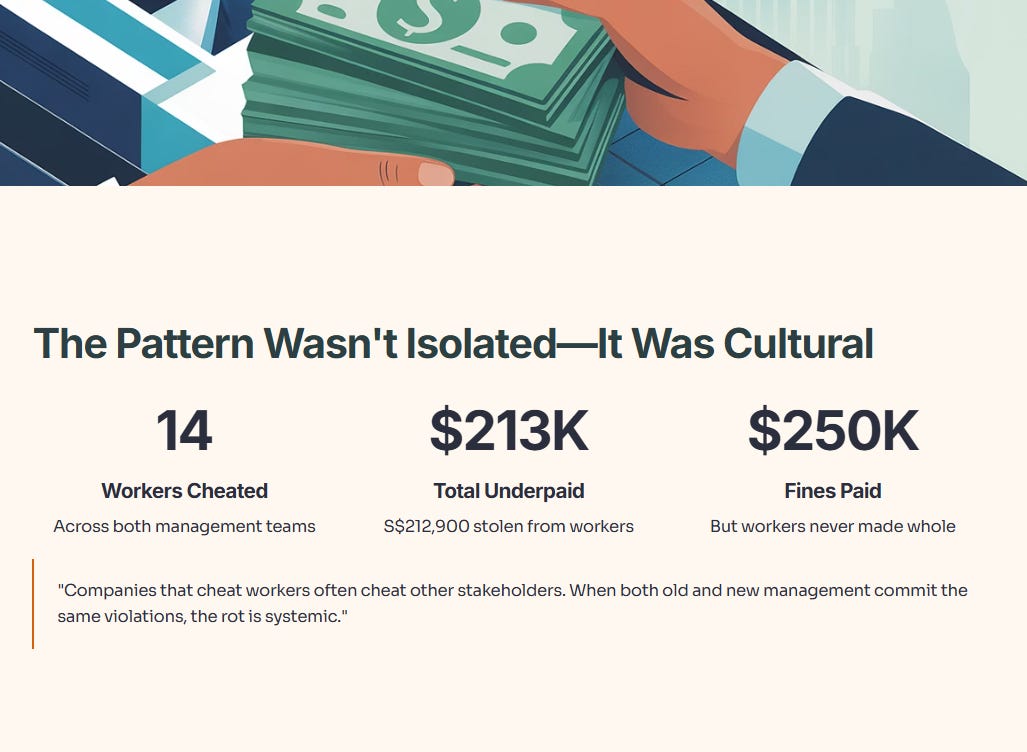
Between 2013 and 2016, Twelve Cupcakes underpaid seven foreign workers a total of S$98,900. These employees—sales executives, customer service staff, and a pastry chef—were promised salaries between S$2,000 and S$2,600. They received S$350 to S$1,400 less per month.
The scheme was deliberate. The company credited full salaries to workers’ bank accounts. Then it asked them to return the difference in cash. No paper trail.
The Ministry of Manpower investigated after a tip-off in December 2018. In January 2021, the company was fined S$119,500. Daniel Ong and Jaime Teo were each fined S$65,000 in March and May 2021.
But here’s the critical detail: the new owners, Dhunseri Group, repeated the same violations.
From December 2016 to November 2018, under Dhunseri’s ownership, the company underpaid seven more foreign workers a total of S$114,000. The defense claimed they inherited the practice from the previous management. The court didn’t care. The company was fined S$119,500.
Two management teams. Same crime. Different excuses.
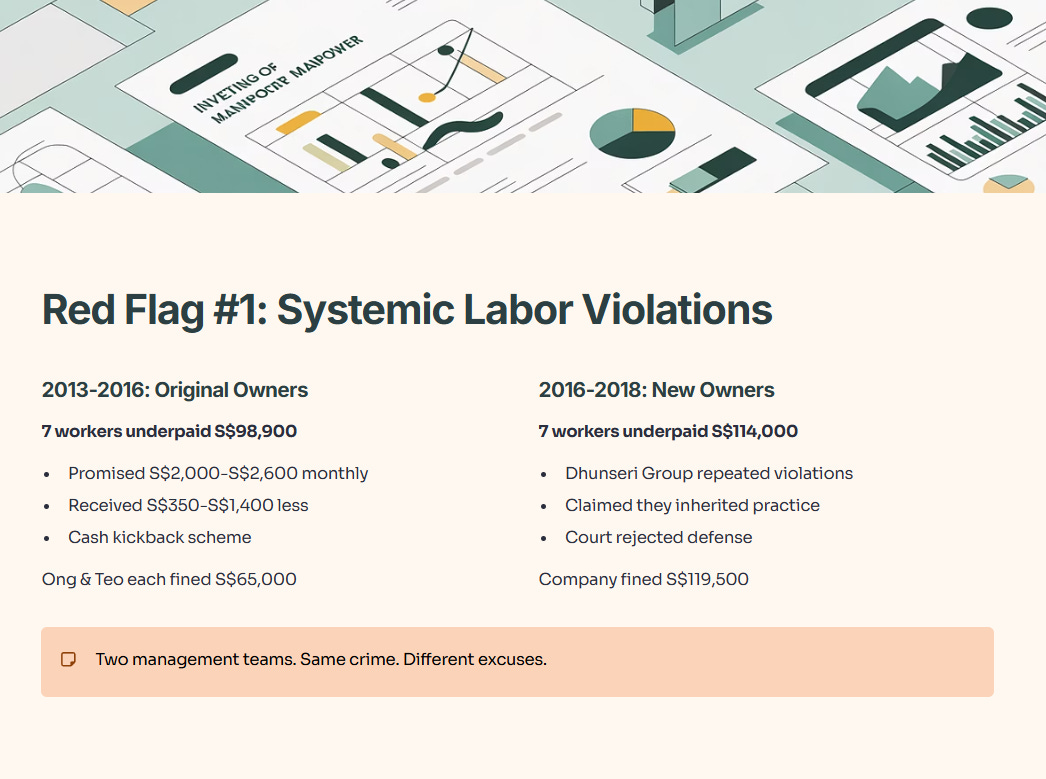
Why This Matters for Investors: Labor violations aren’t just HR issues. They signal deeper problems. Companies that cheat workers often cheat other stakeholders. The pattern here wasn’t isolated misconduct—it was cultural. When both old and new management commit the same violations, the rot is systemic.
Red Flag #2: Declining Revenue and Widening Losses Despite Stable Operations
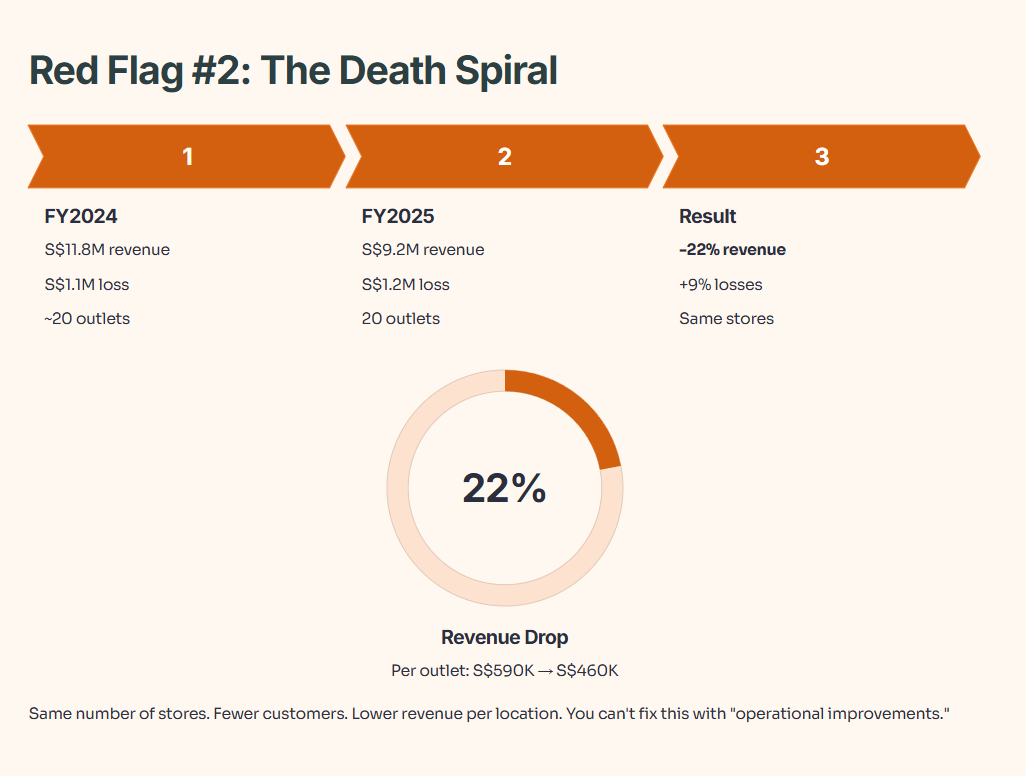
By FY2024, Twelve Cupcakes was bleeding money. Revenue fell from S$11.8 million in FY2024 to S$9.2 million in FY2025—a 22% drop. Net losses widened from S$1.1 million to S$1.2 million.
The outlet count stayed stable at around 20. So this wasn’t about overexpansion or closing underperforming stores. Revenue per outlet dropped 22%, from S$590,000 to S$460,000.
Customer demand was falling. Fast.
What This Table Reveals: The business model was broken. Same number of stores. Fewer customers. Lower revenue per location. Losses getting worse. This is a death spiral. You can’t fix this with “operational improvements” or “cost-cutting.” When your top line shrinks by 22% in one year, you’re done.
Singapore’s F&B industry is brutal. In 2024, over 3,000 outlets closed—the highest in 20 years. Monthly closures hit 307 in 2025, up from 254 in 2024. Rising rents, labor shortages, and fierce competition from overseas brands crushed operators.
But here’s the key: over 3,790 new F&B outlets opened in 2024, meaning 316 new openings per month. The industry still grew by 743 net new outlets. The market wasn’t shrinking. Weak operators were just getting weeded out.
Twelve Cupcakes was weak.
Red Flag #3: Corporate Governance Failures and Management Opacity
Corporate governance isn’t boring compliance paperwork. It’s the operating system that determines whether cash flows reach shareholders or vanish into management’s pockets.
Twelve Cupcakes failed this test repeatedly.
The original founders, Daniel Ong and Jaime Teo, claimed they “signed many documents without a second glance” and let a third-party agency handle payroll. That’s not ignorance. That’s negligence. If you’re a director, you’re responsible for what your company does. Full stop.
The new owners blamed the old owners for the labor practices they inherited. Then they repeated the same violations. That’s not bad luck. That’s deliberate misconduct.
When Twelve Cupcakes finally collapsed in October 2025, it violated every principle of responsible retrenchment. The company didn’t notify the union until the day of closure. Employees got WhatsApp messages at 8pm on October 29 telling them they were fired. No advance warning. No consultation. No severance negotiations.
The Food, Drinks and Allied Workers Union called the move “not only irresponsible, but also lacked due process.” The Ministry of Manpower agreed. MOM is investigating the company for non-payment of salaries and breaches of the Employment Act.
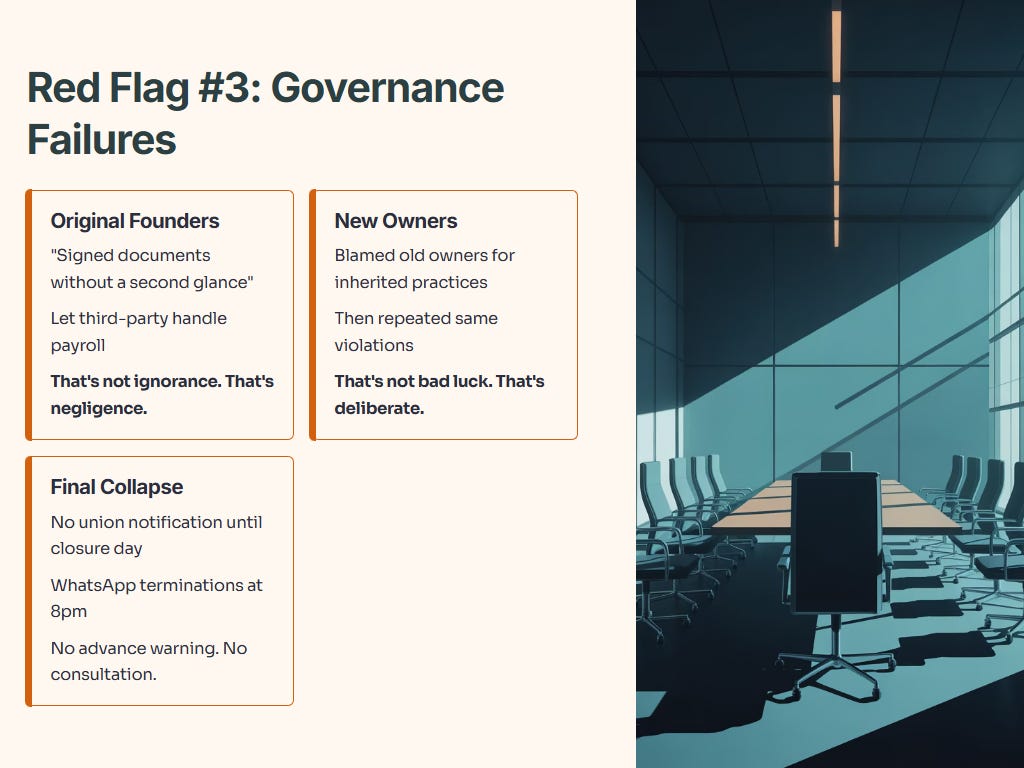
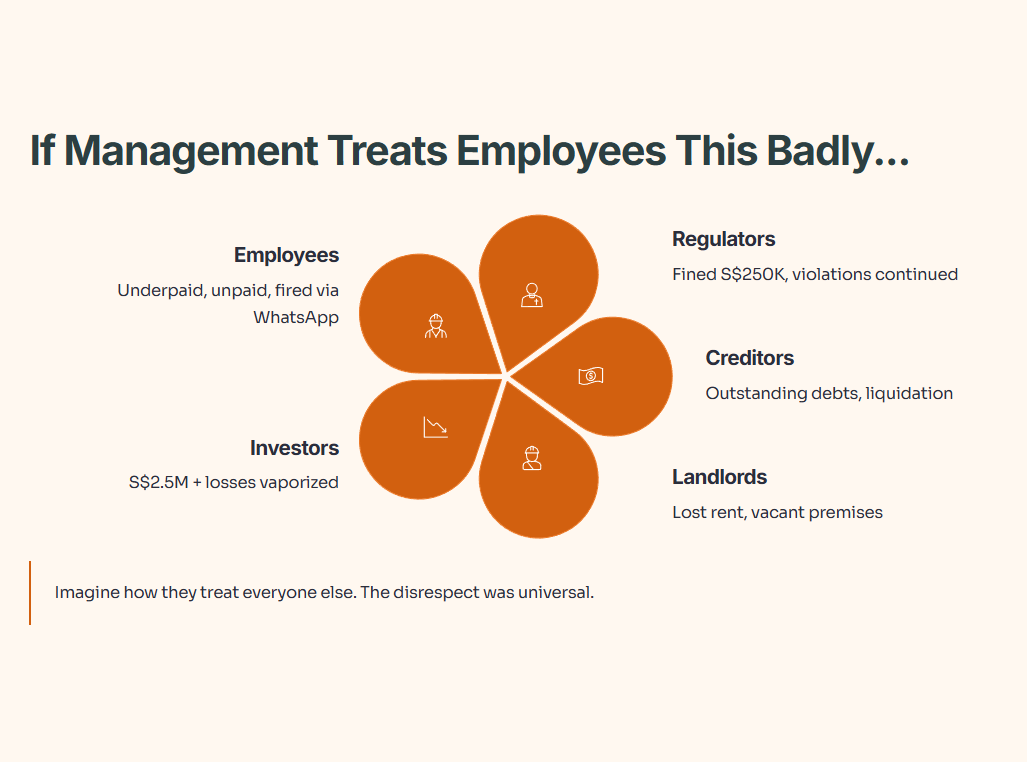
Why Governance Matters: Companies with weak governance can hide problems for years. But eventually, the chickens come home to roost. If management treats employees this badly, imagine how they treat creditors, landlords, and investors. The disrespect was universal.
The Human Cost: 80 Workers, Unpaid Salaries, and Missing CPF Contributions
Fifteen former employees visited the MOM Services Centre on October 31 to file claims for unpaid wages. Some workers reported missing CPF contributions for September and October. The CPF Board filed a claim with the liquidator to recover outstanding contributions.
One outlet manager told reporters: “We did not know anything about this in advance. There was no notice period at all. With so many bills to pay, starting with our rent—what are we going to do now?”
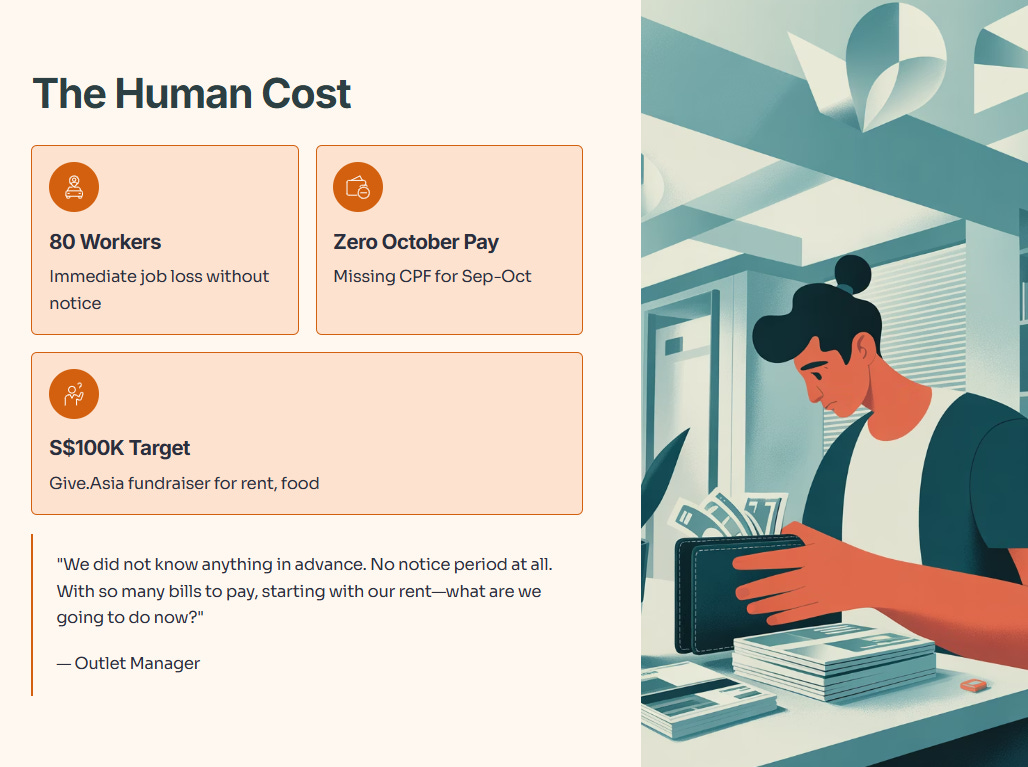
Affected workers launched a Give.Asia fundraising campaign. Their target: S$100,000 to cover rent, food, and basic expenses while they wait for the liquidator’s report.
The taskforce for Responsible Retrenchment and Employment Facilitation—comprising MOM, Workforce Singapore, NTUC, and e2i—stepped in to provide job-matching support, career coaching, and claims assistance.
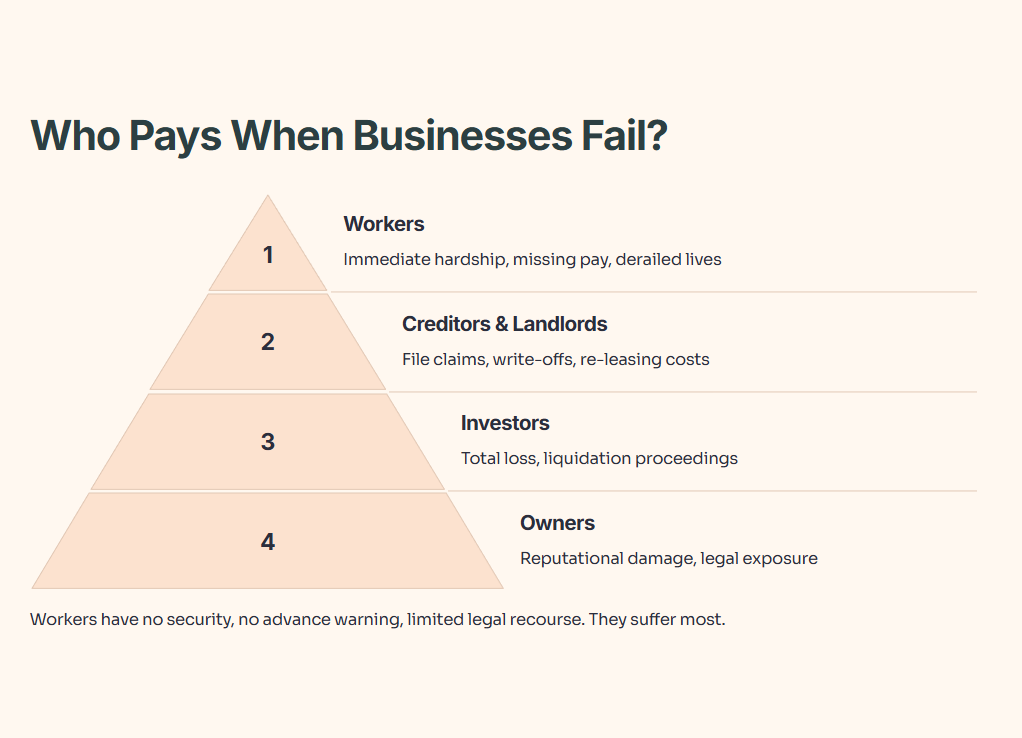
The Reality Check: When businesses fail, workers suffer most. They have no security, no advance warning, and limited legal recourse. Creditors file claims. Landlords find new tenants. Investors write off losses. But workers face immediate financial hardship. Missing salaries and CPF contributions can derail lives.
The Broader Singapore F&B Context: Creative Destruction or Crisis?
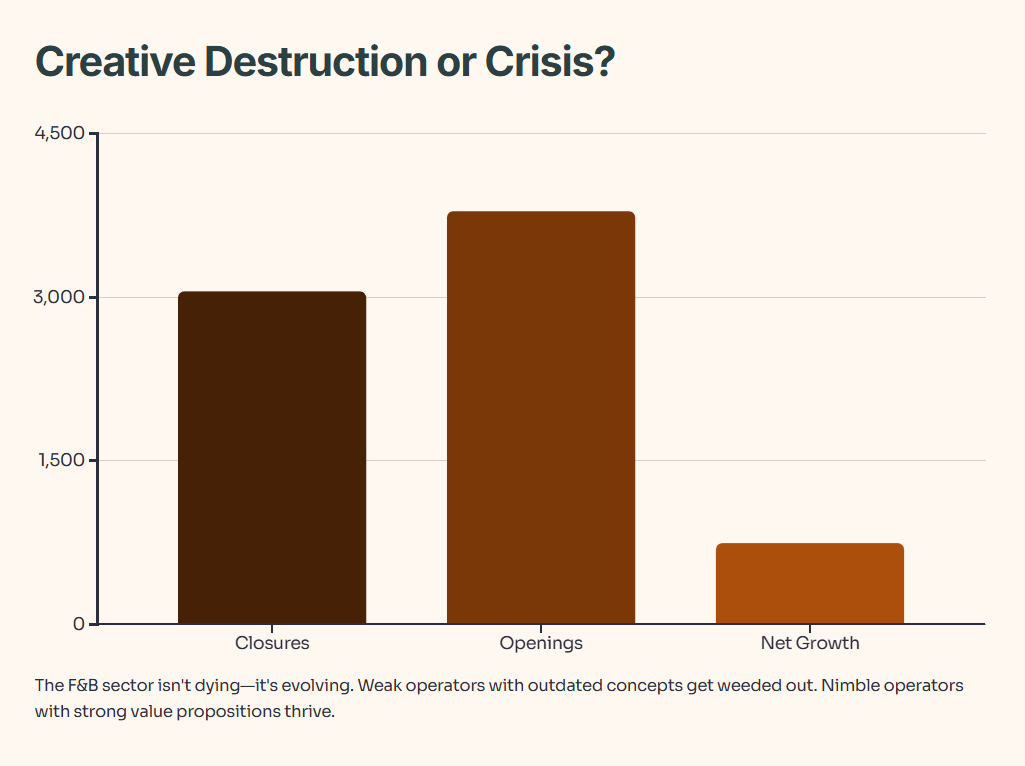
Singapore’s F&B sector recorded 3,047 closures in 2024—the highest in 20 years. In 2025, monthly closures rose to 307, up from 254 in 2024. High-profile casualties included The Prive Group, Haidilao (three outlets), and Eggslut.
But context matters. Over 3,790 new F&B outlets opened in 2024, averaging 316 per month. The industry grew by 743 net new outlets. Singapore’s foodservice market is worth S$28.92 billion in 2025, with a projected CAGR of 18.7% through 2030.
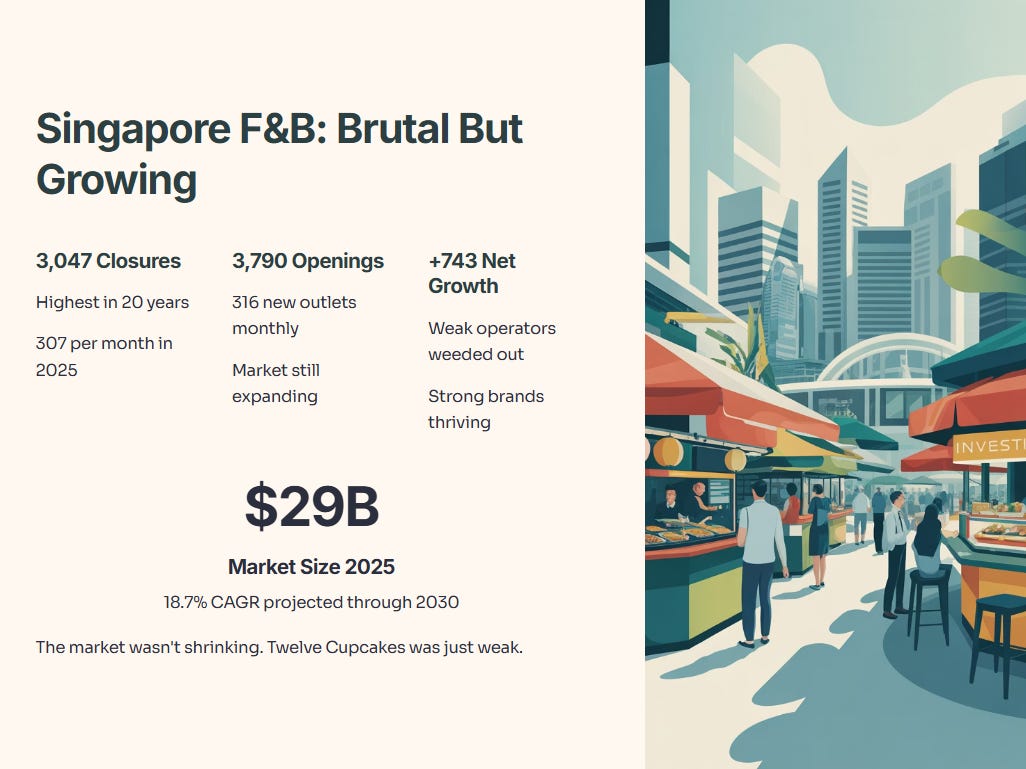
What This Means: The F&B sector isn’t dying. It’s evolving. Weak operators with outdated concepts, poor unit economics, and declining customer demand are getting weeded out. Nimble operators with strong value propositions, experiential dining, and efficient cost structures are thriving.
Twelve Cupcakes fell into the first category.
