


Are your Singaporean portfolios unknowingly exposed to a brewing economic storm in our own backyard? While global headlines focus on US-China rivalry, the real battleground for your hard-earned capital is shifting to Southeast Asia. A flood of cheap Chinese goods now threatens to drown local industries and derail regional growth, demanding a deep, proactive re-evaluation of your investment strategy.
Alright, folks, Iggy here, your Investing Iguana. Gather 'round, because today, we’re diving deep into a fascinating, yet deeply unsettling, economic phenomenon playing out right on Singapore’s doorstep. Forget the complex jargon for a moment; let's start with a simple analogy that perfectly captures the current dilemma faced by our vibrant Southeast Asian neighbours.
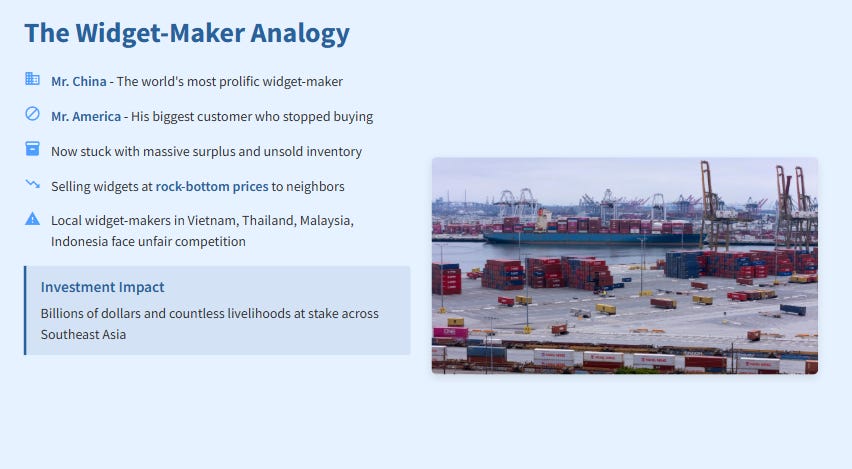
Imagine your neighbour, let’s call him Mr. China, is a master widget-maker, the most prolific in the world. For decades, he’s sold nearly all his widgets to one incredibly rich customer across the street, Mr. America. One day, they have a colossal argument. Mr. America, frustrated, screams, "I'm not buying your widgets anymore!" and slams the door shut, hitting Mr. China squarely in the face with tariffs and restrictions.
Now, Mr. China is stuck. His immense factories churn out widgets, but his biggest customer is gone. He’s got a garage full of unsold inventory, and he needs to keep operations running and workers employed. So, what does he do? He looks around the neighbourhood. He sees you, Vietnam. He sees you, Thailand, Malaysia, Indonesia. He sets up a table on his front lawn and starts selling his widgets to everyone else for rock-bottom prices, often below his production cost. From the outside, it sounds like a great deal for the neighbourhood, right? Cheap widgets for everyone!
But here’s the rub, and this is where the plot thickens for us as investors: What if you, Vietnam, are also a widget-maker? What if your family business, making widgets for generations, suddenly has to compete with Mr. China’s super-efficient, often state-subsidised mega-factory selling at a loss? This isn't just a hypothetical scenario; this is the exact drama, with billions of dollars and countless livelihoods on the line, unfolding across Southeast Asia right now. It's a complex dance of necessity, opportunity, and profound risk. If you're a Singaporean investor with any exposure to regional markets, understanding this dynamic isn't just recommended – it’s absolutely critical for safeguarding and growing your wealth.
The Genesis of the Flood: How US-China Tensions Reconfigured Global Trade
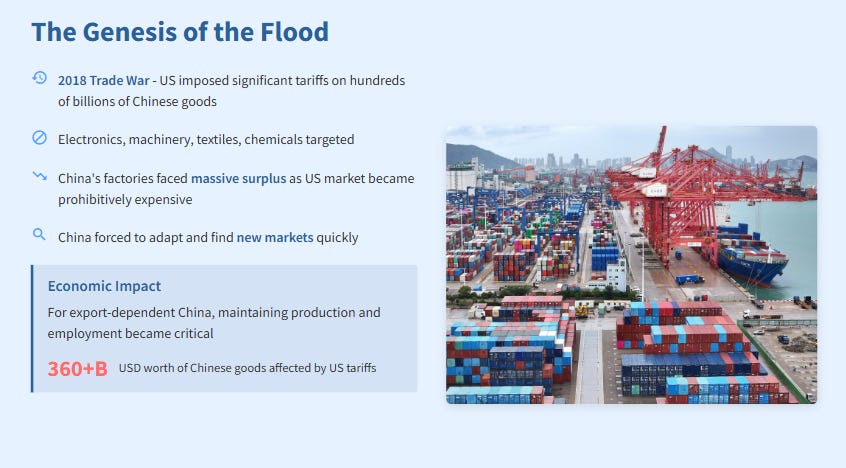
To truly grasp the magnitude of what's happening, we need to rewind a bit. The US-China trade war, initiated in 2018 and largely continued by the current administration, wasn't just political theatre. It was a seismic shift in global supply chains. By imposing significant tariffs on hundreds of billions of dollars worth of Chinese goods – from electronics and machinery to textiles and chemicals – the US made it prohibitively expensive for American companies and consumers to import directly from China. The goal was to reduce the US trade deficit, protect domestic industries, and pressure Beijing on intellectual property and market access.
The immediate effect on China was profound. Its factories, built to serve the insatiable demand of the American consumer, suddenly found themselves with a massive surplus. This wasn't just about a few products; it affected entire industrial ecosystems. For a country heavily reliant on exports to fuel its economy and maintain social stability through employment, this was a severe blow. The Chinese government and its industrial giants were forced to adapt, and their adaptation strategy is what’s now reverberating across Southeast Asia. They needed new markets, and they needed them fast.
