



Your CPF Does Not Follow Your Will: What Your Family Must Do 🦖
Marriage cancels a CPF nomination, divorce does not, and a will cannot replace it. Here is what each path costs your family and the order they must act in.
Imagine a retired uncle at a Jurong West coffee shop telling his friends that his lawyer has already done his will, so his CPF is settled. Nobody at the table argues, because it sounds responsible. The CPF Board says the opposite in writing: a will cannot be used to distribute CPF savings. (An invented example, to show how common the assumption is. The rule is the CPF Board’s.)
If you are a CPF member, who receives your savings when you die is decided by one form, and by what happens if you have not filled it in. I read the CPF Board’s pages and the Public Trustee’s Office pages, and I checked where they disagree with each other. This piece sets out what each path looks like, what it costs, and what your family has to do and in what order.
I am not a lawyer, and nothing here is legal advice. These are the rules as the two agencies state them. A second marriage, a Muslim estate or a nominee under 18 is worth putting to the CPF Board or the Public Trustee’s Office directly.
What This Piece Does
It sets out what happens to CPF savings on death with and without a nomination, and what a nomination does and does not cover.
It shows how many members die without a nomination, and what the law does with their savings.
It works through the Public Trustee’s fee, the steps your family takes in order, and the situations in which a nomination stops working.
The first part is free, including the law’s default split and the marriage rule; the fee worked through on four balances, the household cases and the assets a nomination cannot reach are in the paid half.
Nothing here is legal advice or a recommendation.
Table of Contents
The Short Answer
What a Nomination Covers, and What It Does Not
What Happens With a Nomination
What Happens Without One
How Many Members Die Without One
The Family’s Steps, in Order
What the Paid Half Adds
The Public Trustee’s Fee, Worked Through
Five Household Cases
What a Nomination Cannot Reach
Iggy’s Forensic Read
What I Would Check Next
Sources
The Short Answer
Three rules cover most of it.
First, CPF savings do not form part of your estate, so a will cannot distribute them. The CPF Board says this protects the savings from creditors and keeps them for your nominees.
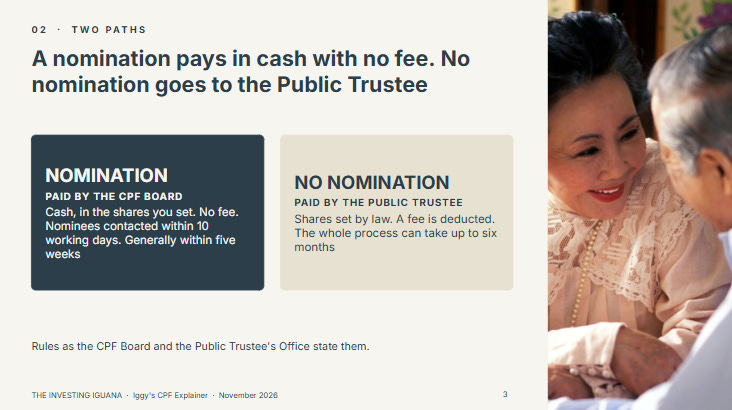
Second, with a valid nomination, the CPF Board pays your nominees in cash, in the shares you set, and charges no fee. It says it contacts nominees within 10 working days of being told of the death, and that nominated savings are generally distributed within five weeks.
Third, without a valid nomination, the CPF Board sends your Ordinary, Special, MediSave and Retirement Account savings to the Public Trustee’s Office. The Public Trustee distributes them under the Intestate Succession Act, or under Muslim inheritance law for Muslims, deducts a fee, and the process can take up to six months.
What a Nomination Covers, and What It Does Not
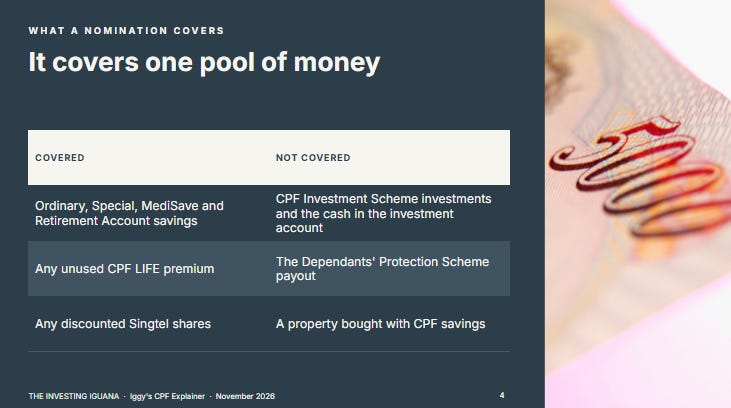
A valid nomination covers three things: the savings in your Ordinary, Special, MediSave and Retirement Accounts, any unused CPF LIFE premium, and any discounted Singtel shares.
It does not cover the investments you bought under the CPF Investment Scheme or the cash in your investment account, which form part of your estate. It does not cover the payout from the Dependants’ Protection Scheme. It does not cover a property bought with CPF savings.

🦖 Iggy’s Insights
The word nomination suggests that one form deals with everything. It deals with one pool of money, the balances sitting in four CPF accounts and the unused CPF LIFE premium. Money that has already become an investment or a flat moves under other rules. I separate the two because the first moves on a form, and the second needs an estate, and the paid half goes through who claims each item.
What Happens With a Nomination
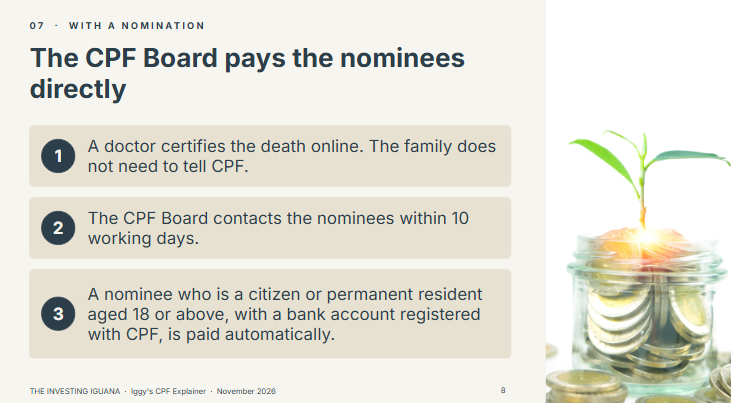
If you are a Singapore Citizen or Permanent Resident who dies in Singapore, a doctor certifies the death online and that registers it with the Immigration and Checkpoints Authority, which informs the CPF Board. Your family does not need to tell CPF. If the death happens overseas, the family reports it to the Immigration and Checkpoints Authority. If the member was a foreigner with a CPF account, the family reports it to the CPF Board.
The CPF Board contacts your nominees within 10 working days of being informed. If a nominee is a Singapore Citizen or Permanent Resident aged 18 or above, with a local address and a bank account registered with the CPF Board, the money is paid automatically and no application is needed. Other nominees get instructions to apply through Singpass. Nominees can also log in with Singpass to see the deceased member’s account information, generally from 10 working days after the CPF Board is notified.
The payment is in cash. Nominees do not pay a fee to receive it, and making the nomination is free.
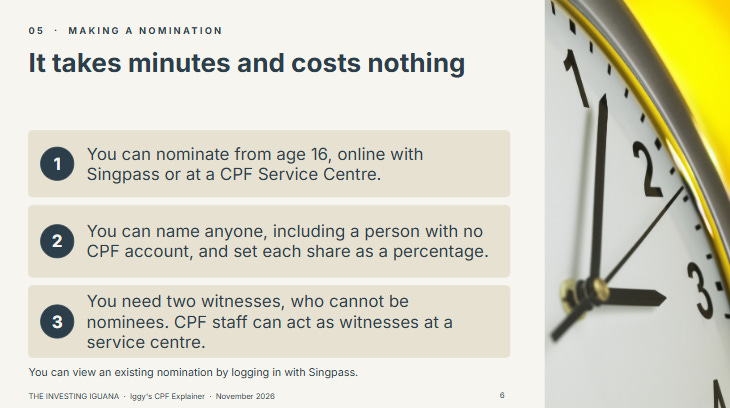
Making one takes minutes. You can do it from age 16, online with Singpass or at a CPF Service Centre, and you can name anyone, including a person who has no CPF account. You choose each nominee’s share as a percentage. You need two witnesses, who cannot be nominees. At a service centre, CPF staff can act as your witnesses. You can check an existing nomination by logging in with Singpass and choosing View nomination details.

The rule that surprises people is marriage. The CPF Board says marriage automatically revokes an existing nomination. Divorce does not revoke one. A nomination you made at 25 and forgot about is gone after you marry, and the savings follow the default rules until you make a new one.
What Happens Without One
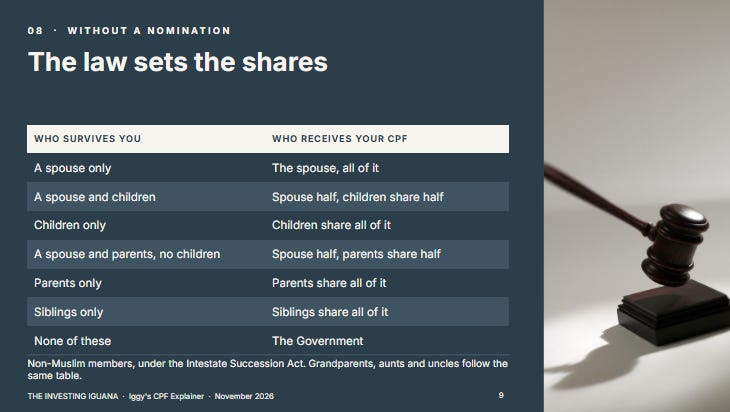
The CPF Board sends the savings to the Public Trustee’s Office, which pays them to your family under the law and not under your wishes. For non-Muslims, the Intestate Succession Act sets the shares. The Singapore Courts publish a summary table, and this is how I read it:
A child who has died is represented by that child’s own children, who take that child’s share. Two points stand out. Once you have a child, your parents receive nothing from this route. And the CPF Board says that if you want to give a larger share to certain loved ones, for example the one who cared for you, a nomination is required.
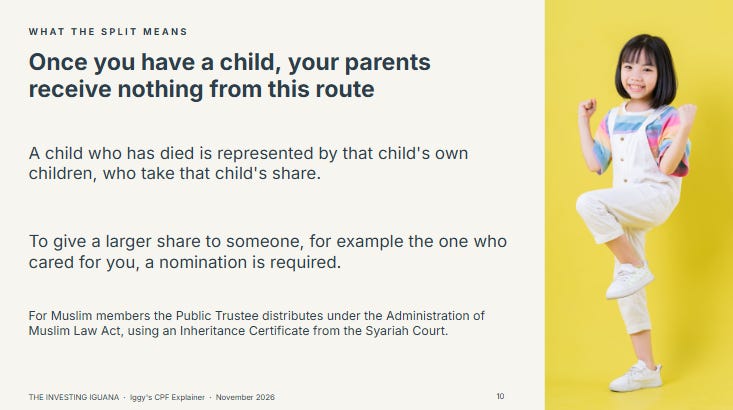
For Muslim members, the Public Trustee distributes under the Administration of Muslim Law Act, using an Inheritance Certificate from the Syariah Court. The CPF Board’s page says Muslims can make a nomination, and that a fatwa from the Islamic Religious Council of Singapore considers a CPF nomination a gift made while the member is alive.
How Many Members Die Without One
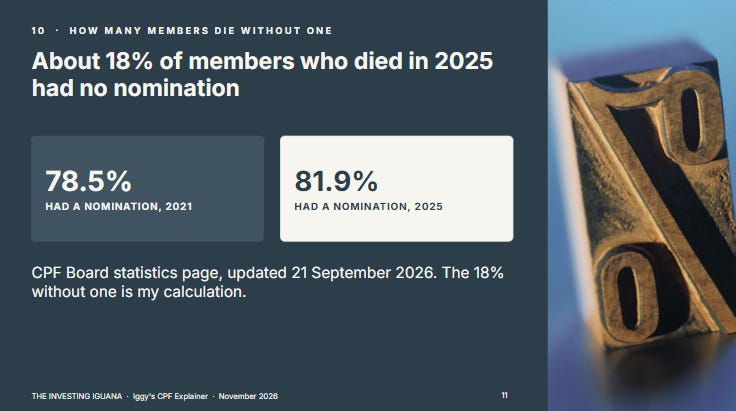
The CPF Board’s nomination statistics page, last updated 21 September 2026, shows the share of deceased members who had a nomination rising from 78.5% in 2021 to 81.9% in 2025. By my arithmetic, about 18% of the members who died in 2025 had none.
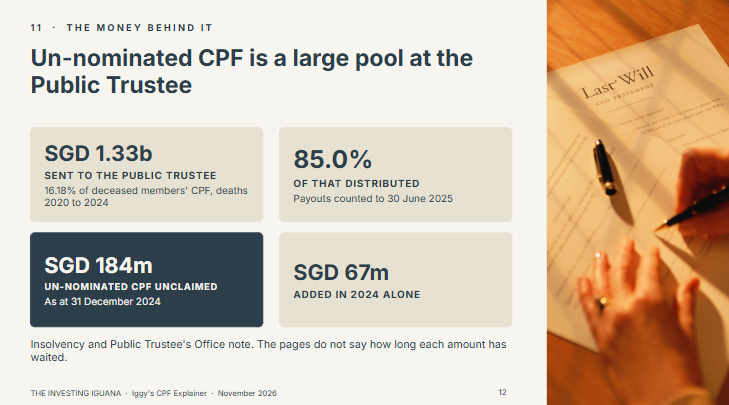
The Public Trustee’s Office gives a second set of numbers. For deaths between 2020 and 2024, with payouts counted up to 30 June 2025, about SGD 1.33 billion of deceased members’ CPF money, or 16.18%, went to the Public Trustee because no nomination was made. About 85.0% of it has been distributed, which by my arithmetic leaves about 15% not yet paid out. As at 31 December 2024, the Insolvency and Public Trustee’s Office held SGD 278 million of unclaimed money, of which SGD 184 million was un-nominated CPF. About SGD 67 million of un-nominated CPF was added in 2024 alone. The pages do not say how long each amount has been waiting, and the latest figure I found is as at 2024.
🦖 Iggy’s Insights
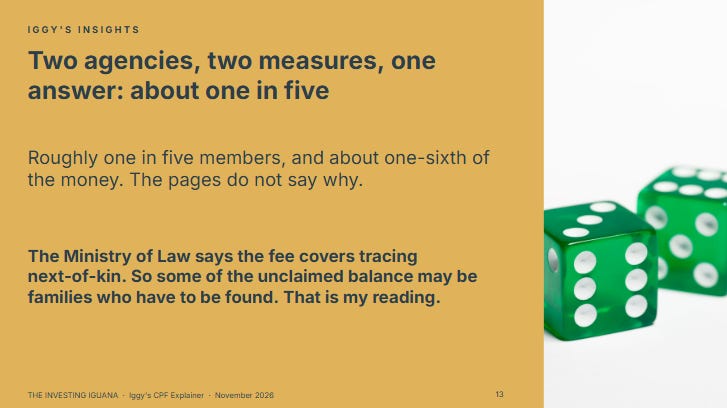
Two agencies, two different measures, and they point the same way: roughly one in five members, and about one-sixth of the money. The pages do not say why. The Ministry of Law’s written answer says the fee covers the cost of tracing next-of-kin and making distributions, so some of the unclaimed balance is likely to be families who have to be found. That is my reading, and neither agency says so.
The Family’s Steps, in Order
The order matters because the first deadline is the hospital’s, not CPF’s. The fee figures that follow in the paid half apply to step 5. These are the steps as the CPF Board and the Public Trustee’s Office describe them.
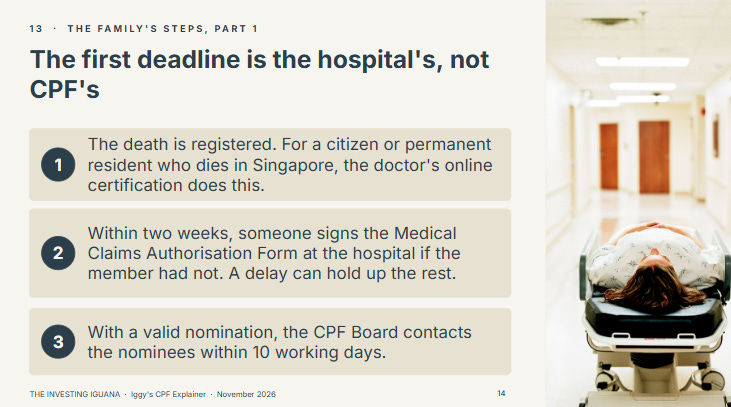
The death is registered. For a Singapore Citizen or Permanent Resident who dies in Singapore, the doctor’s online certification does this, and the family does not need to inform the CPF Board.
Within two weeks, someone signs the Medical Claims Authorisation Form at the hospital if the member had not signed it. The CPF Board says the spouse, a parent, a child aged 21 or above, or a donee or deputy can sign. The hospital must submit the MediSave claim before the member’s CPF savings are distributed, so a delay here can hold up the rest. If there is no immediate family, other relatives can sign with the Ministry of Health’s approval, which the hospital can help obtain.
If there is a valid nomination, wait for the CPF Board to contact the nominees within 10 working days. An eligible nominee is paid automatically. A nominee who does not meet the automatic criteria applies through Singpass.
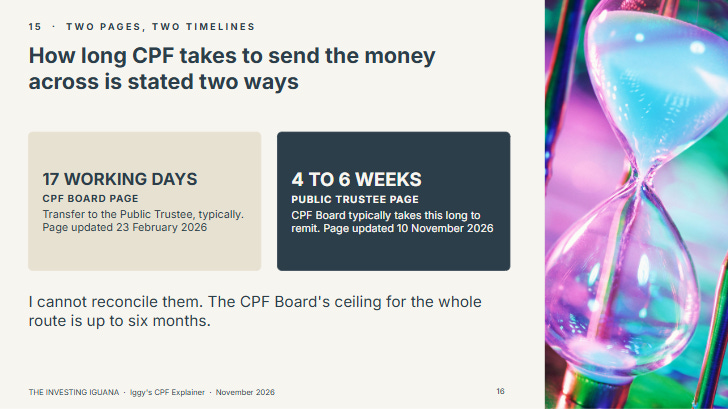
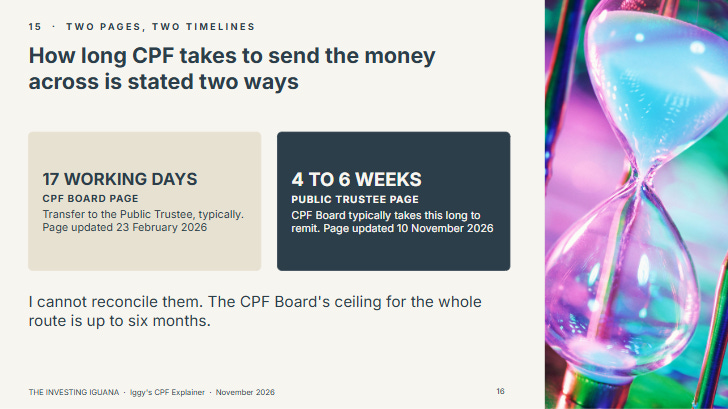
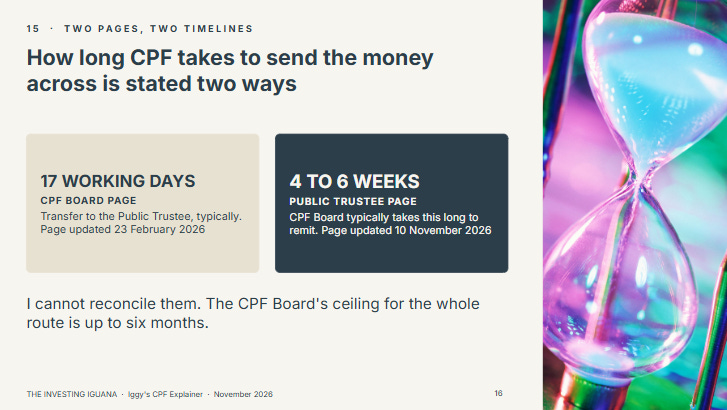
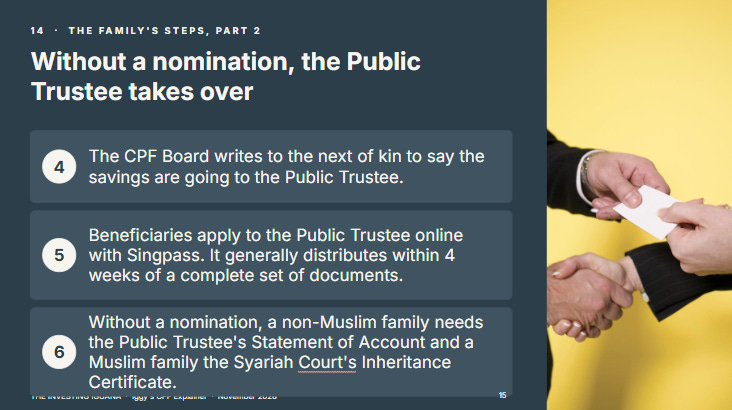
If there is no nomination, the CPF Board contacts the next of kin at the member’s last known address to say the savings are going to the Public Trustee. One CPF page says the transfer typically takes place within 17 working days after the CPF Board is notified. The Public Trustee’s page says the CPF Board typically takes 4 to 6 weeks to send the money. I show both, because I cannot reconcile them.
Beneficiaries then apply to the Public Trustee online with Singpass. The documents depend on whether the member was Muslim or not, and commonly include the death certificate, the birth and marriage certificates that prove the relationship, and the applicant’s identity card. The Public Trustee’s page says it generally distributes about 4 weeks after receiving a complete set of documents. The CPF Board’s own ceiling for the whole route is up to six months.
Family members who are not nominees can still ask to see the member’s CPF account information, but the CPF Board says the request should be made four weeks after the death. Without a nomination, a non-Muslim family needs the Statement of Account from the Public Trustee, and a Muslim family needs the Inheritance Certificate from the Syariah Court.
What the Paid Half Adds
The free half has told you where CPF savings go on death, what a nomination covers, what the law does without one, how many members die without one, and what your family does in order. What it has not done is show you what that costs. The paid half works the Public Trustee’s fee through on four balances, goes through five household cases where a nomination stops doing what you expect, and lists the assets a nomination cannot reach and who claims each one.
The Substack Only Plan, USD 8 a month, gives you the full written analysis, the portfolio walkthroughs and the analyst cheatsheets. The YouTube Only Plan, SGD 5 a month, is the YouTube membership. The YouTube/Substack Combo, SGD 12 a month, gives you all of it.
🔒 What’s Next
The Public Trustee publishes its fee table. The paid section works it through on four balances, then shows five household cases where a nomination stops doing what people expect.
