


What the first ASEAN shooting war in 58 years proves about the risk hiding in plain sight across your SGX portfolio
Section 1: The Global Headline (The Storm)
Forty percent.
That is how much the price of a standard hard drive component jumped — in six months — because two countries you barely think about started firing artillery at each other.
Not a chip shortage. Not US-China trade tariffs. Two ASEAN neighbours having a shooting war across a border zone that most Singaporeans cannot find on a map.
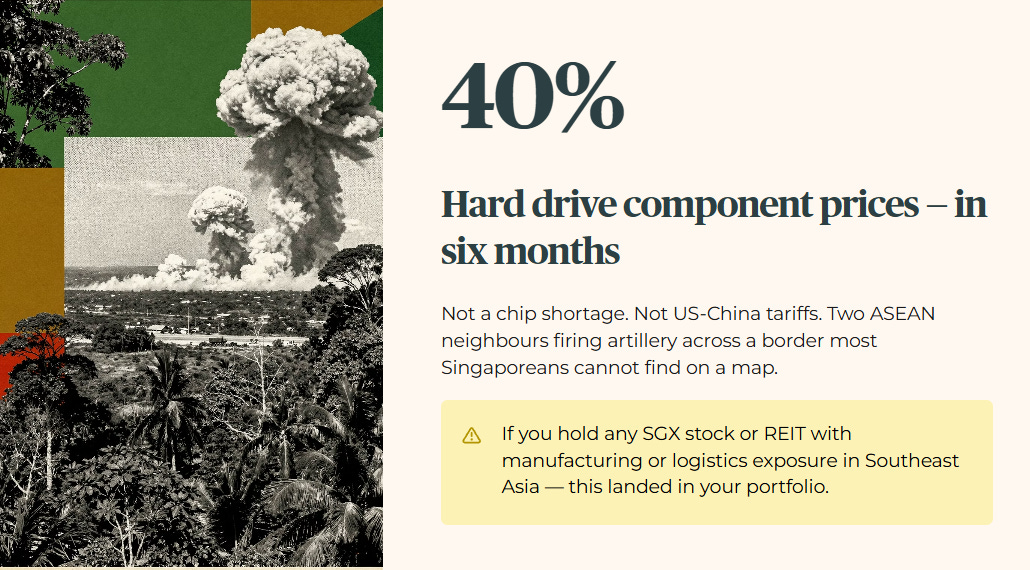
If you hold any SGX stock or REIT with manufacturing assets, logistics exposure, or concentrated revenue in Southeast Asia, this number is not someone else’s problem. It landed in your portfolio whether you noticed or not.
The Thailand-Cambodia border conflict of 2025 was the first direct shooting war between ASEAN member states in the bloc’s fifty-eight-year history. More than one hundred people were killed. Over a million civilians were displaced. Eighteen land checkpoints across seven Thai provinces slammed shut. Monthly bilateral border trade, which averaged sixteen billion baht in early 2025, collapsed to just eleven million baht by September — a near-total wipeout that no yield spreadsheet had priced in.
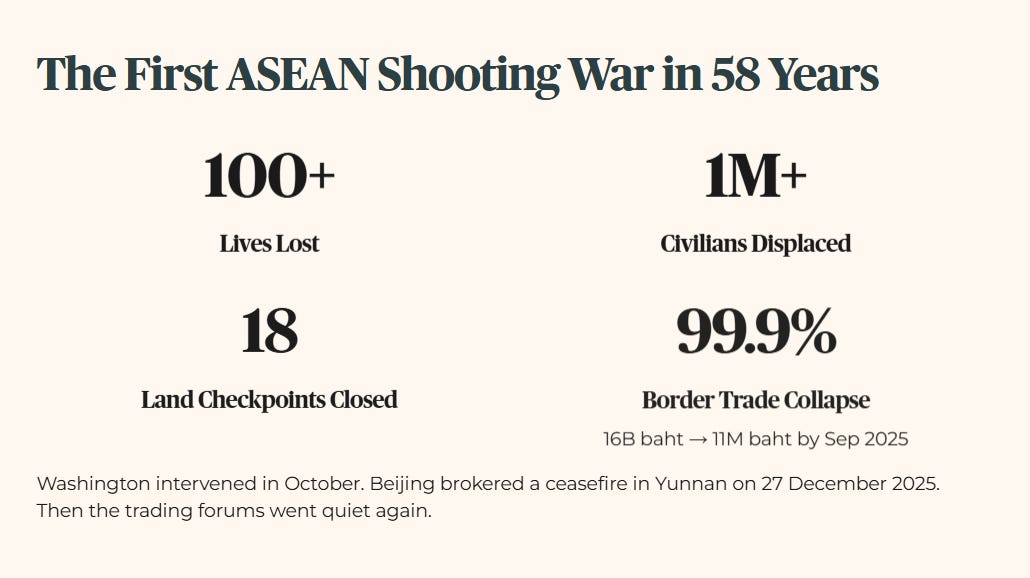
Then Washington intervened in October. Beijing brokered a ceasefire in Yunnan on December 27, 2025. And the trading forums went quiet again.

In This Article:
Section 1: The Global Headline (The Storm)
Section 2: The Local Impact (The Wallet)
Section 3: The Data Proof (The Evidence)
Section 4: The Strategic Landscape (Scenario Matrix and SGX Sector Watch)
Section 5: The Singapore Investor Playbook (Shock Absorption and Retirement Impact)
Section 6: Outro
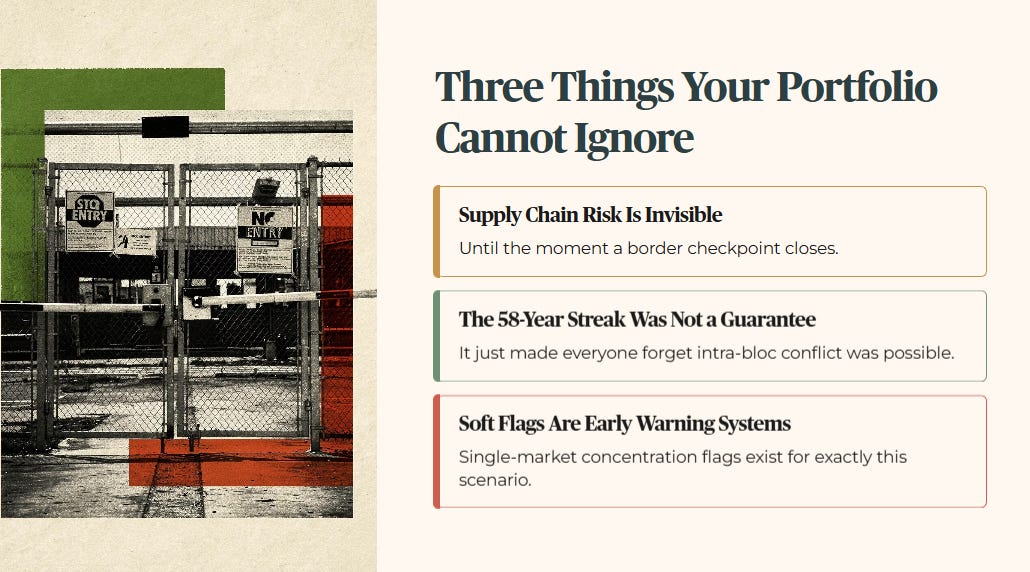
Three things this conflict proved that your portfolio cannot afford to ignore.
First, supply chain risk is invisible right up until the moment a border checkpoint closes. Second, ASEAN’s fifty-eight-year no-war streak did not make intra-bloc conflict impossible — it just made everyone forget that it wasn’t. Third, a “single-market concentration” soft flag in a forensic framework is not bureaucratic box-ticking. It is your early warning system for exactly this scenario.
Trade integration and military stability are not the same thing. Your dividend income stream cannot afford to treat them as if they are.
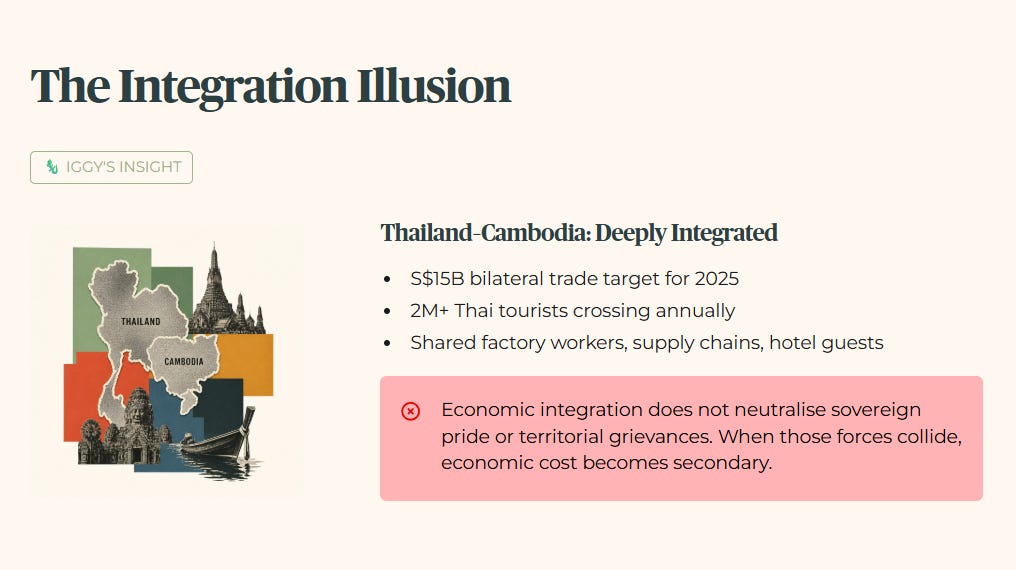
🦎 Iggy’s Insight: The Integration Illusion
Thailand and Cambodia had a fifteen billion Singapore dollar bilateral trade target for 2025. Over two million Thai tourists crossed into Cambodia every year. Their factories shared workers. Their farms shared supply chains. Their hotels shared guests.
And then they went to war anyway.
Here is the forensic lesson: economic integration does not neutralise sovereign pride, territorial grievances, or sudden domestic political pressure. When those forces collide, the economic cost becomes a secondary consideration for the people making the decisions. Your portfolio cannot assume that two countries doing business together means they will never stop doing business together.
Section 2: The Local Impact (The Wallet)
Here is a number that puts this in perspective.
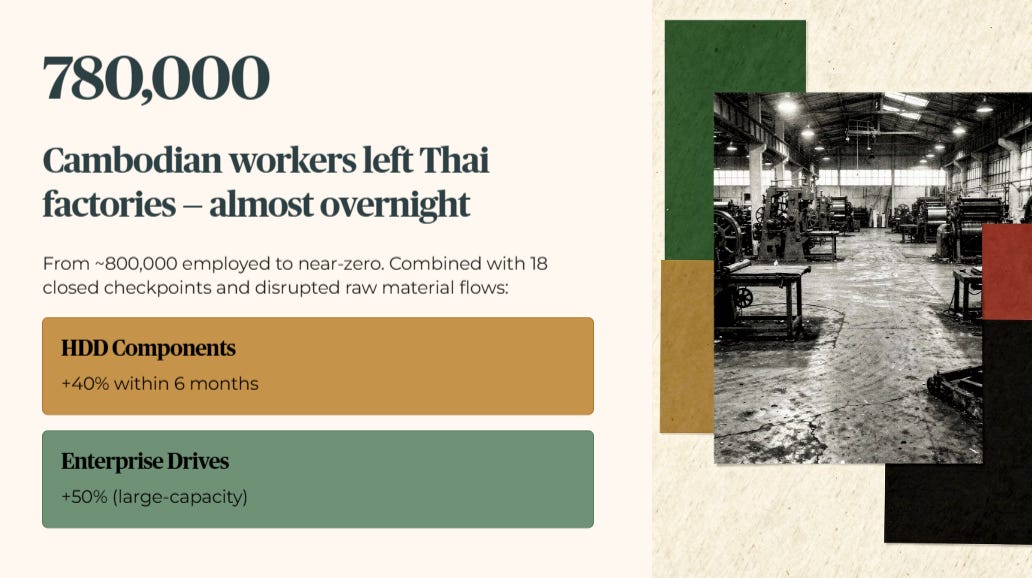
When the conflict escalated, roughly 800,000 Cambodian workers were employed in Thailand. Within weeks of the fighting, approximately 780,000 of them went home. Overnight, Thai factories — including the ones that make hard drive components for data centres around the world — were running short-handed.
That labour shock, combined with eighteen closed border checkpoints and disrupted raw material flows, drove a forty percent spike in procurement prices for standard hard drive components within six months. Enterprise-grade large-capacity drives rose nearly fifty percent.
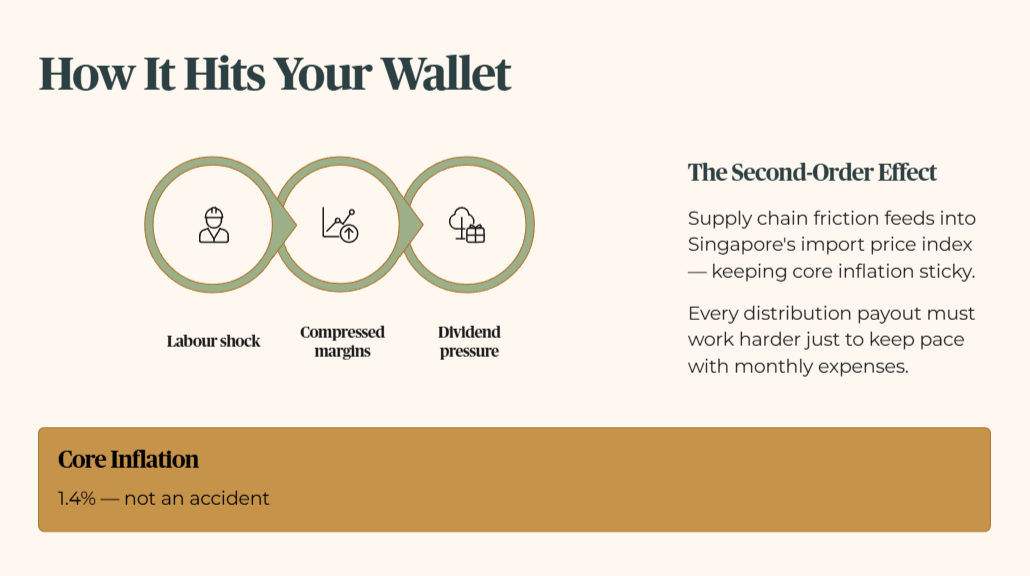
For a fifty-five-year-old investor in Bedok or Toa Payoh, that is not an abstract data point. Think of it this way. Every logistics operator, every data centre, every manufacturer sourcing IT equipment out of Jurong East or Kallang just saw their input costs jump. Higher costs compress profit margins. Compressed margins mean less free cash flow. Less free cash flow puts dividends under pressure.
The second-order effect is the one that hits your grocery bill. When supply chain friction is sustained, it feeds into the import price index, which keeps core inflation sticky. Singapore’s core inflation is currently sitting at 1.4%. That 1.4% is not an accident. It is the cumulative weight of exactly these kinds of regional disruptions — and it is the reason every distribution payout from your SGX holdings has to work harder just to keep pace with your monthly expenses.
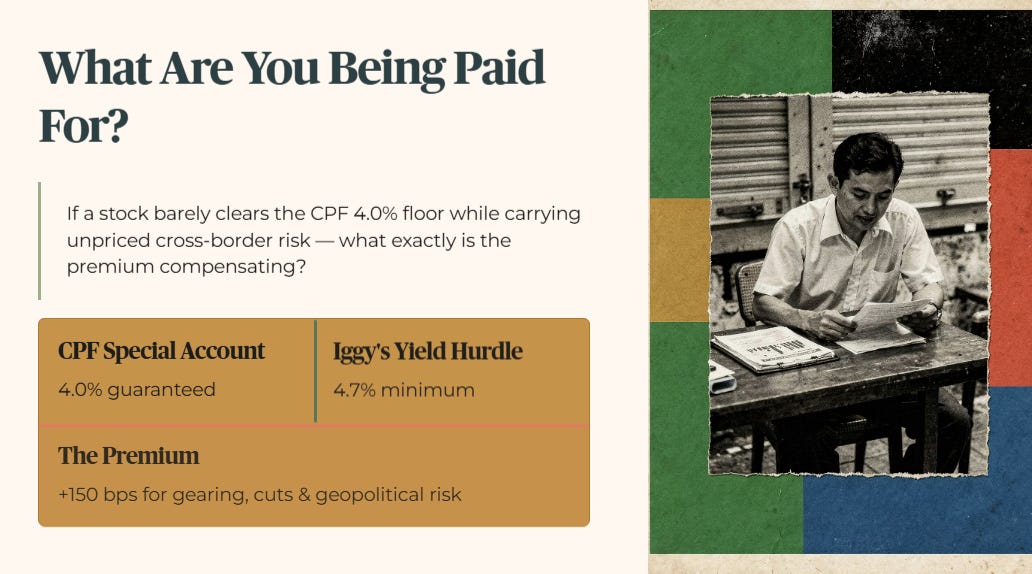
Now ask the harder question. If the CPF Special Account still pays 4.0% guaranteed, and an SGX stock is offering you a yield that barely clears that floor while carrying unpriced cross-border risk — what exactly are you being paid for?
This is why the 4.7% yield hurdle exists. The extra 150 basis points above the CPF rate is not a vanity premium. It is the minimum compensation for everything the CPF system does not expose you to: gearing risk, distribution cuts, and the possibility that a border checkpoint closes and the revenue your dividend depends on simply stops.
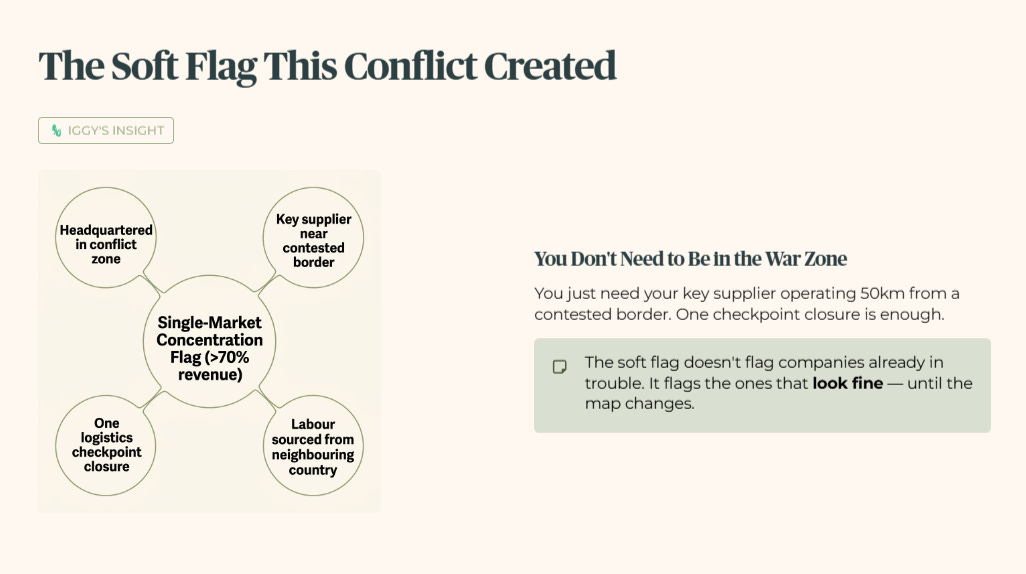
🦎 Iggy’s Insight: The Soft Flag This Conflict Created
One of the forensic soft flags in Iggy’s framework triggers when a company draws more than seventy percent of its revenue or assets from a single country.
A lot of investors look at that threshold and think: fine, I’ll just avoid obviously concentrated plays. But here is what the Thailand-Cambodia conflict demonstrates. You do not need a company to be headquartered in a war zone. You just need its key supplier to be operating in a factory fifty kilometres from a contested border. You need its labour pool to be sourced from the neighbouring country. You need one logistics checkpoint to close.
The soft flag is not there to flag companies that are already in trouble. It is there to flag the ones that look fine — until the map changes.
The next section takes that soft-flag threshold and runs it through the actual macro dashboard and SGX sector data, so you can see exactly how a 40% component cost spike, sub‑2% Thai growth, and single‑market concentration combine into a quantified dividends‑at‑risk profile across your portfolio.
