When a company announces a rights issue, existing shareholders are offered new shares at a set price, often below the market price. Iggy and Angela use three questions to explain what the offer is, what the money is for, and what each of your three choices leaves you with.
A rights issue can look like a bargain, especially when new shares are offered below the market price. But the share price is expected to adjust once more shares exist, so the discount is not automatically extra value. I use a simple example of a $1 share, a 1-for-4 offer at 60 cents, and a theoretical adjusted price of 92 cents to show what is really happening. Then we walk through the three choices: take up the shares, trade the rights, or do nothing, and what each leaves in your pocket.
Key takeaways:
A 1-for-4 rights issue at 60 cents turns a $1 share into a theoretical 92-cent share.
The discount is the price of the extra shares, not a gift.
The stated purpose of the money matters because shareholders are supplying it.
More shares can reduce dividend and earnings per share unless the company says otherwise.
Doing nothing can leave you with shares worth less, because unused rights may have value.

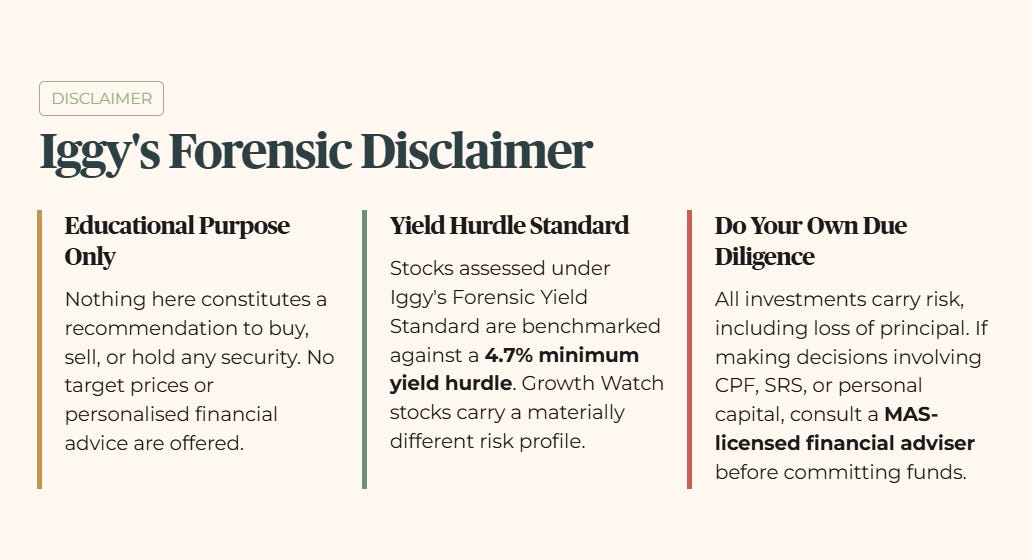
Iggy’s Forensic Disclaimer
This content is produced for educational and informational purposes only. I am not a financial advisor. I am a retail investor who applies forensic analysis to my own portfolio and shares that process publicly. Nothing here constitutes a recommendation to buy, sell, or hold any security, and no specific target prices or personalised financial advice are offered.
Stocks assessed under Iggy’s Forensic Yield Standard are benchmarked against a 4.7% minimum yield hurdle. Stocks flagged as Growth Watch fall below this threshold but demonstrate clean balance sheet metrics and an identifiable growth catalyst. These carry a materially different risk profile and are not suitable as yield replacements for income-dependent investors.
All data is sourced from public filings and verified sources. Where data is unverified, it is explicitly flagged. All investments carry risk, including the potential loss of principal, and past performance is not indicative of future results. If you are making investment decisions involving CPF, SRS, or personal capital, please conduct your own due diligence or consult a MAS-licensed financial adviser before committing funds.